Advertising disclosure: This page includes affiliate product links that may earn us a commission, as well as products from our own store.
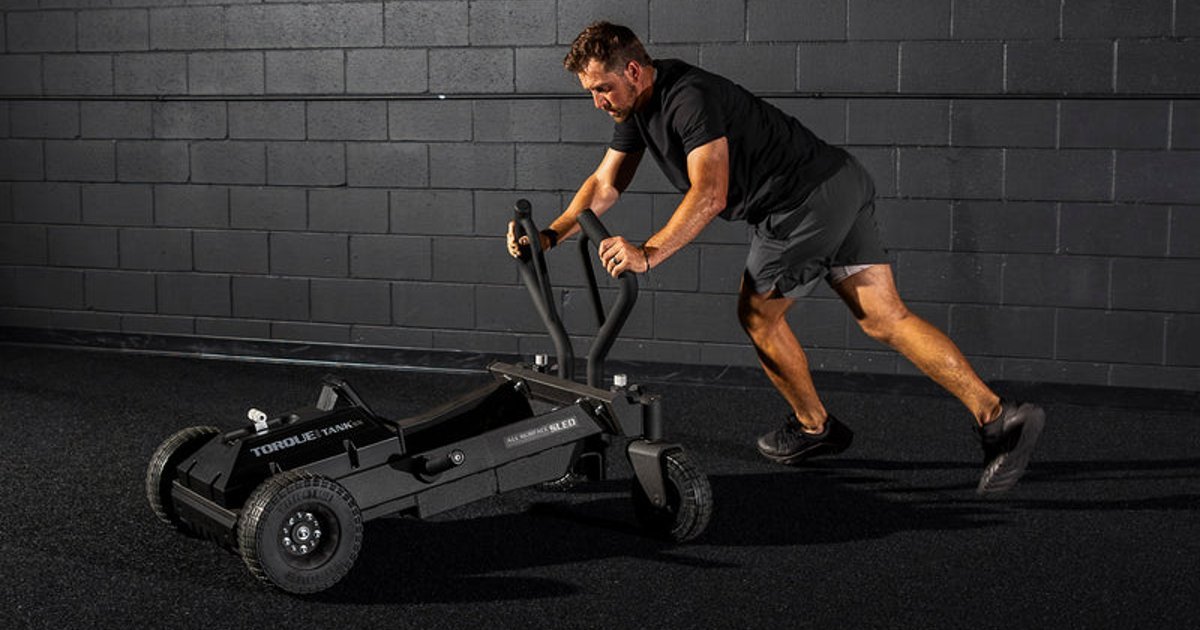
The Torque TANK SX brings magnetic braking, steerable rear wheels and multiple movement options to the wheeled push-sled category. We examine the actual specifications, the practical trade-offs and how to use it without inventing a performance claim.
What the TANK SX actually changes
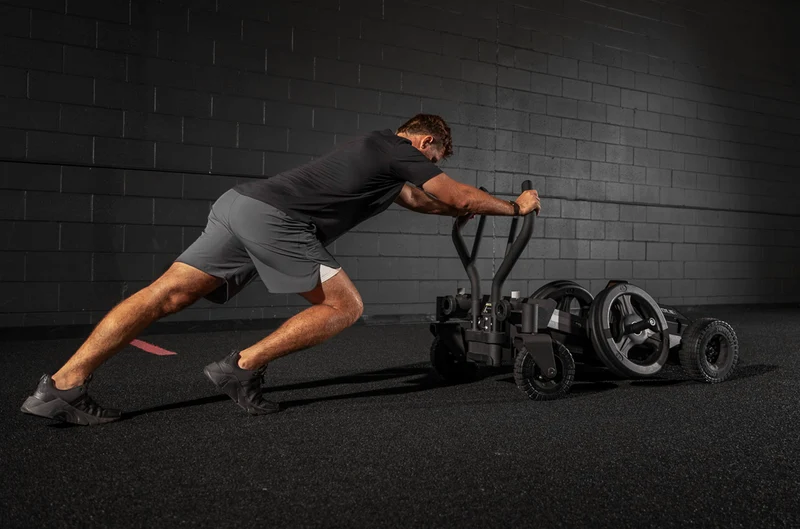
The Torque TANK SX is a four-wheel push sled designed for resisted movement without dragging metal skids across a dedicated turf strip. Rather than relying only on friction between a sled base and the ground, the platform uses a magnetic braking system to oppose rolling motion. That difference affects surfaces, adjustments, movement options and how people should interpret the resistance they feel.
Torque lists approximate dimensions of 56.9 inches long, 32.4 inches wide and 36.9 inches tall, with an unloaded machine weight around 303 pounds. Those are serious numbers for a home or commercial gym. The physical footprint is only the starting point: a user behind the handles, room to accelerate, space to stop, and clearance to change direction all matter more than whether the frame technically fits between two racks.
The feature set includes four wheels with airless tires, several handle positions, plate-loading horns and an included V-Strap for different movement patterns. This makes the SX potentially useful for pushes, pulls, conditioning, wheelbarrow-style drills and certain lateral or turning exercises. None of these features proves that the device will produce better muscle growth than ordinary lifting, or that it can stand in for every strength or cardio session.
For a facility that programs sled work routinely, extra movement options may be valuable. For an individual lifter, the smarter question is how many weekly sessions will make use of the machine, and whether the floor and budget allow it. Treat the SX as specialized conditioning equipment, not as an all-purpose solution to training.
Five resistance selections, not five calibrated weights
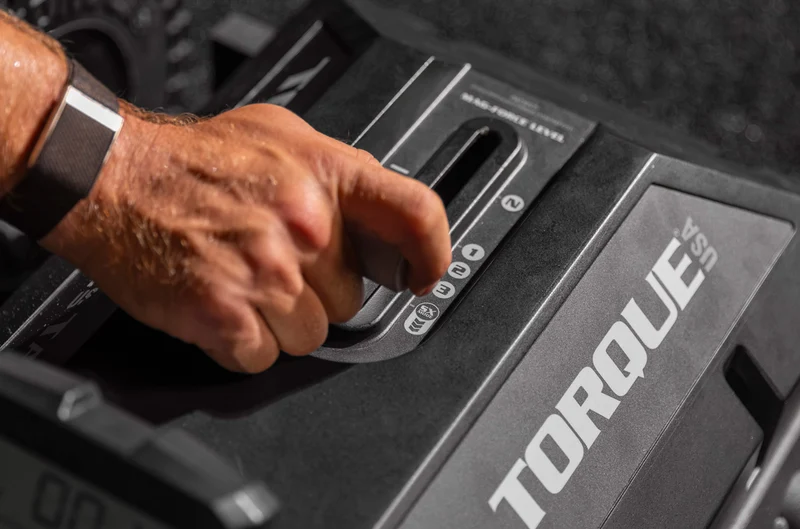
The SX uses two front Mag-Force braking assemblies linked to an adjustment control. The manufacturer describes four regular settings plus SX Mode, offering five resistance selections in total. When several athletes share a lane, a quick lever adjustment may be more convenient than repeatedly changing plates or moving to a different friction sled.
A setting number is not the same as a standardized kilogram load. Magnetic braking and rolling resistance respond to the mechanism, movement speed and surface conditions. The effort an athlete experiences also depends on acceleration, handle height, body position and the length of the interval. It is misleading to convert setting three directly into a barbell weight or to assume that two different sled models have comparable numbered settings.
For a meaningful workout log, keep the same surface, lane, handle position and distance or time. Record the setting, actual work completed and perceived effort. If you add weight plates to the horns, record those separately; they increase the total moving mass and affect handling but do not establish a measured equivalent for the braking force.
Start with a steady push that allows clean, continuous steps. Harder intervals may use a higher setting, while longer conditioning bouts may favor a setting that permits consistent movement. It is still necessary to choose sensible rest, volume and progression. There is no evidence in a product listing that any single lever setting guarantees a particular physiological adaptation.

Equipment Worth Exploring
Explore equipment, accessories and gear from our carefully selected range.


Open Hex Bar
Open-frame trap bar with multiple handles for deadlifts, carries, and lower-body training.


Squat Harness
Wearable harness for hands-free cable squats, sled work, and lower-body training.

Grip Plates
Rubber-coated weight plates with handholds for loading barbells and machines.

Competition Plates
Competition-style bumper plates for Olympic lifts and loaded strength training.


Slam Ball
Low-bounce weighted slam ball for explosive throws and high-intensity conditioning.

Competition Wall Ball
Competition-style weighted wall ball for HYROX, wall-ball shots, and functional conditioning.

Rear-wheel steering and directional movement
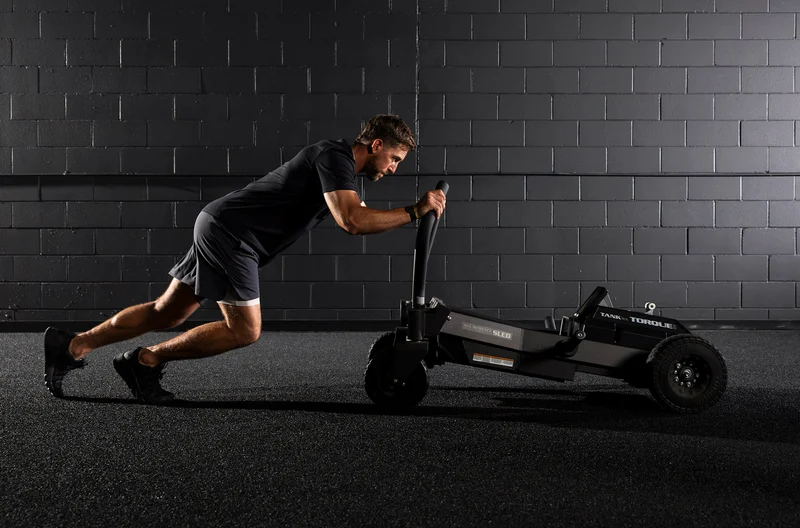
The SX’s swiveling rear wheels make it different from a simple straight-line sled. Traditional friction sleds and many wheeled versions favor pushing along a clear lane, stopping and returning. Steering potentially expands drills to broad turns and changes of direction, which is attractive for coaches building athletic circuits or facilities without one very long uninterrupted lane.
Steering also introduces a control requirement. An athlete should not sharply twist a heavy moving sled with planted feet, rush around a blind corner or attempt a turn in a narrow gap. A four-wheel frame moving under load can strike a rack, wall or bystander if momentum is misjudged. Begin with light effort, a generous arc and visible markers. Progress to tighter paths only if the person can control both the sled and their foot placement.
One useful introduction is a wide two-cone curved course at an easy setting. Keep the torso braced and step around the curve instead of abruptly yanking the handles to redirect the sled. Smooth acceleration, predictable foot placement and a clean stopping position are better targets than fastest possible turning time on the first day.
Do not confuse steerability with a guarantee that a small gym has enough room. Measure the full sweep of a turn, the space occupied by the athlete and a safe stopping margin. A straight-line push with a deliberate reset may be the better choice when side clearance is limited. Directional ability is a feature to use intentionally, not a reason to cut corners on space or supervision.

Cardio Shirts & Workout Gear
Cardio and conditioning gym gear for runners, endurance athletes and anyone who earns the sweat.

Cardio Is Calling You , Meme Top Answer Or Decline? T-Shirt
Make gym days more fun with “Cardio Is Calling You” style.

Skip Cardio – Exit Cardio Meme , , Top T-Shirt
Bring “Skip Cardio” humor to your next gym day.

Negative Cardio Review Cardio Sucks Running , Meme T-Shirt
Heavy lifts, good laughs, and a little “Negative Cardio Review” energy.

Shirt – Sometimes Motivation Finds You – , Swimming T-Shirt
Bring “Sometimes Motivation Finds You” humor to your next gym day.

Shirt – Cardio Is Hardio – & Gymbros T-Shirt
Show some cardio attitude with a playful “Cardio is Hardio” tee.

Shirt – Your Mom Is My Cardio – Meme , Gymbros & Fans T-Shirt
Make gym days more fun with “Your Mom Is My Cardio” style.

Shirt – I Want You To Do Cardio Uncle Sam Patriotic T-Shirt
Heavy lifts, good laughs, and a little “I Want You To Do Cardio Uncle Sam Patriotic” energy.

Anti Cycling Cycling Club – Ironic Cardio Meme & T-Shirt
Show some cardio attitude with a playful “Anti Cycling Cycling Club” tee.

Cardio Kills Gains Shirt 'S Meme & Top T-Shirt
Rep “Cardio Kills Gains” humor in and out of the gym.

Exercise Your Demons | Cardio Workout From Hell Graphic T-Shirt
Show some cardio attitude with a playful “Exercise Your Demons” tee.
How to use pushes, towing and wheelbarrow work
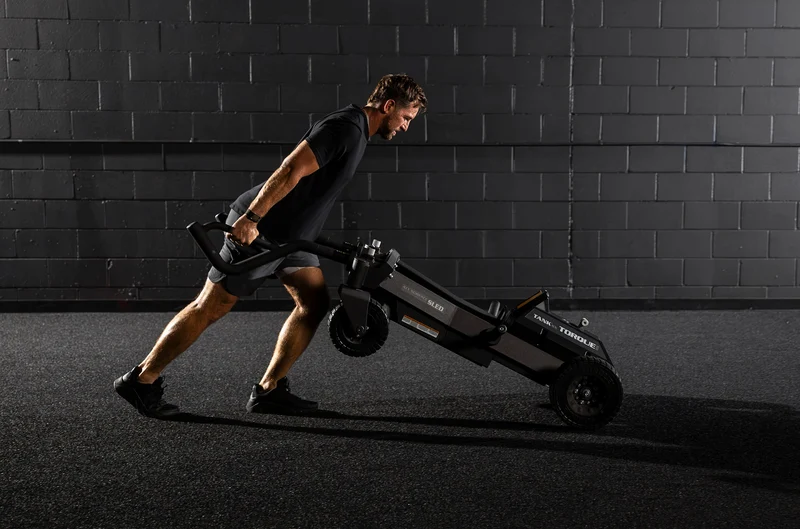
The basic push begins with the hands on secure handles, trunk braced and body leaning forward as one connected unit. Drive through the floor in short, controlled steps and avoid letting the lower back sag as fatigue builds. Hand position changes the feel of the movement: lower handles often encourage a deeper lean, while a higher grip may make a more upright push easier to maintain.
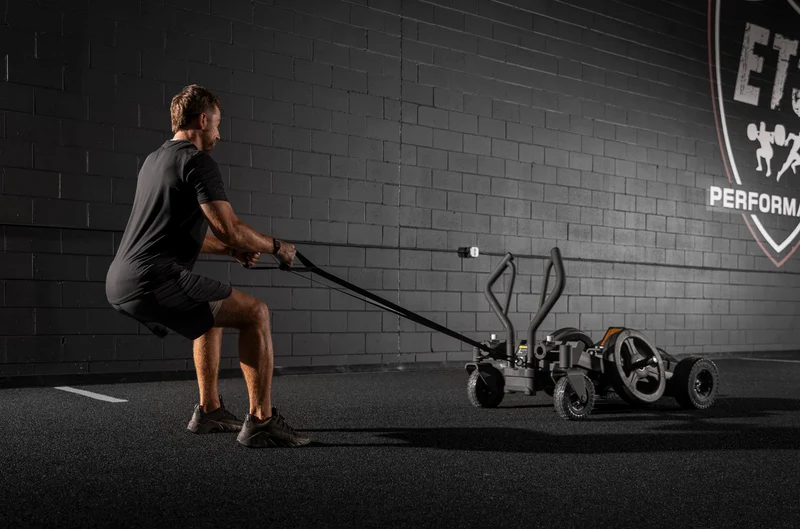
The included strap opens towing and pulling variations where the attachment is used correctly. The product gallery also shows wheelbarrow-style handling and other loaded travel drills. These are meaningfully different from one another. The push emphasizes continuous leg drive, a tow places more attention on strap alignment and rhythm, and wheelbarrow work adds grip and upper-body stabilizing demands alongside locomotion.
For pulling, avoid sudden jerks and make sure the strap does not rub across an edge or become entangled with equipment or people. Set up a clear pathway and confirm the attachment remains secure at easy effort before increasing the challenge. Directional or lateral drills should begin with modest speed and a clear plan for where the sled will stop.
These formats can add variety to conditioning, but they do not remove the need for conventional strength training when maximal strength or muscle growth is the goal. An athlete can use pushes after a squat workout, towing on a conditioning day, or lighter wheelbarrow movement as a focused coordination challenge. Choose the variation for the specific training objective rather than combining every option into one exhausting circuit.
Tires, loading and the space calculation
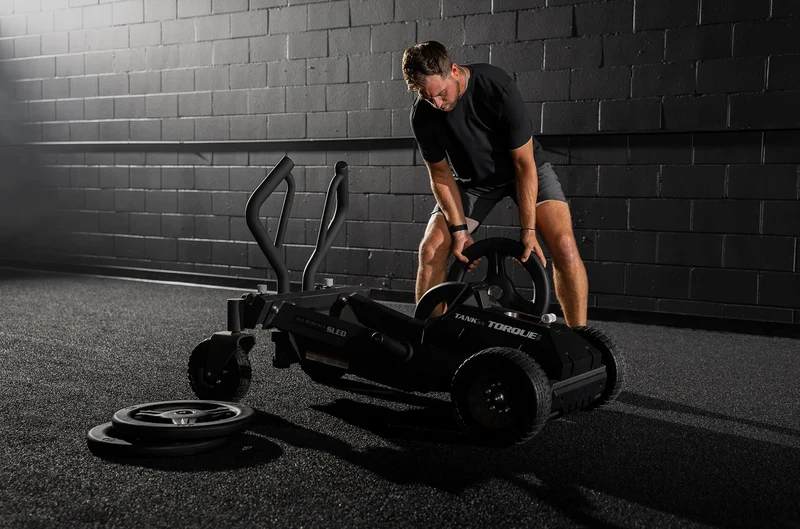
Airless tires and a wheeled design make the TANK SX potentially practical on more surfaces than a steel skid sled. That is not a blanket guarantee for every driveway, turf, rubber floor or outdoor path. Gravel, loose sand, standing water, steep slopes and delicate flooring can all alter traction and handling. Check the manufacturer’s floor guidance and test movement slowly before adding effort or allowing a faster athlete to push.
Loading horns allow added plates, but the base machine already weighs roughly 303 pounds. Keep hands away from moving components, secure all plates and avoid exceeding any manufacturer’s limit. A loaded machine should not be left where another person might trip over a strap or collide with the frame. Wheels, fasteners and the resistance mechanism also deserve ordinary pre-session inspection.
Measure more than the advertised width and length. A 57-inch-long sled in a 57-inch corridor leaves no useful working distance. You need the athlete behind the handles, the run-up or working interval, room to stop, and space to turn or safely reset without contacting benches or racks. Noise and the suitability of the floor may also matter in apartments or shared facilities.
If space or cost is the barrier, a more basic sled on suitable turf, heavy carries, controlled step-ups or loaded marching can still provide valuable conditioning and lower-body work. They are not identical to magnetic sled resistance, but they offer a way to discover whether you genuinely enjoy this kind of training before dedicating a significant floor area and budget to specialized equipment.
Equipment Worth Exploring
Explore equipment, accessories and gear from our carefully selected range.

Cast Iron Kettlebells
Textured cast-iron kettlebells for swings, squats, carries, and full-body training.


Rubber Hex Dumbbells
Rubber-coated hex dumbbell pairs with a stable shape for home and commercial strength training.


Leather Wrist Grips
Padded leather lifting grips help support the hands and wrists on heavy pulling exercises.

Leather Lifting Straps
Padded leather straps support grip during heavy rows, deadlifts and pulling exercises.

Price, optional console and the TANK MX comparison
The official product listing reviewed on November 8, 2026 showed a price around $2,699, with shipping indicated for early 2027. That price is a snapshot rather than a guaranteed quote for every country, and the delivery statement is not a promise of a particular arrival date. Tax, shipping, accessories and regional stock can alter the total. Confirm current terms on the official TANK SX page before paying.
The SX joins an existing TANK lineup that includes the MX, but differences in steering, wheel configuration and resistance controls matter more than the nameplate. For a straight lane, a simpler existing model might still suit the routine. For coaching sessions involving curved paths or a wider range of loaded movement patterns, the SX’s rear-wheel steering becomes much more relevant.
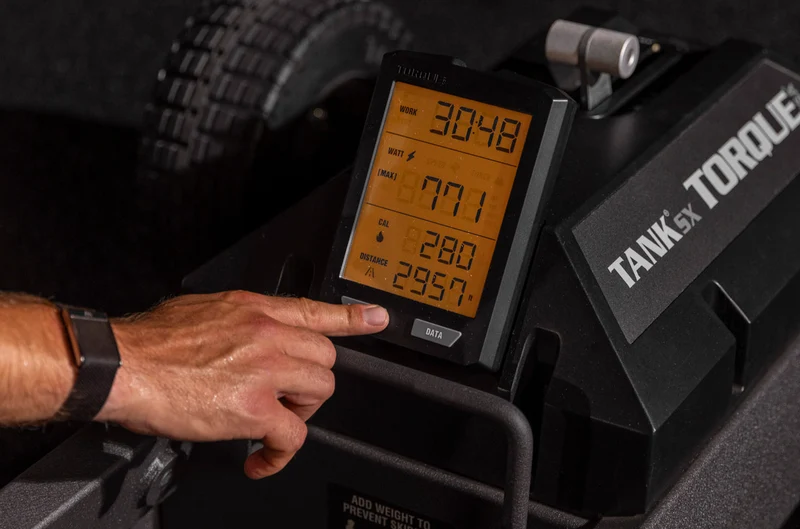
The product imagery shows a performance console, which is listed separately. A display could simplify standardized sessions, but timing rounds and recording lever settings can also be done without electronics. Check which equipment and accessories are included in the actual package rather than assuming everything photographed is part of the base purchase.
Compare the all-in cost, durability, service access, clear training area and likely weekly usage with the alternatives you could buy. For a gym serving groups, a premium might be justified by quick changes and versatility. For a lone lifter training mostly barbells and dumbbells, that same premium could be difficult to justify. A meaningful comparison is how many quality sessions the machine will create—not how many features appear on a sales page.
Functional Fitness Shirts & Workout Gear
Functional-fitness shirts, tanks and workout gear for athletes who train strength, conditioning and everything in between.


Break the Stereotype Tee
Show some gym-girl attitude with a playful “Break The Stereotype Gym Girl” tee.


Viva La Resistance Bands , Meme Shirt, Top T-Shirt
Make gym days more fun with “Viva La Resistance Bands” style.

For Whom the Bell Curls Tee
Show some metalhead attitude with a playful “For Whom The Bell Curls Kettlebell” tee.

Hell's Bells Kettlebell Tee
Show some rock-and-lifting attitude with a playful “Hell's Bells Kettlebell” tee.

Grunge Kettlebell Shirt Rock Music & Gymbros Top T-Shirt
Rep “Grunge Kettlebell” humor in and out of the gym.
An original two-day, six-week conditioning plan
The following plan is an example for healthy adults already familiar with basic resistance exercise. It is not a clinical rehabilitation protocol and was not used to test the TANK SX. Place the sessions on separate days or after strength training, and begin each with a short general warm-up followed by two very easy practice pushes. Always clear the lane, set an appropriate resistance level and agree where the sled must stop.
Day A: steady forward pushes
During weeks one and two, complete five pushes lasting 15 to 20 seconds each, resting 75 to 90 seconds between efforts. The goal is continuous steps and nearly identical movement quality across rounds, not exhaustion. In weeks three and four, build to six rounds lasting 20 to 25 seconds if the same setting remains manageable. In weeks five and six, consider six to eight rounds lasting 20 to 30 seconds, or a small setting increase when your existing duration is steady. Change only one major variable at a time.
Day B: pulling and control
For weeks one and two, perform three short, easy towing intervals and three controlled higher-handle pushes, taking full recovery. Add broad, low-resistance turning practice only if there is generous clearance. During weeks three and four, increase to four rounds of each movement. During weeks five and six, progress to four or five rounds and introduce a short wheelbarrow or gentle lateral drill if control is consistently good. Narrow spaces call for straight-line efforts and deliberate resets instead.
Log surface, distance or time, setting, rest interval and technique. Stop when the sled begins to wander, the athlete loses their brace, or footwork becomes erratic. After six weeks, repeat an early benchmark under the same conditions. Improvements in controlled speed, duration or resistance are more meaningful than assuming a magnetic lever setting corresponds to a precise weight. If pain or injury restrictions are involved, individualize the plan with an appropriately qualified professional.
Bottom line: The SX is an interesting specialist tool for genuine sled training. Its value still depends on a suitable lane, disciplined technique and sufficient actual sessions to justify its size and price.