Advertising disclosure: This page includes affiliate product links that may earn us a commission, as well as products from our own store.
Sissy squats demand a different kind of quad control from conventional squats. The classic free-standing lean-back and the padded bench-supported version look related, but they solve different balance problems. This guide compares both, explains knee comfort and equipment setup, and gives you a six-week way to progress without rushing depth or load.
What a sissy squat trains and how it differs from a regular squat
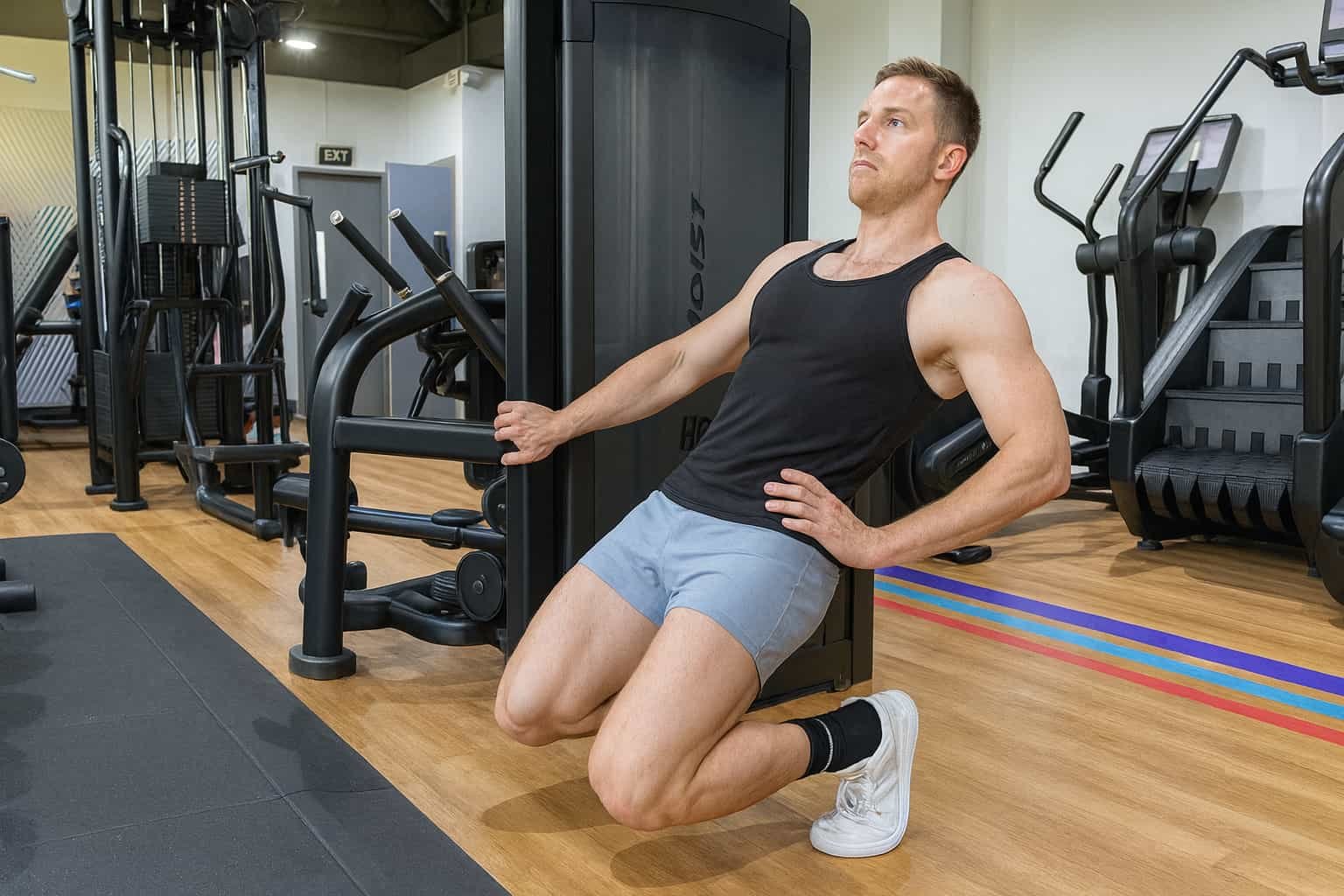
A regular back squat asks the hips and knees to bend together while a load moves over the middle of the foot. A classic free-standing sissy squat changes the relationship: the knees move forward, the torso leans back and the hips stay more extended. The quadriceps have to create a substantial knee-extension effort as you control the descent. It is a specialist knee-dominant pattern, not a substitute for every kind of leg training.
The quadriceps include four muscles: rectus femoris, vastus lateralis, vastus medialis and vastus intermedius. All participate in straightening the knee. Rectus femoris also crosses the hip, so body position changes its length and mechanical environment. But it is too strong to say the sissy squat isolates one quad head or guarantees superior growth. The movement chiefly provides an additional, adjustable quadriceps challenge.
In the traditional version you balance on the balls of your feet, lean back and bend the knees while staying relatively straight from knee to shoulder. Even at bodyweight this can be demanding. The calves and feet help with balance; the trunk provides stiffness. Compared with normal squats, the exercise generally involves less deliberate hip flexion and therefore is not the principal way to train heavy glute-dominant strength.
Look for smooth knee motion, useful muscular tension and a range you can repeat, rather than chasing maximum depth on the first attempt. A good sissy squat looks controlled at both ends. If you only want a more accessible quad movement, leg extensions, goblet squats and heel-elevated squats remain perfectly valid options.
How to do an assisted free-standing sissy squat
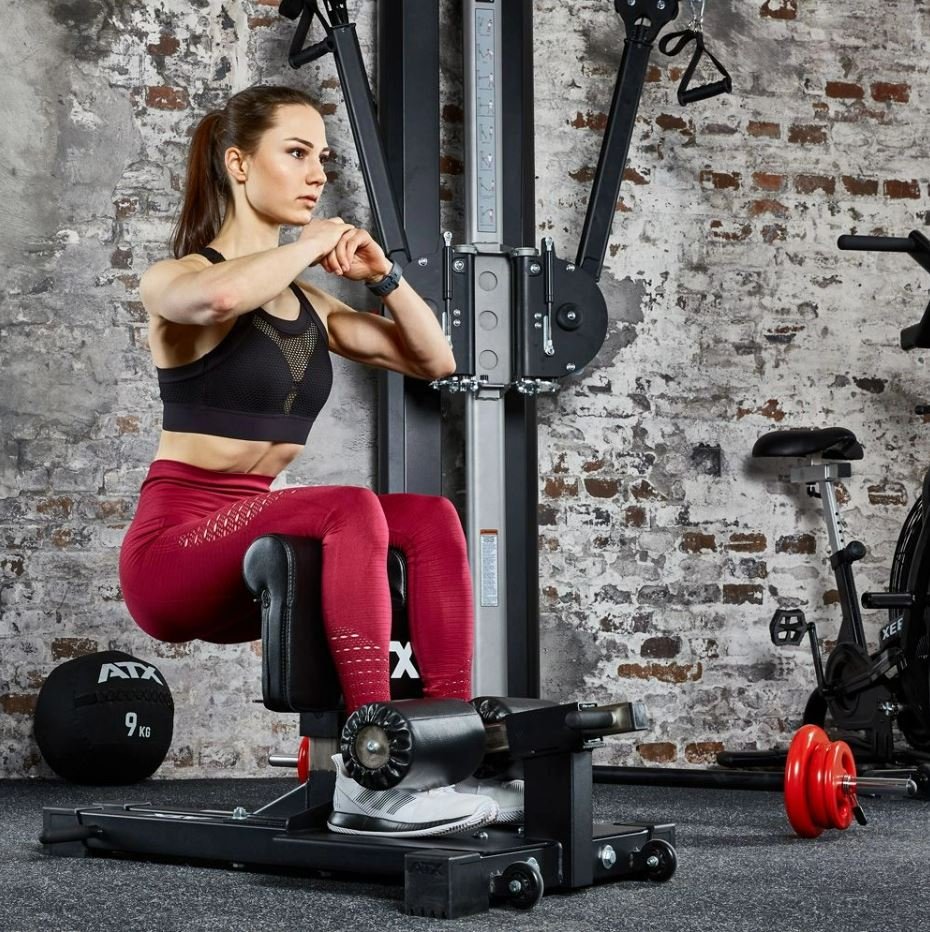
Begin next to a solid squat rack upright or another fixed support. Hold it lightly with one hand; a rolling chair, loose door or mobile object is not suitable. Stand about hip-width, soften the knees, lift the heels just enough to balance on the forefeet and brace the abdomen. Think about keeping the chest, pelvis and thighs in a long, supported line.
Now allow the knees to travel forward as the body inclines backward, maintaining a gently extended hip instead of sitting backward into a conventional squat. Lower slowly, perhaps for two or three seconds, until the quadriceps feel loaded and you can still reverse without bouncing. Pull lightly on the rack only as much as your balance requires. Return by extending the knees and lifting the body as a unit.
Your starting range may be surprisingly short. That is normal. A few partial repetitions with consistent balance are more valuable than an unstable deep rep. Keep the support within reach throughout the set, and pause whenever the forefeet begin to slip. The heels do not have to rise to an extreme height; choose a secure foot position rather than performing a circus trick.
Try one or two sets of five controlled partial repetitions before doing working sets. If you cannot maintain a comfortable line from knees through shoulders, step back into a simpler quad exercise. With practice the range may improve, but depth is not a prize. Avoid adding a plate at the chest until bodyweight repetitions are reliably smooth.

Equipment Worth Exploring
Explore equipment, accessories and gear from our carefully selected range.

GymPin Squat Wedges
Non-slip 15-degree squat wedges help elevate the heels for deeper quad-focused squats.

Studio V-Squat
Plate-loaded V-squat machine for supported lower-body strength training.

Leg Press/Hack Squat BPR-790
Convertible 45-degree leg press and hack squat machine with a broad footplate and band pegs.

Compact Leg Press CLP-700
Compact reverse-style leg press with a moving seat carriage and an adjustable footplate.

Leg Extension/Curl BCO-780
Leg extension and lying leg curl combo with plate loading, band pegs and a cable-loading option.

Seated Leg Combo BCO-680
Adjustable seated leg extension and leg curl machine with band pegs for added resistance.


HUSLA Leg Extension Pad
Pad attachment designed to increase usable range of motion on compatible leg-extension machines.

Competition Plates
Competition-style bumper plates for Olympic lifts and loaded strength training.

What a sissy squat bench changes—and what it does not
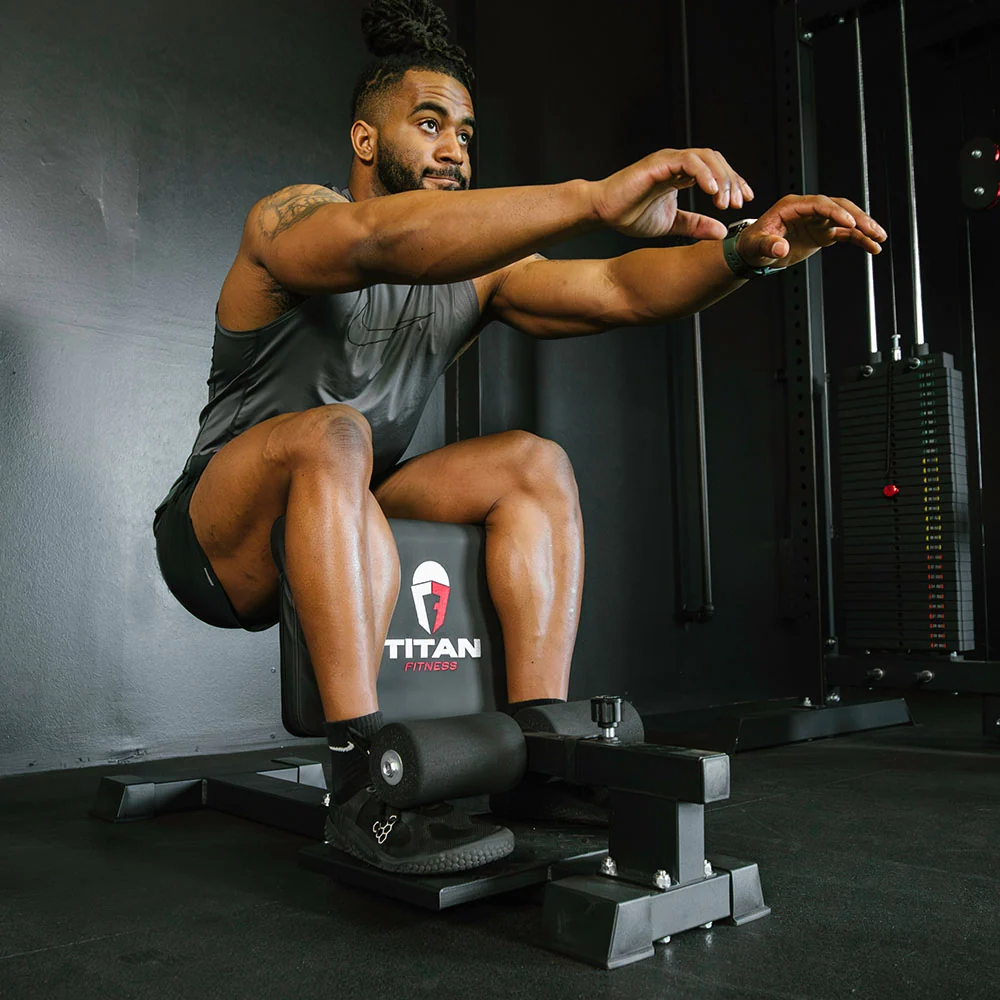
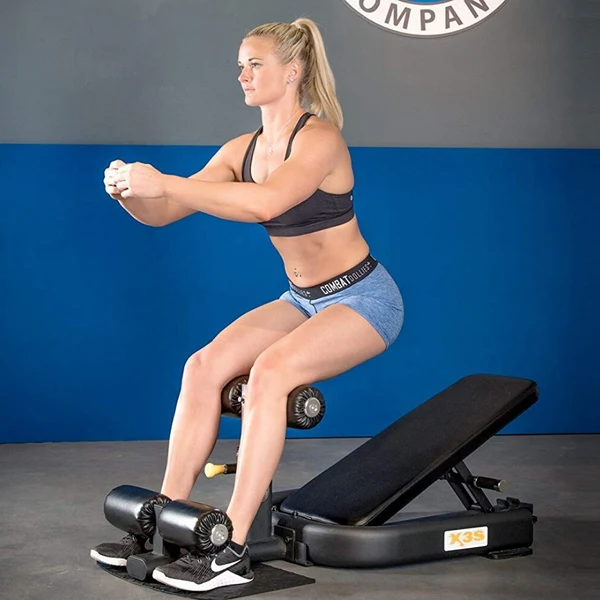
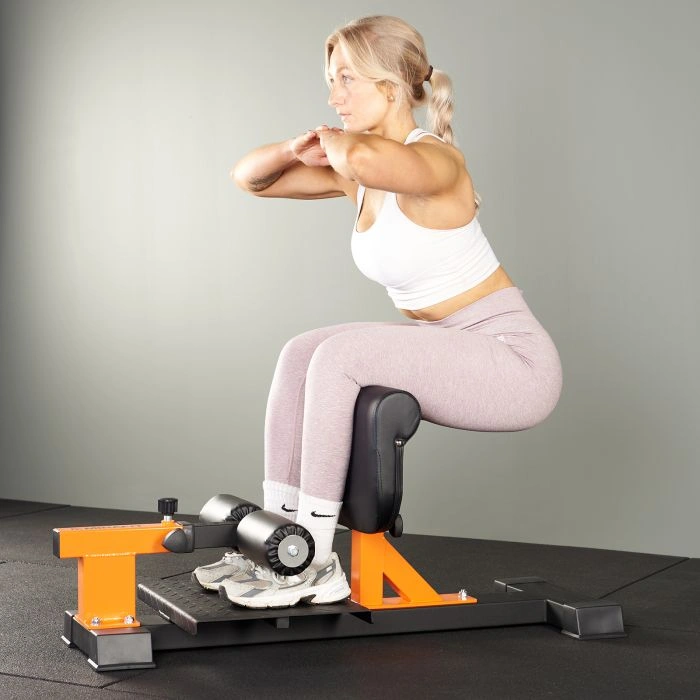
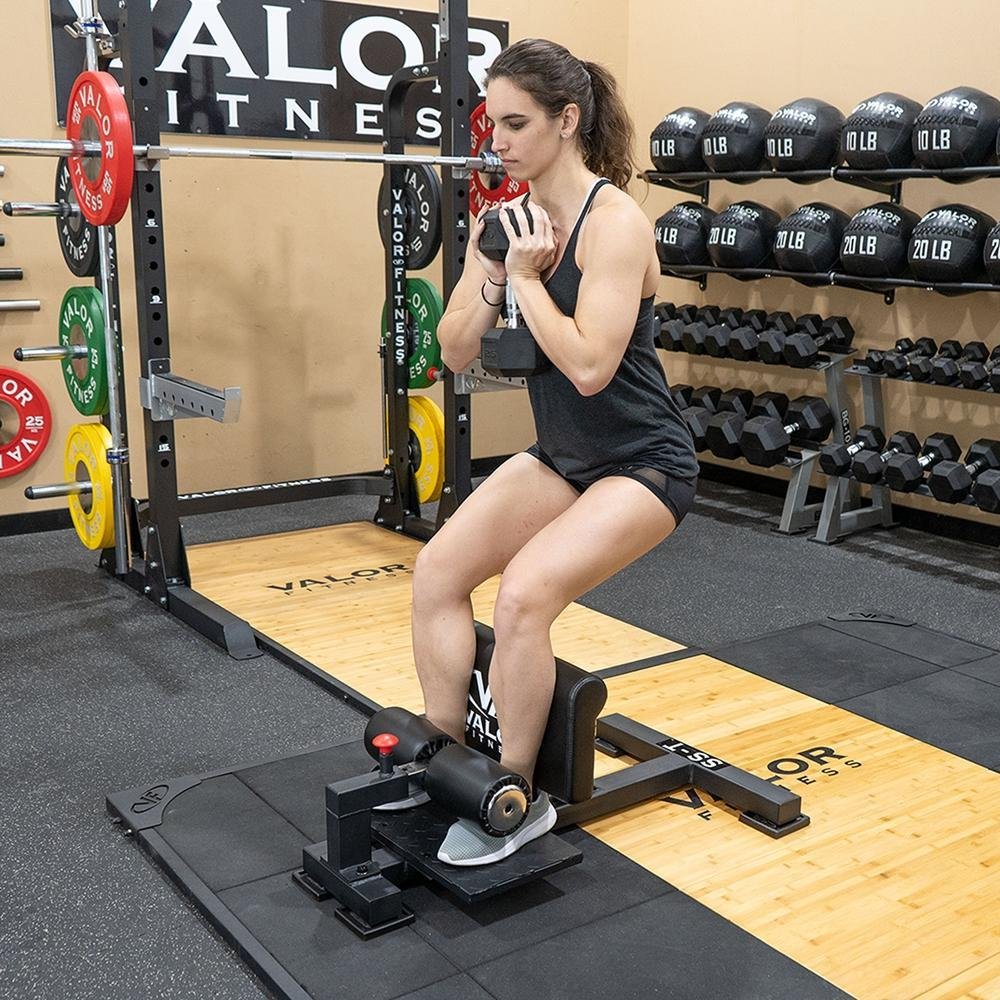
A sissy squat bench usually anchors the lower legs with padded rollers and provides a fixed footplate. The user can sit or lean back into the movement without balancing on the toes in quite the same way as a free-standing version. This makes the bench useful for lifters who want to concentrate on the quadriceps while controlling the body path. Its motion, however, is not mechanically identical to the traditional free-standing sissy squat.
Set the machine on firm, level flooring and adjust the calf and ankle pads so the feet stay secure without painful pressure. The support should fit the lifter, not force the knees into a fixed uncomfortable track. Start with arms in front of the chest and a shallow range; think of sitting backward under control rather than dropping abruptly. Use the leg muscles to stand rather than jerking the trunk.
A bench can make balance easier but does not eliminate knee loading. In fact, removing a balance limitation may let you work the quads harder. That is useful only if the position feels manageable and the equipment stays stable. Do not treat any product’s advertised maximum loading capacity as permission to use that load. Review assembly, stability, pad adjustment and actual room clearance before each session.
For a compact home gym, a stable rack-assisted bodyweight version may be more space-efficient than purchasing a special bench. The choice depends on whether you value the classic lean-back challenge or consistent, bench-supported repetitions. Neither version has a universal muscle-growth superiority proven simply by its name.

Leg Day Shirts & Workout Gear
Leg-day gym shirts and workout gear for lifters who never skip squats, lunges and lower-body punishment.

Leg Day Thou Shalt Not Skip Leg Day Medieval Knight Gym T-Shirt
Make gym days more fun with “Leg Day” style.

6 Plates Squat Club Meme Shirt – Essential T-Shirt
Heavy lifts, good laughs, and a little “6 Plates Squat Club” energy.

I Look Better Bent Over Squats Deadlifts & Booty Tank Top
Add some leg-day attitude to training with “I Look Better Bent Over”.

Brains Beauty Booty Focused On Glute Gains & Memes Tank Top
Add some lifting attitude to training with “Brains Beauty Booty”.

Negative Leg Day Review 1 Star Not Recommended Tank Top
Train hard, laugh a little, and rep “Negative Leg Day Review”.

Barbie Leg Day Squats Booty Builder Strong & Gains Hoodie
Show off your leg-day humor in a laid-back “Barbie Leg Day” hoodie.

Leg Day Is Calling You Squats & Deadlifts Meme Hoodie
Stay casual and show some leg-day attitude with “Leg Day Is Calling You”.

Deadlift Skull Gym Gold Heavy Metal Crewneck for Powerl T-Shirt
Show some gym-day personality with “Deadlift Skull”.

Invisible Booty To Visible Booty Motivation Decal Sticker
A fun “Invisible Booty To Visible Booty” touch for bottles, laptops, and lockers.

Squat Inspector Gym | Edgy Leg Day Meme Workout Decal | Sticker
A fun “Squat Inspector” touch for bottles, laptops, and lockers.
Knee comfort: load management matters more than slogans
A sissy squat can generate a large demand at the knee, especially when you move toward deeper knee flexion with the hips relatively straight. For some lifters that is a productive quadriceps stimulus; for others it is an unnecessarily aggressive place to begin. More knee travel is not automatically dangerous, but it is a poor idea to ignore pain or major changes in symptoms simply to copy a demonstration.
Use a comfortable depth, a slow descent and assistance that you can gradually reduce. Someone returning from knee pain or with a history of instability may need a clinician or qualified trainer to assess whether this exercise is suitable. Sharp pain, swelling, giving way or persistent symptoms warrant stopping and seeking professional guidance. Muscular effort or mild next-day soreness should not be mistaken for the same thing as joint distress.
A useful comparison is the leg extension machine: it provides a stable knee-extension task with a defined adjustment range and load, whereas free-standing sissy squats add a demanding balance and body-position component. Heel-elevated squats still involve both knee and hip movement. None is automatically required for healthy knees or bigger quadriceps.
Knee comfort is influenced by total weekly work, individual tolerance, range and fatigue. If the exercise feels fine for one set but not for three, that matters more than a theoretical claim about an ideal repetition count. Start conservatively and increase only one variable at a time: range, reps, assistance or resistance.
Progressions, regressions and alternatives for stronger quads

The easiest useful entry point is a lightly supported quarter-range lean-back with both heels near the floor. Progress to a longer controlled lowering phase, then a modestly larger range. The next step is less assistance from the rack—not automatically a heavier weight. A full free-standing sissy squat demands both strength and balance, so it is an optional skill rather than a mandatory milestone.
A dedicated sissy squat bench offers another progression route. Establish a fixed comfortable pad position and depth, then add repetitions at the same tempo. Only after you can complete all sets without pushing against the supports should you consider a light dumbbell or plate at chest level. The chest-held load adds challenge; it does not rescue sloppy mechanics.
Other quad exercises solve different problems. Leg extensions give straightforward knee-extension work with external resistance. Heel-elevated goblet squats let the knees travel forward while the hips participate. Split squats and step-ups provide unilateral leg work. Reverse Nordic curls also challenge knee-extension control from a kneeling position, but they place different demands on the body and should be treated as their own exercise.
A person with a few square feet and adjustable dumbbells might combine goblet squats and leg extensions with small sissy-squat exposures. A lifter with a full rack may use the rack as a handhold. The smartest option is the one you can load, repeat and recover from. Variety is helpful when each exercise has a purpose, not when it merely creates a new kind of soreness.
Equipment Worth Exploring
Explore equipment, accessories and gear from our carefully selected range.



Multi Pull Smith Rack MPHR-780
All-in-one rack with a Smith machine, functional trainer, lat pulldown and low row.


Foldable Wall Rack
Wall-mounted folding squat rack designed to save floor space between workouts.


Rubber Hex Dumbbells
Rubber-coated hex dumbbell pairs with a stable shape for home and commercial strength training.


Safety Squat Handles
Barbell squat handles that reduce shoulder positioning demands during high-bar squats.

Where to place sissy squats in a home-gym leg session
For most people, the sissy squat fits after the principal squat or leg press, when the aim is additional quad-specific work rather than a personal record. For example, start with two or three challenging squat sets, add a unilateral movement such as a split squat, then perform two measured sissy-squat sets. The pattern can also replace leg extensions for someone who enjoys it, but that is a preference, not a scientific mandate.
Warm up with a few minutes of easy movement and submaximal knee-bending, then test the exact supported range before your first working set. A set of eight controlled repetitions, even with assistance, can be demanding. Leave roughly two or three clean repetitions in reserve initially; quality is easier to assess before the legs start shaking. Take enough rest for your next set to reproduce the same alignment.
Keep home-gym floor space and equipment clear. If you use a rack as a support, check that it is secure and does not tip when you pull lightly. If you use a bench, check foot retention and the pad fit. A sissy squat station should not double as a substitute for a properly adjusted safety rack. Wear footwear that provides predictable traction rather than soft or slippery socks on a platform.
Pair the knee-dominant work with a hip hinge or hamstring curl elsewhere in the week. Sissy squats do not give you a complete leg program: hamstrings, glutes and calves still deserve work. Count weekly hard sets in context rather than automatically adding another four every time a new leg accessory looks appealing.
Powerlifting Shirts & Lifting Gear
Powerlifting shirts and gym gear for squat, bench and deadlift lifters who live for heavy numbers.

Gym The Bar Does Not Lie Medieval Knight Lifting Shirt T-Shirt
Make gym days more fun with “The Bar Does Not Lie Medieval Knight” style.

2000lb Club Shirt Meme Top T-Shirt
Show some powerlifting attitude with a playful “2000lb Club” tee.

Gold Skull , Uplift Iron Club Gym Pullover, Bodybuildin Hoodie
Keep it laid-back with a little “Gold Skull” attitude.

Deadlift Military Skull Gym Pullover for Powerlifters, Hoodie
Keep it laid-back with a little “Deadlift” attitude.

Gym Cult Occult Barbell Meme – Powerlifting Bodybuildin T-Shirt
Show some gym-day personality with “Gym Cult”.

Heart Weight Plate Valentine's Day – Fitness Meme Jumpe T-Shirt
Bring “Heart Weight Plate” humor to your everyday gym style.

My Therapy – Lifting Bodybuilding Powerlifting Meme Dec Sticker
Bring “My Therapy” attitude to your water bottle or laptop.

Praise The Deadlift Holy Lifting Meme Decal Water Sticker
Put “Praise The Deadlift” gym humor on your laptop, bottle, or gym gear.

Heavy Metal Deadlift – Skeleton Gym for Powerlifters an Hoodie
Stay casual and show some metalhead attitude with “Heavy Metal Deadlift”.

Pancake Weight Plate 45LB Plate Pancakes & Weights Brea Sticker
Put “Pancake Weight Plate” gym humor on your laptop, bottle, or gym gear.
A practical six-week plan and progress checklist
Weeks 1–2 are an introduction. Once or twice per week, perform two sets of six to eight assisted partial-range repetitions after your main leg exercise. Lower for about three seconds, return smoothly and stop each set while you can still control your body line. Rest around ninety seconds to two minutes, or longer if necessary. Record the depth, amount of hand assistance and how your knees felt afterward.
Weeks 3–4 focus on repeatability. If the first phase was comfortable, work toward two or three sets of eight to ten reps at the same range with slightly less support. Do not simultaneously increase depth, load and total sets. Bench users can keep the pad configuration fixed and build repetitions before adjusting the challenge. If form slips, return to your previous level and accumulate several steady sessions.
Weeks 5–6 allow one carefully chosen progression: a modest additional range, a slightly slower eccentric, or a very small increase in external load for experienced users. Aim for two or three sets of eight to twelve clean reps. Keep two days or more between hard exposures if soreness or total leg-session fatigue requires it. You do not need to reach failure to call the program successful.
Use a simple scorecard: stable feet, consistent depth, controlled descent, manageable knee symptoms and a repeatable number of reps. A gain in range with unchanged comfort is progress. More reps at the same range is progress. If a regular squat, supported sissy squat or leg extension suits you better, substitute it rather than pushing through symptoms. After six weeks, retain the variant that strengthens your training without making the rest of leg day worse.