Getting stronger is not quite the same as producing force faster, and neither ability tells the whole story about what happens once a muscle becomes tired. A controlled 2026 experiment offers an unusually useful distinction: brief maximal isometric training improved peak knee-extension torque and the ability to preserve force during repeated all-out efforts, without a clear improvement in the first fractions of a second of an unfatigued contraction. That finding matters for anyone who assumes every new strength record automatically translates into greater explosiveness or endurance.
Some product links may be affiliate links, which can support Mind Muscle Perfection at no additional cost to you.
Three different questions hidden inside the word strength
Peak strength asks how much force a muscle can ultimately produce. Rate of force development asks how rapidly that force appears after contraction begins. Fatigue resistance asks how well performance holds up when demanding efforts repeat. These measurements overlap, but they are not interchangeable. A heavy squat tests a different combination of qualities from a short jump, and both differ from sustaining high-quality repetitions late in a hard session.
In the laboratory, knee-extension torque measures rotational force around the knee. Researchers can also calculate impulse: the accumulated torque over a specific period of time. A high peak does not guarantee a large impulse in the first 30, 100 or 200 milliseconds. A lifter might eventually generate impressive force but reach it too slowly to exploit it during a very short athletic movement.
For practical training, that distinction prevents two common mistakes. First, moving a heavier load does not prove your jump height or sprint acceleration improved. Second, a lower number late in a session does not automatically mean your maximum fresh strength has fallen. Exercise selection, intent, rest intervals and fatigue all change which capacity you are testing. A useful program measures progress against the task it actually aims to improve.
What the three-week isometric experiment actually tested
Nineteen physically active young men who had not followed systematic resistance training in the previous six months took part. Ten completed the training intervention; nine continued their usual activity as controls. The training group used maximal unilateral isometric knee extensions for three weeks, twice per week. Each session consisted of three sets of ten four-second maximal contractions, separated by short pauses, with two minutes between sets. This was a tightly controlled single-joint protocol, not a barbell program or a test of experienced powerlifters.
Before and after the intervention, the researchers measured fresh maximal voluntary torque, early torque impulse and muscle electrical activity. They also used a five-minute all-out knee-extension test: sixty maximal contractions, each lasting three seconds with two seconds of rest. This produced a progressively fatiguing series rather than a single fresh attempt. The researchers compared the early part of each contraction across 30-, 100- and 200-millisecond windows.
Because the test used fixed positioning and a dynamometer, it could isolate mechanical behavior more precisely than watching a gym set. Yet that precision comes with a tradeoff. A seated, fixed-angle knee extension does not recreate the coordination, momentum, balance or technique of a squat, sprint or jump. The sample was small and male-only, and three weeks is too short to draw sweeping conclusions about long-term hypertrophy. Treat the results as evidence about a particular neuromuscular adaptation, not a universal training prescription.

Equipment Worth Exploring
Explore equipment, accessories and gear from our carefully selected range.


FID Bench MAX
Adjustable bench offering flat, incline, and decline positions + adjustable headrest.

GymPin Squat Wedges
Non-slip 15-degree squat wedges help elevate the heels for deeper quad-focused squats.


More peak torque did not mean faster fresh contractions
After the intervention, fresh maximal knee-extension torque increased significantly in the trained group relative to controls. The same comparison did not establish significant improvements in the torque impulse accumulated during the first 30, 100 or 200 milliseconds of an unfatigued contraction. Integrated electrical activity measured over those early windows also showed no consistent training effect. Put simply, the participants became better at generating a high eventual force, but the experiment did not show that they became quicker at building it immediately.
That difference is plausible because early force production depends heavily on how quickly the nervous system recruits and fires motor units. The mechanical properties of the muscle and tendon matter as well. The neural strategy for reaching a high peak can change without identical changes in the earliest part of the force-time curve. Longer heavy-training interventions have sometimes improved early force production, so the correct conclusion is not that heavy strength training can never build explosiveness. It is that this short, specific protocol did not demonstrate that outcome.
For lifters, the distinction is a reason to avoid treating a personal record as a substitute for every performance measure. If your goal is a stronger controlled press or squat, peak load remains useful. If your goal includes rapid force production, add appropriately coached, low-fatigue explosive work and measure that skill separately. Quality matters more than simply attempting to accelerate a maximal load when technique is breaking down.

Powerlifting Shirts & Lifting Gear
Powerlifting shirts and gym gear for squat, bench and deadlift lifters who live for heavy numbers.

Lifting Is In My DNA Shirt – & Meme T-Shirt
Rep “Lifting Is In My DNA” humor in and out of the gym.

6 Plates Deadlift Club Motivational Meme & Essential T-Shirt
Bring “6 Plates Deadlift Club” humor to your next gym day.

Girl Power – & Top T-Shirt
Bring “Premium Gym Girl Power Graphic” humor to your next gym day.

Strong Woman Leg Day Meme Hooded Barbie Hoodie
Make your off-duty look more fun with “Strong Woman”.

Barbie & Barbells Strong Leg Day Athletic Shirt Tank Top
Train hard, laugh a little, and rep “Barbie & Barbells”.

Anti Social Lifting Club Powerlifters & Fans Vest Tank Top
Your gym-day look, with a playful “Anti Social Lifting Club” twist.

Lift With Me Renaissance Michelangelo Sistine Chapel Sticker
Bring “Lift With Me Gym Renaissance” attitude to your water bottle or laptop.

Lifterella Princess Sweater Female Meme T-Shirt
Bring “Lifterella” humor to your everyday gym style.

Lifterbell Fairy Meme Hooded Girls & Hoodie
Stay casual and show some gym-girl attitude with “Lifterbell Gym Fairy”.

Heavy Squatter Harry Potter Squat Meme Sweater Leg T-Shirt
Show some gym-day personality with “Heavy Squatter”.
Under fatigue, the trained muscle held on longer
The more interesting result emerged during the sixty-contraction test. As repeated maximal efforts accumulated, both peak torque and early impulse declined. After training, that decline was slower: the fitted time constant describing the fall in performance increased. The participants could therefore preserve a greater share of their available force and impulse across the demanding sequence. The study also found more accumulated impulse above the critical level, despite no clear change in the critical torque or critical impulse themselves.
Think of a force-output curve with an initially high level that drops toward a lower plateau. Training can improve the amount of work performed above that plateau by slowing the descent, even if the plateau barely moves. That is not the same as increasing the number of repetitions someone can perform with a barbell, but it illustrates why the shape of fatigue matters. Two athletes with similar fresh strength may behave differently when repeated efforts leave little recovery time.
Electrical recordings suggested a higher starting level of activation during the fatiguing sequence, while the rate of change across contractions was not clearly different. When the researchers normalized the accumulated impulse by this activation measure, the training effect was no longer statistically clear. That is an important caveat: the study supports improved mechanical performance under fatigue, but it does not isolate one simple cause. Neural drive, muscle contractile behavior and task-specific learning can interact. Avoid claiming the experiment proved that one particular fiber type or energy system improved.
Why these findings do not settle the best workout method
A three-week isometric knee-extension intervention tells us something about repeated maximal knee-extension contractions. It does not compare isometrics against conventional squats, leg presses, plyometrics or long-term hypertrophy programming. Nor does it establish that short-rest maximal contractions are a superior way to train fatigue resistance for running, field sports or high-repetition lifting. Transferring a laboratory result to those tasks requires evidence that the relevant movement and performance measures actually improve.
Training history also matters. People returning to strength training may improve quickly through familiarization and neural adaptations. An experienced lifter with years of heavy squatting may respond differently. The study included only nineteen men, with ten in the training arm, so a nonsignificant early-impulse result should not be interpreted as proof that no individual improved. Likewise, a significant group difference does not guarantee every trainee benefits to the same degree.
Earlier research on rapid force development found that heavy resistance training can increase both maximal force and early neural drive over longer periods. Reviews of explosive strength also emphasize that testing procedures and contraction instructions strongly influence the measurement. These bodies of evidence are compatible rather than contradictory: different durations, exercise methods and testing windows can produce different adaptations. The most useful response is to match the training stimulus to the outcome you care about and keep your comparisons honest.
Equipment Worth Exploring
Explore equipment, accessories and gear from our carefully selected range.
VOLTRA
Compact digital cable trainer with smooth, adjustable resistance.

Go-Tone Pro
Portable digital cable trainer with up to 66 lb (30 kg) of adjustable resistance.

Squat Harness
Wearable harness for hands-free cable squats, sled work, and lower-body training.


Safety Squat Handles
Barbell squat handles that reduce shoulder positioning demands during high-bar squats.


How to combine strength, speed and repeatability in training
Start with a stable strength base. Choose a squat or leg-press pattern, a hinge, an upper-body press and a pull that you can perform consistently. Progress load or repetitions gradually while maintaining a repeatable range of motion. For heavy compound work, allow enough rest that the next set reflects strength rather than an accidental conditioning test. A deliberate pause or isometric hold can help you practice bracing and position, but it is an accessory rather than a replacement for the movements you want to improve.
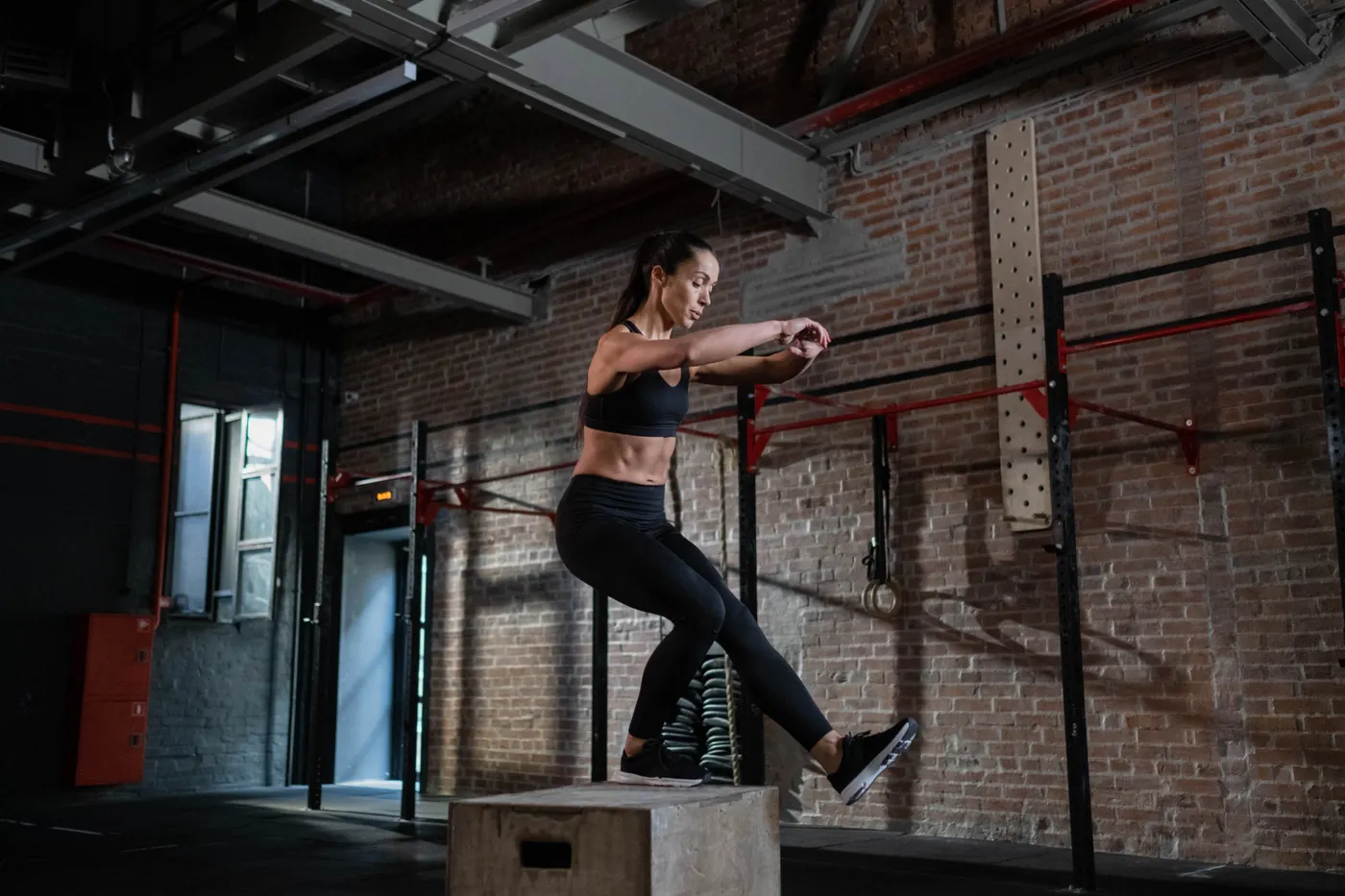
If rapid force production is important, include a small amount of crisp explosive work while fresh: for example, low-volume jumps, light medicine-ball throws or fast concentric repetitions with an appropriately manageable load. Stop a set when speed, landing quality or control noticeably deteriorates. More exhaustion is not automatically more power. People without a jumping background can start with fast but controlled bodyweight sit-to-stands or simple step-ups rather than high-impact plyometrics.
For repeatability, introduce a separate dose of repeated moderate efforts, such as controlled sled pushes, short bike intervals or higher-repetition accessory sets. Log rest periods as carefully as weights. A circuit with forty-five seconds between exercises measures a different quality from three heavy sets separated by three minutes. Combining the three approaches is a programming option, not a claim that everyone needs three separate workout days. Use the smallest dose that supports your goals without interfering with recovery, and reduce volume if technique or sleep deteriorates.
Leg Day Shirts & Workout Gear
Leg-day gym shirts and workout gear for lifters who never skip squats, lunges and lower-body punishment.

Deadlifter Life Shirt – Halloween Ghost T-Shirt
Rep “Deadlifter For Life” humor in and out of the gym.

I Love Squats Valentine'S Day Shirt Meme & T-Shirt
Bring “I Love Squats Valentine's Day” humor to your next gym day.

Patriotic – Uncle Sam Squats USA Meme 4th Of July, & T-Shirt
Bring “Patriotic” humor to your next gym day.

Booty Building Mode Leg Day & Squats Meme Top Tank Top
Add some leg-day attitude to training with “Booty Building Mode”.

Let It Grow Leg Day Squats & Booty Building Meme Hoodie
Keep it laid-back with a little “Let It Grow” attitude.

Fantastic Booty Leg Day Squats & Glute Building Vest Tank Top
Train hard, laugh a little, and rep “Fantastic Booty”.

Girl She-Hulk Sweater Weightlifting & Leg Day Meme T-Shirt
For laid-back days and superhero humor: “Gym Girl”.

Squat You Must Star Wars Leg Day Meme Decal Water Sticker
Give your everyday gear a playful “Squat You Must” twist.

Bunny Squats & Booty Motivation Decal Cute Water Sticker
Give your everyday gear a playful “Gym Bunny” twist.

Zombie Deadlift Deadlift Lovers & Leg Day Meme Hooded Hoodie
Make your off-duty look more fun with “Zombie Deadlift”.
A four-week way to track progress without laboratory equipment
In week one, establish consistent baselines rather than chasing fatigue. Record a technically clean five-repetition set in one lower-body movement, the height or distance of a simple low-risk power task if you already perform it, and a repeatable short accessory test. Keep equipment, warm-up, range of motion, tempo and rest the same each time. Note the difficulty of the final repetition and whether movement quality changes near the end. Avoid repeated maximal isometric tests or all-out five-minute knee-extension challenges without specialist supervision.
In weeks two and three, train your main strength movement twice weekly at a recoverable effort. Add two or three small sets of crisp speed work at the beginning of one session and one brief repeat-effort block on another day. If the first two strength sets remain technically solid, increase load modestly or add a repetition. If speed work becomes slow, stop it rather than forcing the planned number. Do not use soreness as your scorecard.
In week four, repeat the original measures after a normal recovery interval. Look at each dimension separately: did the controlled five-rep load improve, did the power task improve, and did your repeated-effort performance hold up better under the same rest conditions? A mixed result is useful information. You might be stronger but no faster, or more consistent late in a set without a large change in peak load. That is exactly why the distinction between maximum force, early force and fatigue resistance deserves attention. Use the findings to adjust the next block, not to declare one exercise universally superior.