Advertising disclosure: This page includes affiliate links that may earn us a commission at no additional cost to you.
Ethan Katzberg’s 84.12-metre hammer throw at the Paris Olympics was an extraordinary display of power. Yet the most useful detail for a person who trains with weights is not the distance or the size of the athlete. It is the relationship between strength and the skill required to express it.
Before Paris, Katzberg described trying to make his movement smooth instead of overpowering the implement with his muscles. That sounds counterintuitive in a sport where the objective is to send a heavy object as far as possible. But the difference between possessing force and delivering it in the right direction is central to athletic performance.
His rise offers an example of why a stronger athlete still needs patient technical practice, consistent preparation and a realistic way to measure progress.
From a difficult international debut to world champion
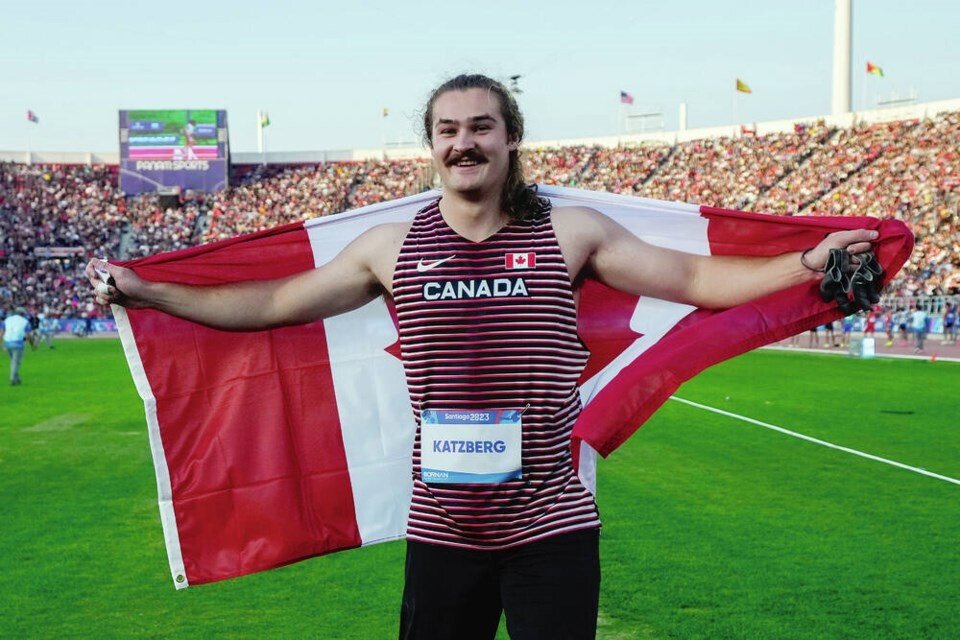
Katzberg did not arrive at his first senior Olympic final as an athlete who had always dominated international competition. In 2021, he reached the final of the World Under-20 Championships but failed to register a valid throw. A year later, he won Commonwealth Games silver with 76.36 metres. In 2023, he claimed the world title with 81.25 metres in Budapest, then added Pan American Games gold.
After high school, Katzberg moved from Nanaimo to Kamloops to develop under coach Dylan Armstrong, an Olympic shot put medallist. That change put him in an environment where training could be organised around a highly specialised event. By 2024, the Canadian was winning consistently on the international circuit, including an 84.38-metre performance in Nairobi that April.
These results show a career moving forward through several seasons rather than one miraculous transformation. They also illustrate how an early competition failure need not reveal the limits of an athlete’s potential. The 2021 final told us that Katzberg had not recorded a valid mark on that occasion, not that he was incapable of becoming a world champion.
That distinction matters in the gym. A missed lift can reflect a technical error, a poor attempt selection, inadequate recovery or insufficient strength. The correct response depends on the cause. Rebuilding a programme every time one session goes badly can prevent the consistency needed to find out what is really working.
Equally, the improvement in Katzberg’s competitive distances cannot establish exactly which gym exercises or loading schemes caused it. His results are evidence of athletic development, not a controlled experiment comparing training methods.
Why a powerful throw is not a fight with the hammer
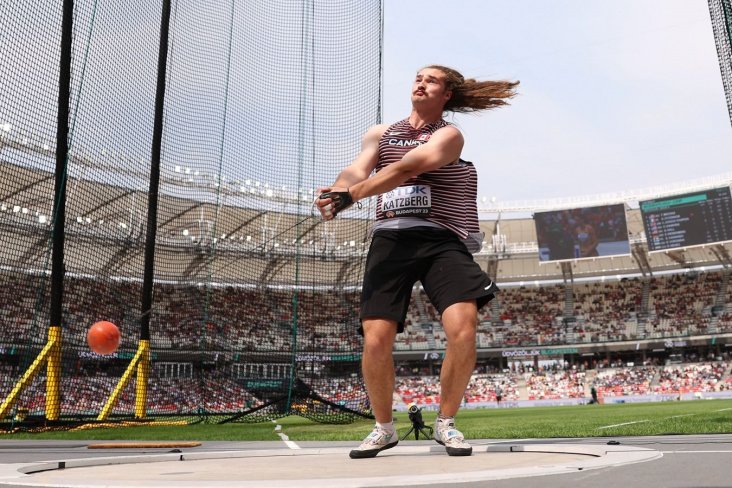
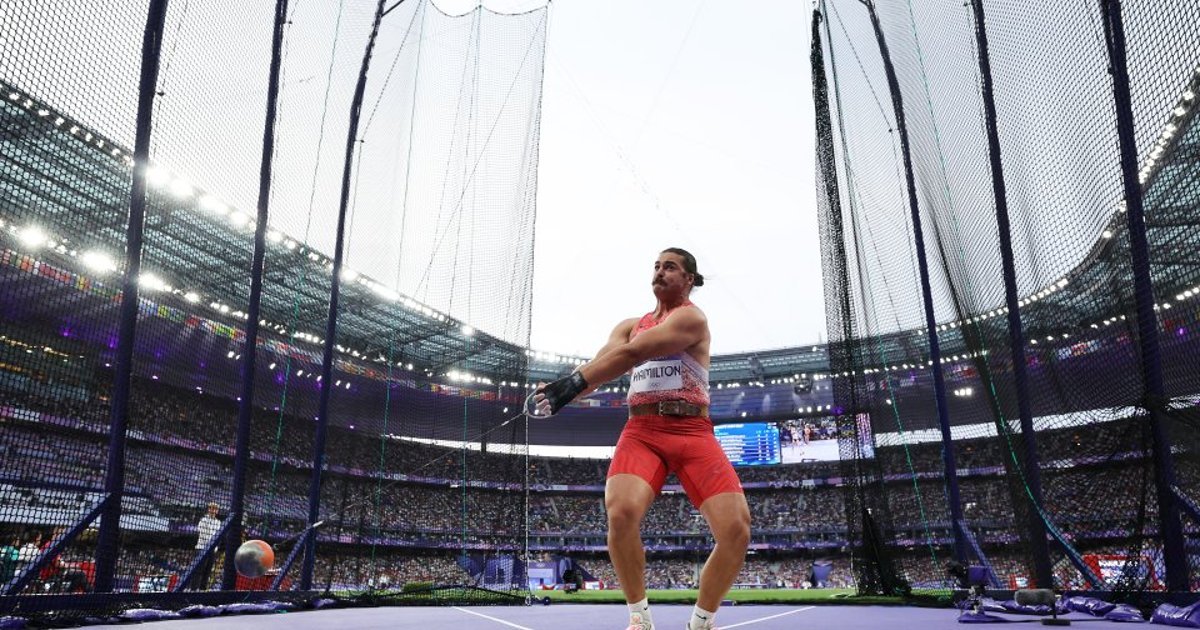
A hammer throw is a rotational action with a particular mechanical challenge: the athlete must accelerate an implement connected to a wire while maintaining balance and control inside a small circle. The men’s competition hammer weighs 7.26 kilograms. Its distance depends heavily on the speed and direction of release, as well as the trajectory of the implement.
Muscular strength supports that task, but a thrower cannot simply pull harder at an arbitrary point in the movement and expect the best result. The athlete has to manage the implement’s changing position, transfer force through the body and keep the movement coordinated as speed builds. An uncontrolled effort can disrupt the very position needed for the next part of the throw.
Katzberg’s approach before Paris was to seek a fluid movement rather than trying to wrench the hammer around. This is not an argument against getting stronger. It is an argument against confusing excessive tension or visible strain with effective execution. The appropriate amount of effort depends on the task.
For a lifter, consider the difference between a heavy deadlift performed with a deliberate setup and a hurried attempt that begins before the lifter is ready. Both can look aggressive, but only the first makes it easy to identify whether the athlete maintained the intended position. Bracing hard when a heavy barbell requires it is entirely compatible with avoiding unnecessary rushing or pulling out of position.
The analogy has limits. A hammer throw requires coordinated rotation and a release, whereas a deadlift is judged on a different set of requirements. You should not deliberately relax the trunk during a heavy lift just because a thrower talks about fluidity. Borrow the principle of task-specific control, not the movement or the exact muscular cues.
The value of making preparation repeatable
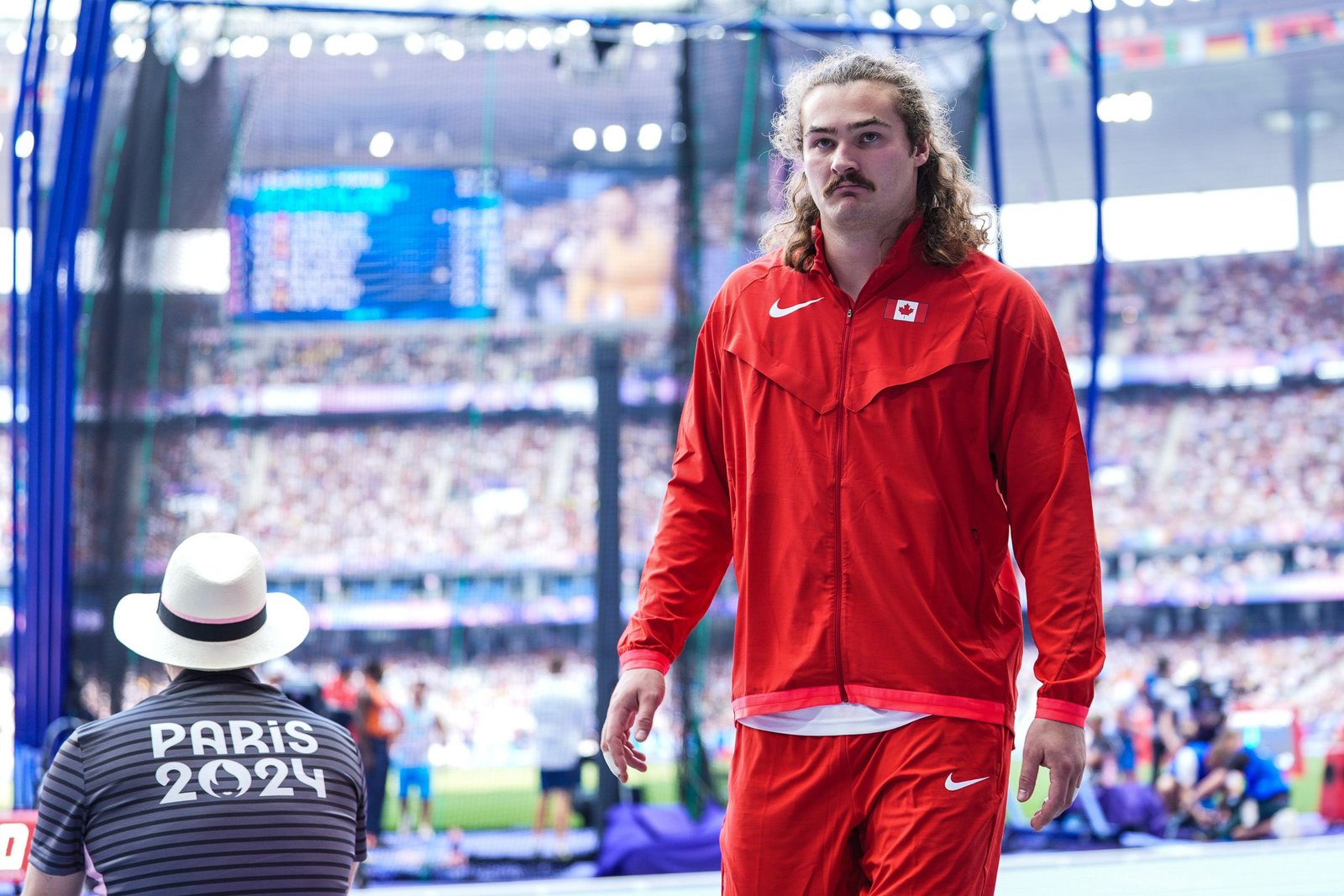
At the Canadian trials in June 2024, Katzberg explained how he practised similar preparatory movements in training, warm-ups and competition. Rather than treating the moments before a throw as a separate ritual, he used them as another opportunity to reinforce the action he intended to perform. His goal was familiar execution even when the surroundings were different.
During that competition he registered marks of 78.06, 80.51 and 82.60 metres, the last on his fourth attempt. The important feature is not that a fixed routine guarantees a better result on each attempt. It is that preparation provides a familiar starting point from which the athlete can make adjustments.
The same approach can be surprisingly useful for strength athletes. Before your working sets, use a warm-up that rehearses the positions and movement pattern you will actually need. An experienced squatter might repeat a consistent foot placement, grip, unrack and walkout on progressively heavier sets. A bench presser could practise the same contact points and descent path with light loads before increasing the weight.
There is no requirement to turn a preparation sequence into a rigid superstition. If a bench is unfamiliar or you need to adjust your stance, adapt to the situation. The purpose of repetition is to make useful behaviour easier to reproduce, not to make the athlete dependent on every small detail happening in the same order.
Armstrong’s work with Katzberg was also influenced by an individualised approach to training and adaptation. That context matters: a high-level thrower’s response to weeks of competition and training is monitored in a way that is very different from an ordinary lifter following a generic internet schedule. It would be misleading to invent the Olympic champion’s exact weekly gym routine or suggest his competition calendar should determine yours.
What the Paris final actually reveals
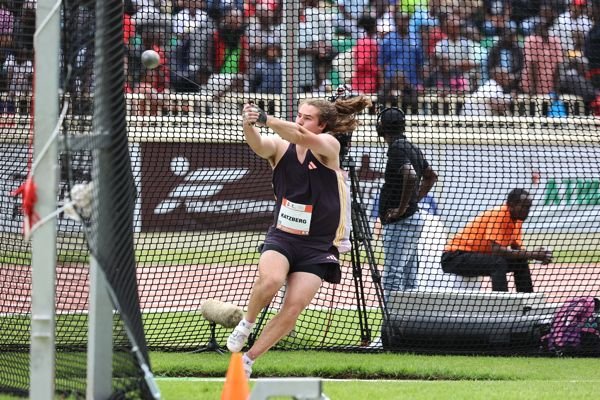
At the Paris final on August 4, 2024, Katzberg produced his winning distance with his opening attempt. He also recorded a valid throw of 82.28 metres on his third attempt. Bence Halasz won silver with 79.97 metres, while Mykhaylo Kokhan took bronze with 79.39 metres.
The gap between the winning mark and silver was more than four metres. Yet the complete attempt series is just as instructive as the headline: Katzberg registered two valid distances and four fouls. The result demonstrates that even an exceptional athlete can produce an outstanding maximum without every attempt being successful.
That is why it is useful to separate the demands of a competition from the purpose of most training sessions. In the hammer final, the best legal attempt determines the placing. In training, frequent valid, controlled efforts can be valuable because they allow the athlete and coach to assess patterns and make technical changes. A maximum is one measure of capacity, not a complete description of performance.
For gym training, a personal record is worth celebrating. But if it is achieved only by changing the range of motion, losing the position you were trying to practise or relying on assistance that was absent before, the number is less informative than it appears. Decide what counts as a successful repetition before increasing load.
There is also no reason to interpret the fouls as a failure of Katzberg’s approach or to assume a specific cause without evidence. They are part of the recorded series. The sensible takeaway is that repeatable preparation can help support performance without making human movement perfectly repeatable.
How to apply the principle to your own strength training
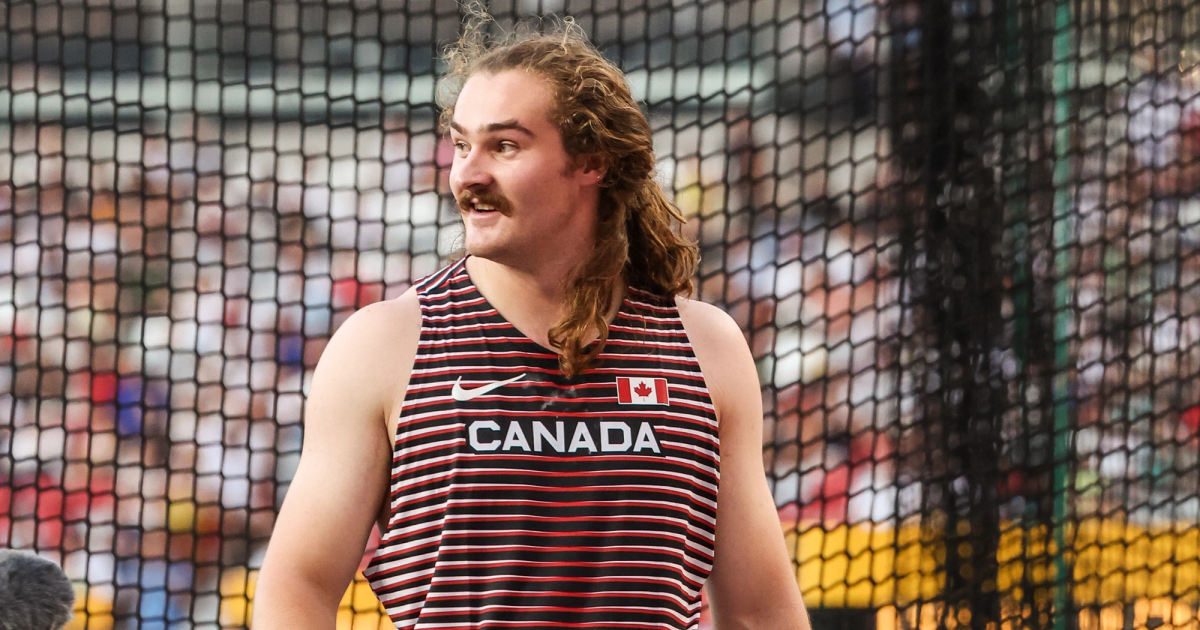
Start by identifying a lift you want to improve and define the feature you want to reproduce. For a squat, that might be consistent depth and balance. For a deadlift, it might be a deliberate setup and a stable start position. For a medicine-ball throw, it might be coordinated acceleration and a clear release into a suitable training area.
Choose a manageable load and record a few sets from the same camera angle. Compare repetitions against your chosen standard rather than against whichever set looks most dramatic. A useful technical change is often a small adjustment that makes the movement easier to repeat, rather than a complete reinvention of the exercise.
Here is a simple example of how to organise practice around a main strength lift, not a reconstruction of Katzberg’s own routine:
- Warm up progressively using the same main movement pattern.
- Perform three to four working sets of three to five repetitions at a load that leaves approximately two repetitions in reserve.
- Rest long enough to reproduce the desired execution, typically several minutes for demanding compound lifts.
- Review the first and last working sets, looking for meaningful changes in position or range of motion.
- Increase the load gradually only when the target repetitions and technical standard are consistently achievable.
If the objective is explosive power, the load and repetitions should suit that objective instead. Keep explosive efforts short, allow sufficient recovery and stop the set when execution or speed noticeably deteriorates. Do not turn high-speed practice into an endurance test unless fatigue tolerance is the specific quality you are targeting.
Anyone interested in actual hammer throwing should learn in an appropriate athletics facility with qualified coaching and proper safety arrangements. A crowded gym or backyard is not a suitable place to improvise competitive hammer throws.
Katzberg’s example is ultimately about making strength useful. Train to build force, practise the skill that expresses it and judge the quality of the work against the requirements of the task. The goal is not to imitate an Olympic champion’s training without knowing it. It is to make your own training more deliberate.

Funny Gym Shirts & Workout Gear
Funny gym shirts, tanks, hoodies and workout gear for lifters who like training hard.

Determination Stoic Sigma – Meme With Greek God T-Shirt
Make gym days more fun with “Determination Stoic Sigma” style.

Funny Gain Train Gym | Thomas The Tank Engine Meme Work T-Shirt
Bring “Gain Train” humor to your everyday gym style.

Composure Stoic Sigma : Meme & Greek God T-Shirt
Show some lifting attitude with a playful “Composure Stoic Sigma” tee.

Funny Lift O'Clock Gym | Bodybuilding Muscle Shirt For Tank Top
Train hard, laugh a little, and rep “Lift O'Clock”.

Improvement Stoic : Meme Shirt Sigma & Greek God T-Shirt
Rep “Improvement Stoic” humor in and out of the gym.

No Excuses Mermaid Decal Water Bottles & Equipment Sticker
Stick a little “No Excuses Mermaid” humor on your favorite gear.

Medieval Gymbro Lifting Iron Knight Hoodie
Show off your medieval humor in a laid-back “Medieval Gymbro Lifting Iron” hoodie.

I Am The One Who Lifts Breaking Bad Decal Water Sticker
Bring “I Am The One Who Lifts” attitude to your water bottle or laptop.

Science Based Lifting Rick And Morty Evidence-Based Tank Top
Train hard, laugh a little, and rep “Science Based Lifting”.

Funny Train Hard Gym | Thomas The Tank Engine Muscle Sh Tank Top
Bring “Train Hard” humor to your next lifting session.