Advertising disclosure: This page includes affiliate product links that may earn us a commission, as well as products from our own store.
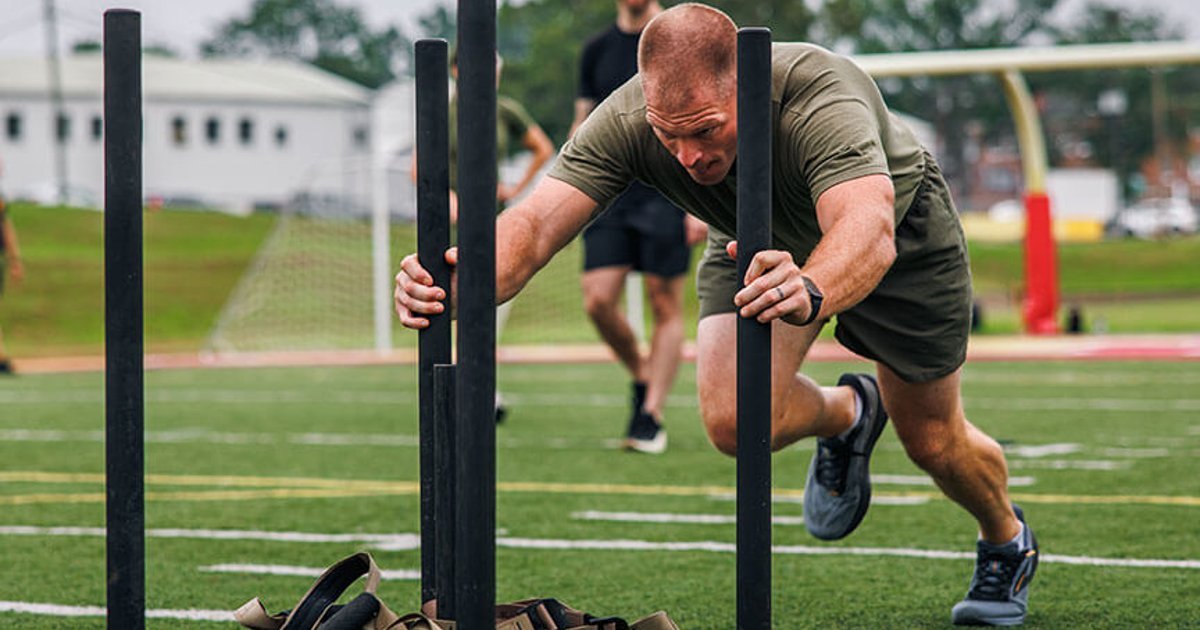
Two athletes can push the same sled, loaded with the same plates, and get completely different workouts. One can accelerate across the lane with a crisp rhythm; the other struggles to move beyond a powerful walk. If the purpose is sprint development, those two efforts should not automatically be treated as equivalent.
Bodyweight percentages are easy to communicate, but they are only a starting point. A more informative approach is to measure how much resistance slows the athlete down. This is called velocity decrement. It gives coaches, strength athletes and hybrid competitors a way to define a session by the movement it produces rather than the mass displayed on the sled. The goal is not to replace heavy work with light work. It is to make the choice deliberate.
Start with the speed you want to preserve
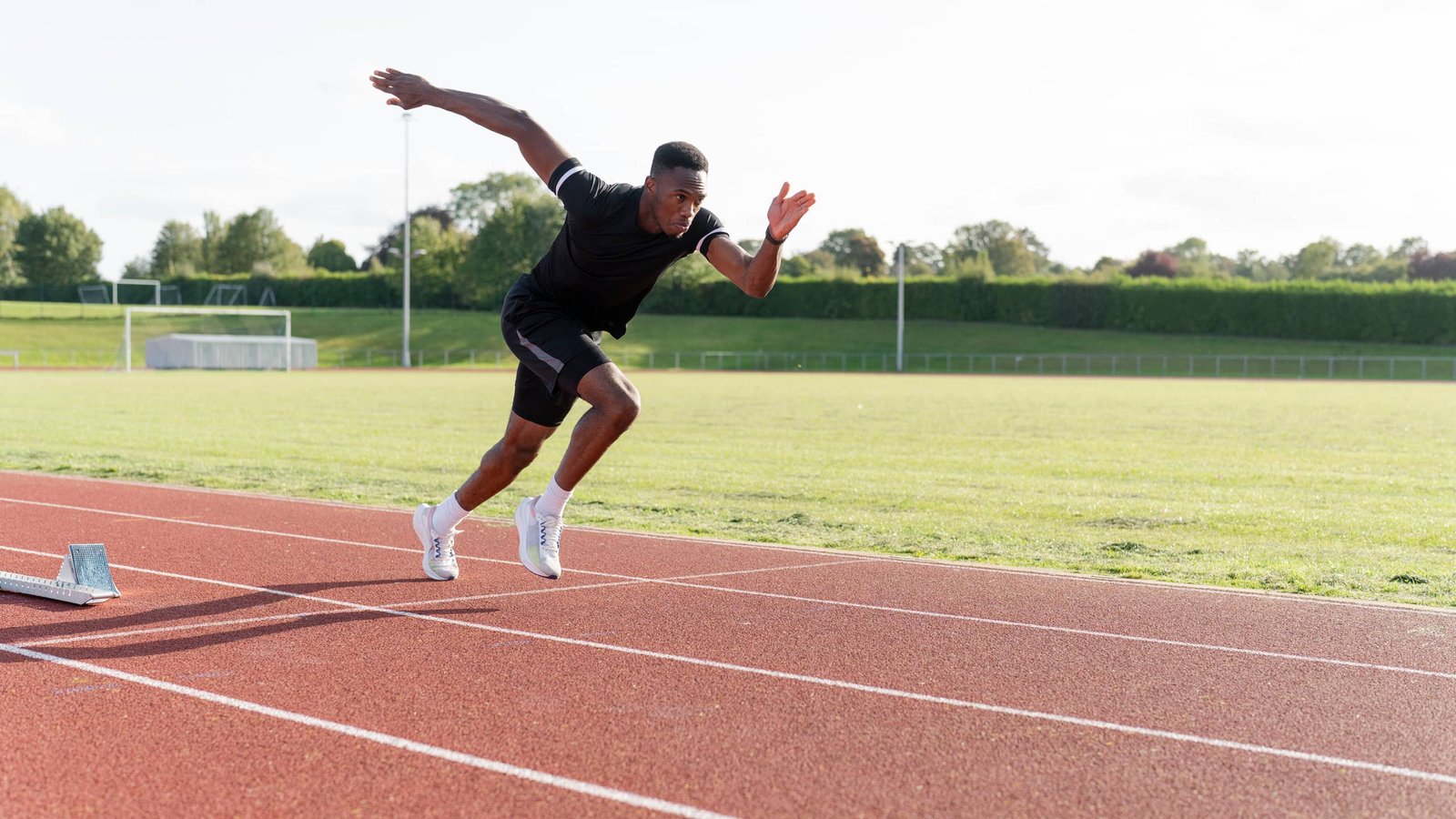
A free sprint establishes a reference for movement speed. When you introduce a sled, you change the task: the athlete has to overcome the resistance of the equipment in addition to accelerating their own body. The heavier or harder-to-move the sled becomes, the slower the athlete generally travels. Measuring that difference turns a vague description such as “moderately heavy” into something you can compare over time.
Velocity decrement (%) = 100 × (unresisted velocity − resisted velocity) / unresisted velocity. Imagine an athlete who reaches 8 metres per second in an unresisted trial. A resisted trial reaching 6 metres per second represents a 25% decrease. A trial at 4 metres per second represents a 50% decrease. At 2 metres per second the decrease is 75%. These are illustrative calculations, not recommended loads or measured individual results.
The important detail is what you measure. Peak velocity and average velocity over a distance are not interchangeable. A 10-metre sprint completed in two seconds has an average speed of 5 metres per second, but its peak speed may be higher. If you only have timing gates or a reliable video setup, you can calculate an average-speed decrement over a fixed interval and use that as your own local training metric. Do not claim that your average-speed measurement reproduces a peak-velocity research threshold.
Even the difference between elapsed time and velocity matters. A 50% increase in time over the same distance is a one-third decrease in average speed, not a 50% decrease. A trial that takes twice as long has half the average speed. That distinction prevents a surprisingly easy error when using split times to calibrate resistance.
What the 90-athlete study tells us about loading
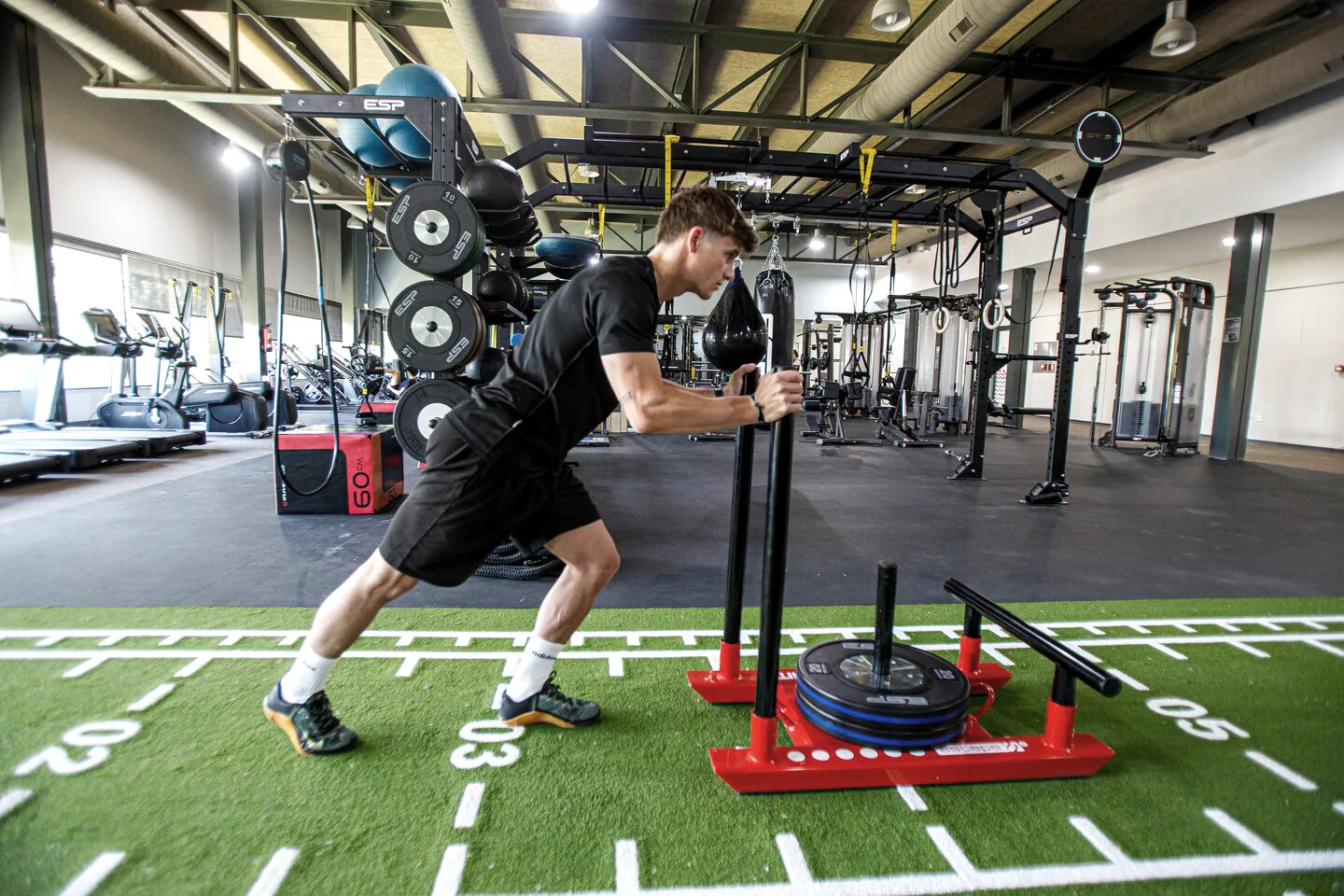
A 2021 investigation tested 90 male high-school athletes, averaging approximately 17 years of age. Each performed a free sprint and three increasingly resisted sled pushes. Radar measurements captured peak speeds. The resulting relationship between load and speed was strongly linear within each participant. In a smaller group who repeated the tests on three occasions, the estimated loading thresholds were reasonably consistent.
What makes the results useful is the variation between athletes. The estimated mean total sled masses corresponding to 25%, 50% and 75% peak-speed decrements were approximately 33%, 66% and 100% of body mass, respectively. The corresponding reported 95% intervals were 23–42%, 45–85% and 69–131%. Those ranges describe the investigation, not universal loading recommendations or a requirement to reach any particular number.
Consider an 80 kg athlete and the middle interval. On paper, 45–85% of body mass translates to total sled masses of 36–68 kg. If the empty sled weighs 27 kg, that leaves 9–41 kg of plates. The arithmetic illustrates why copying a teammate’s plate stack is not a reliable way to match the stimulus. It does not establish where any individual will actually fall within that interval.
The investigation examined loading and repeatability, not which velocity loss produces the greatest long-term improvements in every sport. Participants were adolescent male team-sport athletes rather than a representative sample of adult lifters, recreational runners and competitive hybrid racers. They also tested on a specific sled with a consistent protocol. Treat the findings as a reason to measure your own response, rather than as a chart of mandatory prescriptions.
Build a load-velocity profile on your own turf
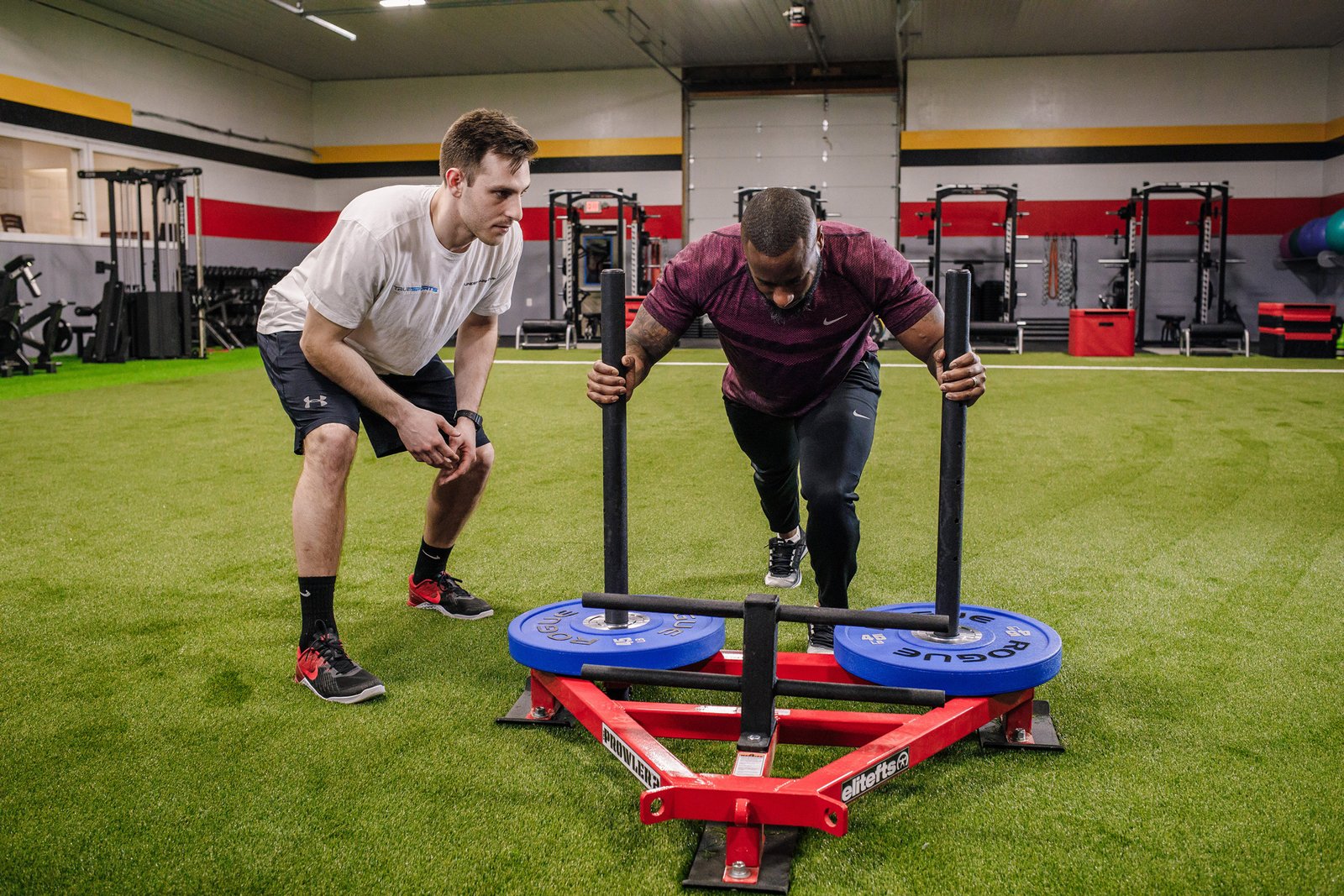
You do not need a laboratory to start collecting useful information. You do need a clear lane, repeatable equipment, a sensible warm-up and a measurement method you can reproduce. If the sled’s empty mass is already challenging, begin with familiarisation rather than forcing a full test of heavy resistance.
- Establish a reference. After progressive warm-up runs, perform a small number of high-quality free sprints. Use adequate recovery so fatigue does not artificially reduce your reference speed.
- Standardise the setup. Record the sled, total mass including the frame, surface, footwear, handle height, start position and direction of travel. Keep the distance and timing method consistent.
- Test manageable resistance. Start with the unloaded sled and add conservative increments. Recover sufficiently between trials. Stop before movement becomes unsafe or technique deteriorates.
- Calculate the change. Use the same definition of speed for every effort. Record the mass and velocity together, not just the percentage.
- Choose a bracket. If a target falls between two measured loads, use a sensible intermediate mass and retest rather than trusting a precise prediction outside your tested range.
For example, suppose an athlete records 5 metres per second over a consistent timed interval. With a total sled mass of 40 kg the average speed is 3.8 metres per second; at 55 kg it is 3.0 metres per second. Those trials represent losses of 24% and 40%. If the coach wants to stay near a quarter reduction for that particular timing method, the first load already fits the aim. There is little reason to add plates merely to hit a rounded bodyweight percentage.
Write down conditions as carefully as the result. The same sled can feel dramatically different on freshly cleaned indoor turf, worn carpet or damp outdoor grass. A magnetic or wheeled resistance sled creates a different relationship between movement and resistance from a conventional friction sled. Do not transfer the numbers between these devices without measuring again. A kilogram of added mass is not itself a unit of horizontal resistance.

Equipment Worth Exploring
Explore equipment, accessories and gear from our carefully selected range.


Pro Sled System
Heavy-duty push-pull training sled for loaded conditioning, speed, and strength work.


Grip Plates
Rubber-coated weight plates with handholds for loading barbells and machines.

Competition Plates
Competition-style bumper plates for Olympic lifts and loaded strength training.


Cast Iron Kettlebells
Textured cast-iron kettlebells for swings, squats, carries, and full-body training.

Choose a load for the job, not the ego
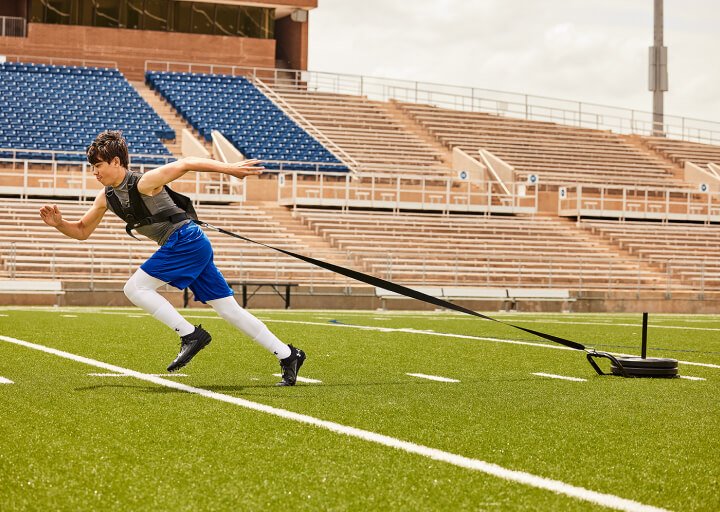
Light and heavy sled work can both be useful, but the appropriate choice depends on the session. If your priority is acceleration with a relatively quick turnover, select a resistance that lets you maintain coordinated, forceful steps. If your priority is applying force against a substantial resistance, a slower push can make sense. Neither objective requires every repetition to resemble an unloaded sprint perfectly.
Training evidence provides a little more context. An eight-week sled-push intervention in 50 male high-school athletes compared unresisted running with three resisted conditions. The largest improvements tended to occur in the earliest sprint split, and the heavy group showed the largest magnitude of improvement in split times. That supports exploring resisted pushes for short acceleration, but it does not establish one optimal load for everyone. Group size, training background and the specific test matter.
Research on sled towing also suggests that athletes from different sports do not necessarily slow down or alter their mechanics in the same way under a given relative load. Pushing and towing are not identical tasks: gripping upright handles changes arm action and trunk support, while a harness allows a different running pattern. A resisted-sprint review found clearer benefits over early acceleration distances than over longer splits, but the underlying studies had important methodological limitations. Use the evidence to guide decisions rather than promise a fixed improvement.
For a hybrid race, the goal may instead be to complete a defined sled station efficiently and then run again. A competition-specific push can be slow and strenuous without being a failed speed workout. Its load, distance and fatigue should be evaluated against the event demands. Train acceleration and race-specific muscular endurance as distinct objectives whenever possible, so that an impressive conditioning effort does not accidentally replace the high-quality sprint work you intended.
Turn your profile into a repeatable training plan
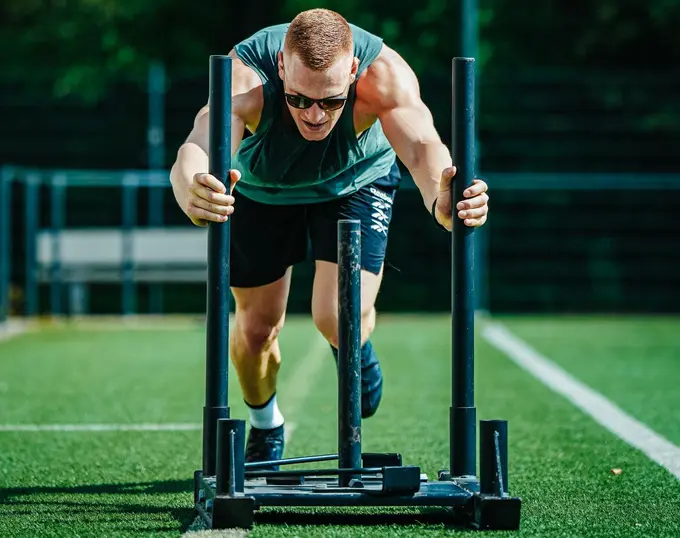
Here is one example of how an experienced, healthy athlete could organise four weeks around a fresh sled-push profile. This is an original programming example rather than a tested protocol from the research. Adapt it to your training age, recovery, sport and equipment. Athletes new to maximal sprinting or returning from injury should build up with appropriate supervision and submaximal efforts first.
| Week | Speed-oriented session | Force-oriented session |
|---|---|---|
| 1 | Familiarise and establish a reference | 3–4 × 10 m controlled pushes |
| 2 | 4 × 10–15 m at a modest measured slowdown | 4 × 10 m with a heavier, manageable load |
| 3 | 4–5 × 10–15 m, same resistance if quality holds | 4 × 10–15 m, progress only one variable |
| 4 | Reduce volume and repeat the reference test | 3 × 10 m at the established load |
Separate demanding sessions by enough recovery, ideally several days when your other training permits. Use roughly two to four minutes between short, high-effort repetitions as an initial planning allowance, extending recovery if quality drops. On the speed-oriented day, the purpose is not to accumulate as many metres as possible. Finish while you are still producing the intended movement. On the force-oriented day, avoid grinding to failure or struggling with an unstable body position.
Keep a simple log of your best and typical speeds at the chosen load. If you move faster at the same resistance on the same surface, that may reflect improved performance. Confirm it over more than one session and compare with your free-sprint reference, because improved unresisted speed can change the percentage decrement even when loaded speed stays the same. Recalibrate after major equipment or surface changes, and after a substantial change in fitness or body mass.
In practice, the most useful sled load is not the heaviest one you can move. It is the one that produces the intended effort, lets you reproduce the work and leaves room for progression. Set the objective first, measure the response second, and add plates only when that change serves the objective.

Functional Fitness Shirts & Workout Gear
Functional-fitness shirts, tanks and workout gear for athletes who train strength, conditioning and everything in between.

High Rocks Functional Fitness Tee
Show some lifting attitude with a playful “Hyrox High Rocks Gym Bro” tee.

Hybrid Athlete – Strength & Endurance Crewneck for Func T-Shirt
For laid-back days and lifting humor: “Hybrid Athlete”.

Hybrid Athlete – Built Different Gym Pullover for HYROX Hoodie
Show off your lifting humor in a laid-back “Hybrid Athlete” hoodie.


Anti HYROX HYROX Club Meme Shirt Gymbro T-Shirt
Make gym days more fun with “Anti HYROX HYROX Club” style.


Vive Le Resistance Bands – Resistance Bands Warmup Reha Sticker
Bring “Vive Le Resistance Bands” attitude to your water bottle or laptop.


Burpees Bad Breaking Bad Shirt – Meme & Cardio Haters T-Shirt
Show some cardio attitude with a playful “Burpees Bad Breaking Bad” tee.