Advertising disclosure: This page includes affiliate product links that may earn us a commission, as well as products from our own store.
The band no-money drill is a small movement with an easily missed purpose. With your elbows bent beside your ribs and your palms facing upward, you rotate the forearms apart against a light band. The challenge is keeping the shoulder movement distinct from an elbow flare, a shrug or a backward lean. Use it as a controlled accessory or part of an upper-body warm-up, rather than treating the widest possible stretch as the goal. Here is how to make the setup, repetitions and progression repeatable.
Set the band before you chase resistance
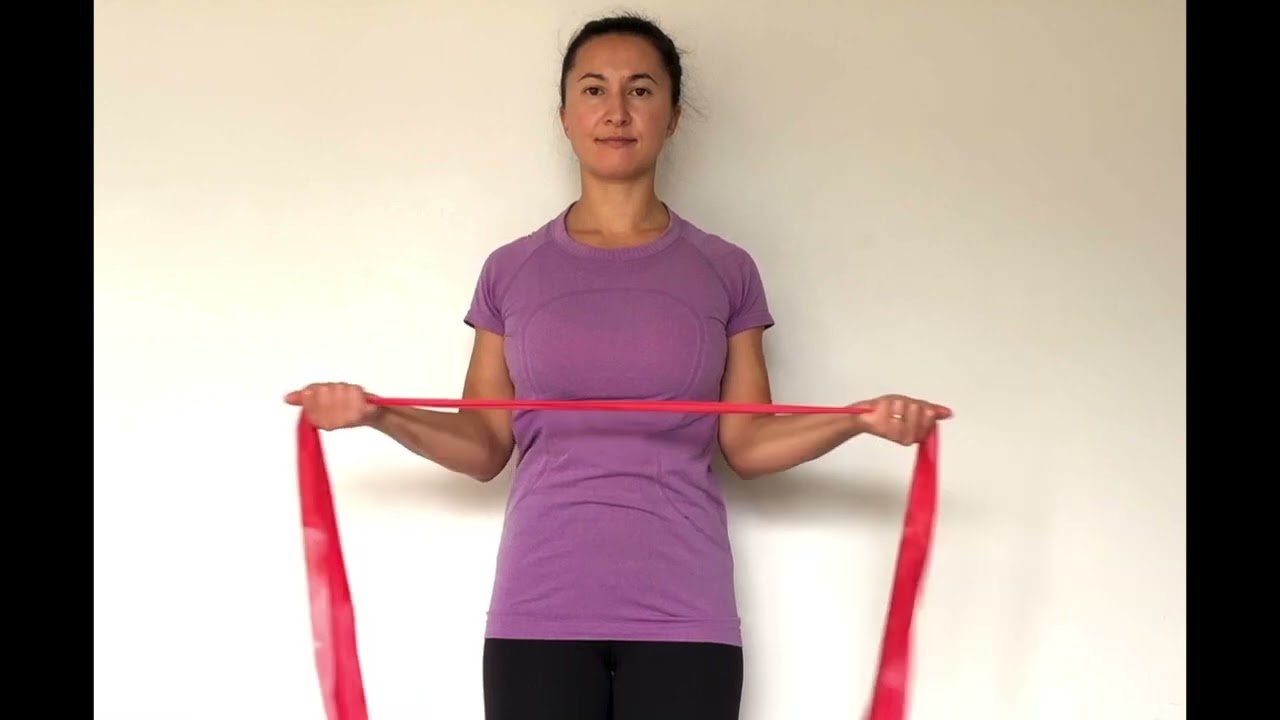
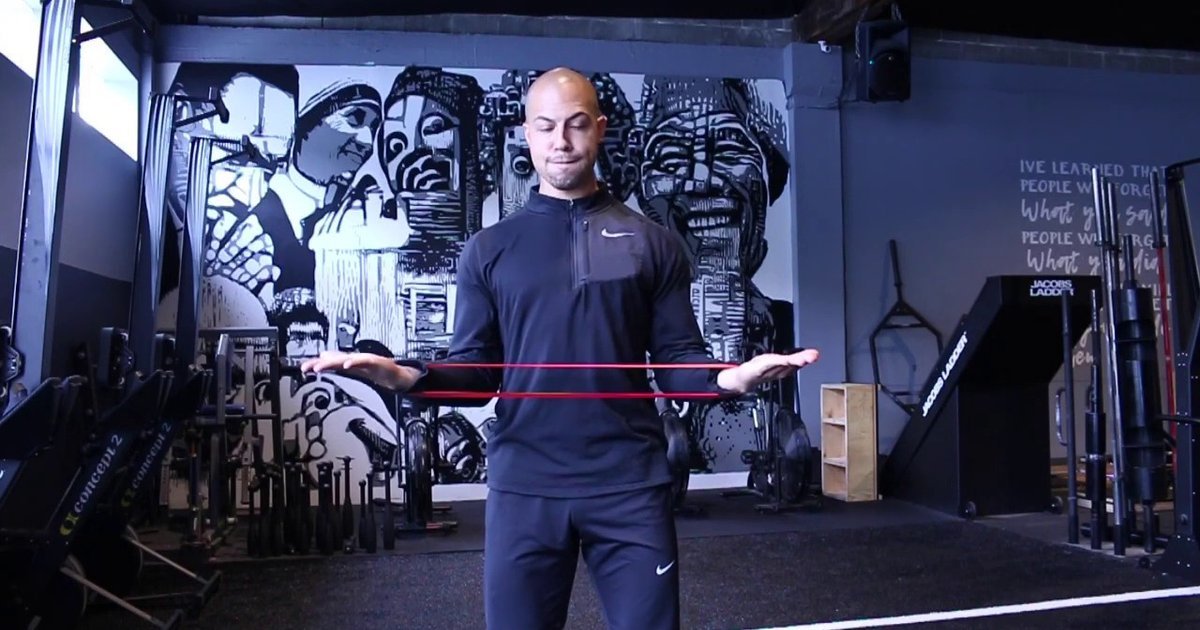
Choose a light resistance band that you can hold comfortably with both palms facing up. Inspect it for tears, worn areas or damaged connections before stretching it, and follow its maker's handling instructions. Keep the band away from your face and clear of sharp edges. The basic bilateral drill needs no external anchor: your hands hold the band between them.
Bend both elbows to about a right angle and bring the upper arms gently alongside your torso. Set your hands far enough apart that the band has a little tension without forcing the shoulders into an awkward starting position. Your forearms point forward, your wrists remain steady and your stance feels balanced. Avoid crushing the elbows into your ribs so hard that the position becomes uncomfortable.
Band color is useful for identifying your own equipment, but it is not a universal unit of resistance. Different makes, lengths and starting stretches can feel different even when the bands share a color. Record the actual band and your grip spacing if you intend to compare sessions. Shortening the working length changes the challenge, so count that as a setup change rather than free progress.
Begin with several unhurried practice repetitions. If the band pulls you out of position immediately, use less resistance or a more forgiving starting stretch. There is no prize for choosing the thickest band. The initial test is whether you can keep the setup recognizable while the upper arms rotate, not whether you can move your hands a dramatic distance.
Keep the elbows steady as the hands separate
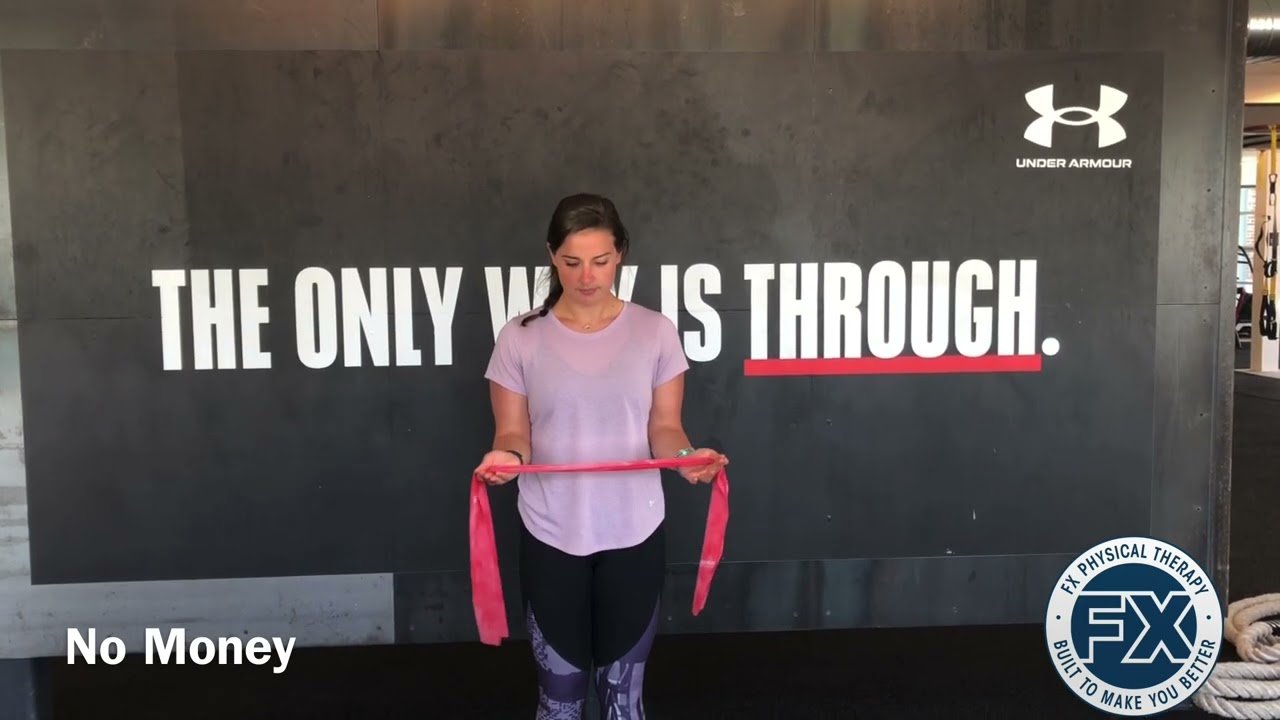
Start the outward movement at the shoulders. Let the forearms rotate apart while the elbows remain beside the torso and the elbow bend stays broadly consistent. Keep the hands supported by steady wrists instead of twisting the palms to create extra travel. Your shoulders can move naturally, but the movement should not turn into a large shrug or a forceful chest thrust.
Stop the outward phase when you reach a comfortable position you can control. You do not have to bring the hands level with your sides, and two people need not finish at the same angle. Once further hand travel requires the elbows to drift or the trunk to lean, you have reached the end of the repetition you intended to perform.
A brief pause can make the finishing position easier to assess. Then return slowly, keeping enough control that the band does not snap the hands together. Maintain the same elbow bend through the return. Think about managing both directions: pulling outward is only half the repetition, and an uncontrolled return makes successive reps harder to compare.
Use a mirror or a short front-view recording to check elbow position, shoulder height and wrist movement. A side view can reveal a backward lean that is less obvious from the front. Film a manageable set, then choose one correction for the next attempt. Trying to change your stance, grip, range and tempo simultaneously usually makes the next comparison less clear.
Recognize when a small drill becomes a different exercise
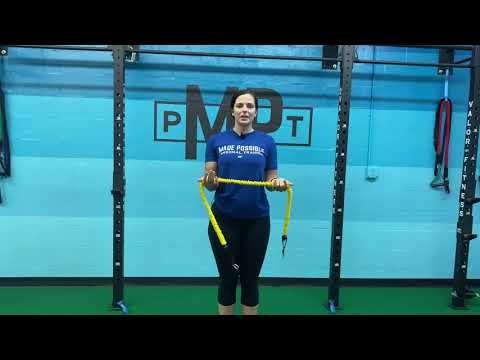
The first common change is elbow flare. As the elbows move away from the ribs, the arms enter a different position and the hands may travel farther. That is not automatically a better no-money repetition. Return to the intended setup, reduce the resistance if needed and stop the outward phase earlier. Do not let the band dictate a movement you were not trying to train.
The second change is using the torso to finish. An arched lower back, lifted rib cage or forward-moving head can make the band appear to open farther while the shoulders contribute less of the extra distance. Stand comfortably rather than rigidly, then keep the trunk reasonably consistent. A lighter band can make that distinction easier to feel and see.
The third change is confusing this drill with a straight-arm pull-apart. In the no-money drill the elbows stay bent near the sides; a pull-apart generally holds the arms farther in front and uses a different movement pattern. Both can belong in training, but their repetition counts and band settings should be logged separately. An exercise name is less useful than a clear description of what actually moved.
If you feel joint pain, stop rather than stretching harder to prove that the drill is working. Persistent symptoms or a current shoulder injury need an individual assessment, not an online warm-up experiment. For ordinary training, the standard is a comfortable, controlled movement. A burning sensation or a larger band stretch does not establish better shoulder function or guarantee protection during your next press.
Compare anchored bands, cables and dumbbells carefully
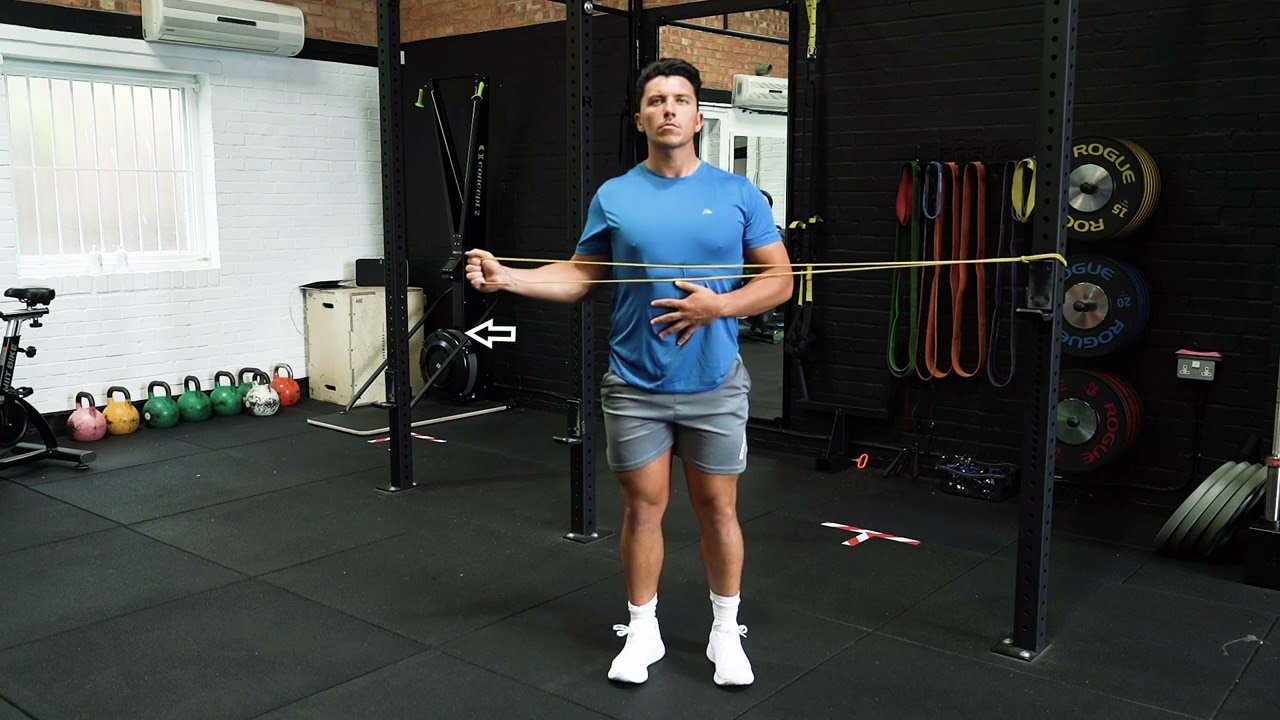
An anchored one-arm band rotation changes the arrangement. Instead of the other hand providing the opposing side of the band, an external anchor supplies resistance. Check the anchor's suitability and security, keep the working elbow beside the body and position yourself so the line of pull matches the intended rotation. The anchored example is a comparison, not the bilateral no-money drill.
A cable version uses a pulley and a suitable single-hand attachment. It can make loading easier to document, but its starting resistance may be too high for a small controlled rotation. Choose the lowest manageable setting and an attachment you can hold comfortably. A cable machine is optional equipment for a different version; it is not required to perform the original band drill.
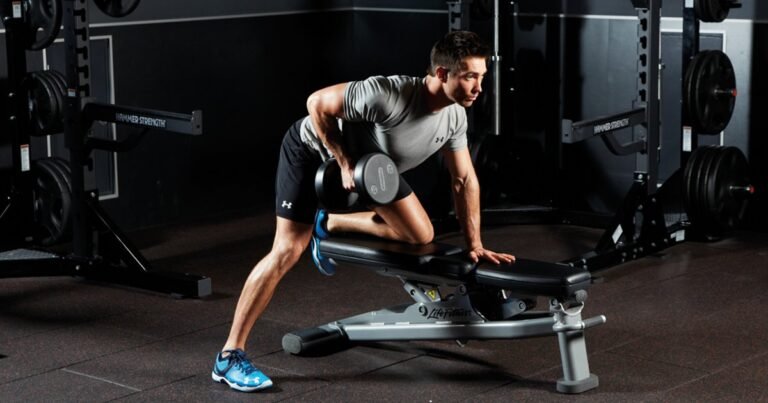
A light dumbbell can also train external rotation in an appropriate side-lying setup on a firm surface or stable bench. Gravity acts downward, so simply holding dumbbells while standing in the no-money position does not reproduce the band's sideways resistance. Body position determines what the weight resists. Learn the side-lying version separately and avoid rolling the torso backward to lift the dumbbell.
Choose equipment for the setup you will actually use. Ordinary or adjustable dumbbells, a stable bench, suitable cable handles and a cable unit support those alternatives, while a simple light band covers the basic drill. Check clearances, starting load and handling before comparing performance. Do not buy a large machine to solve a drill that already works comfortably with the equipment you have.

Equipment Worth Exploring
Explore equipment, accessories and gear from our carefully selected range.


Rubber Hex Dumbbells
Rubber-coated hex dumbbell pairs with a stable shape for home and commercial strength training.


FID Bench MAX
Adjustable bench offering flat, incline, and decline positions + adjustable headrest.


Multi Bench MBX-650 2.0
Adjustable multi-bench with roller adjustment, 15 backrest positions and accessory mounts.


GymPin Ergo Handles
Pair of ergonomic cable handles shaped for comfortable triceps and pulling exercises.
Make the drill serve the session
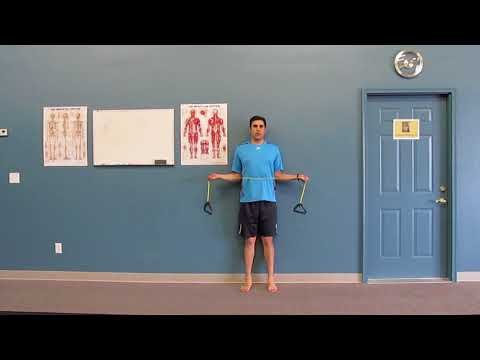
Decide whether this is practice, warm-up work or a separate accessory. Those purposes do not require the same amount of fatigue. Before bench presses or shoulder presses, keep the drill modest enough that you can still perform the planned warm-up and working sets comfortably. Completing more band repetitions is not automatically useful if it disrupts the training that follows.
As an illustrative learning session, try one or two light sets of around ten to fifteen controlled repetitions, leaving capacity to repeat the same movement. These are starting examples, not a uniquely proven no-money prescription. Pause briefly at the outward position if it helps you check control, and rest enough to reset your setup. Follow individual professional instructions instead if the exercise is part of a rehabilitation plan.
For example, write down that the last few repetitions involved elbow drift instead of quietly counting them as equivalent to the first few. At the next session, repeat the lighter setup and see whether all repetitions meet the same standard. That gives you a specific task to improve without changing your main lifting program or interpreting every sensation as a sign that more resistance is needed.
Record the band, grip spacing, set count and repetitions. Add a short note about range, elbow drift or any setup adjustment. Keep those details consistent across several sessions before changing resistance. If you want to progress, alter one variable at a time: first improve repeatability, then consider a few more clean repetitions or a small resistance increase without sacrificing the established position.
Review the drill by asking concrete questions. Can you keep the elbows near the torso? Does the return remain controlled? Is the position comfortable, and does the drill fit the available training time? Those answers are more useful than a claim that one band movement fixes posture or makes the shoulder injury-proof. Keep it when it serves a clear purpose; adjust the setup or choose another suitable exercise when it does not.

Funny Gym Shirts & Workout Gear
Funny gym shirts, tanks, hoodies and workout gear for lifters who like training hard.

Vive Le Resistance Bands – Resistance Bands Warmup Reha T-Shirt
Rep “Vive Le Resistance Bands” humor in and out of the gym.

Vive La Resistance Bands – Resistance Bands Warmup Mobi T-Shirt
Add a playful “Vive La Resistance Bands” touch to your casual rotation.

Vive La Resistance Bands Painting Meme – Resistance Ban T-Shirt
Rep “Vive La Resistance Bands” humor in and out of the gym.


Control Your Gains Stoic Greek God Marble Sculpture T-Shirt
Make gym days more fun with “Control Your Gains Stoic Greek God Marble” style.

Routine Stoic – Greek God Marble Sculpture Shirt & T-Shirt
Show some lifting attitude with a playful “Routine Stoic Bodybuilding” tee.

Mind Muscle Perfection Brain and Biceps Gym for Science Tank Top
Bring “Mind Muscle Perfection Brain and Biceps” humor to your next lifting session.

Shoulder Press Dost Thou Even Press Medieval Knight Gym Sticker
Give your everyday gear a playful “Shoulder Press” twist.

One More Rep Shirt: Motivational & T-Shirt
Make gym days more fun with “One More Rep” style.

Shirt – Broscience – Meme & Gymbros T-Shirt
Make gym days more fun with “Broscience” style.