Advertising disclosure: This page includes affiliate product links that may earn us a commission, as well as products from our own store.
Turning a dumbbell from palm-up to palm-down is a different job from curling it towards your shoulder. Forearm rotation asks you to control the direction of the hand while keeping the elbow, upper arm and wrist position reasonably steady. A small change in where you hold the weight can make it feel surprisingly different. For lifters adding this to an arm session, the useful starting point is a supported elbow, a manageable implement and a clear definition of one repetition. Learn those details before treating a heavier dumbbell as progress.
Support the elbow and leave the hand clear
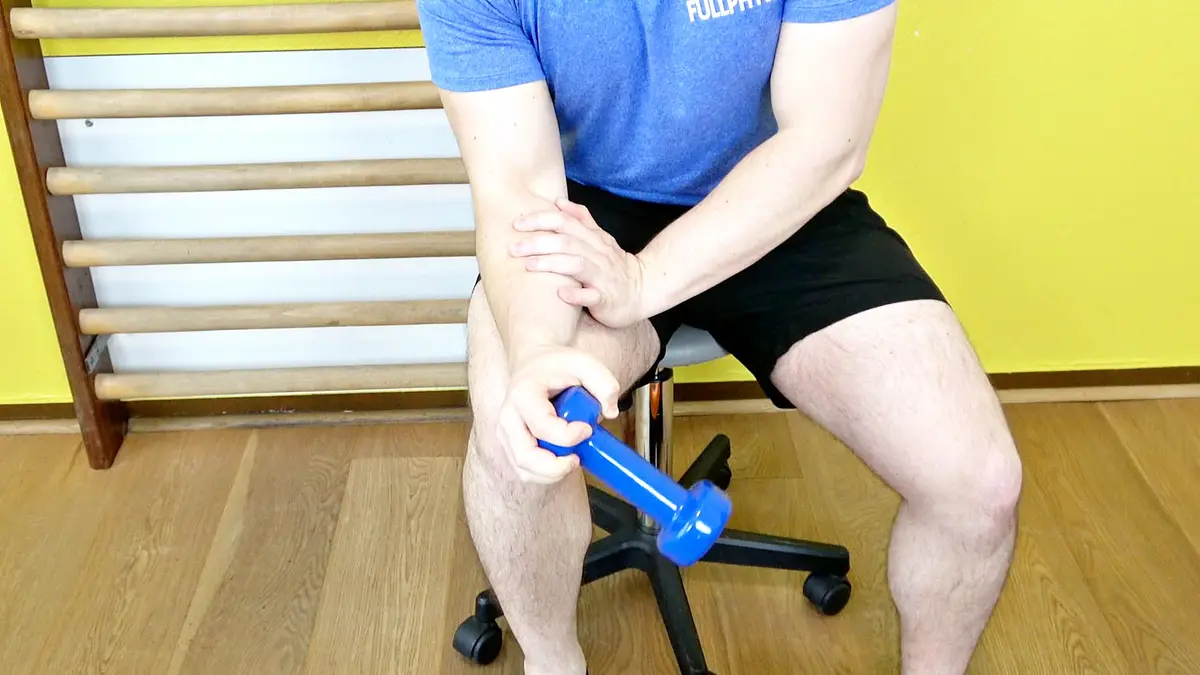
Sit beside a stable bench or table, or use your thigh as support. Bend the elbow to roughly a right angle and settle the forearm so the hand can move beyond the edge. Check that the dumbbell has room to turn without striking the pad, your knee or a neighbouring weight. A cramped position encourages you to lift the elbow simply to finish the movement.
Begin with the thumb pointing upwards, like a handshake. Keep the hand broadly in line with the forearm rather than bending the wrist sharply forwards or backwards. Hold the implement securely and let the shoulder stay comfortable. The support should help you notice whether you are rotating the forearm or moving the entire arm around the weight.
Try the movement without a weight first. Turn the palm towards the ceiling, return through thumb-up and turn it towards the floor. Notice the comfortable limits on each side. Do not force the hand to match an imagined textbook angle, especially when one direction feels less familiar. The purpose of this rehearsal is to understand the movement before an external load starts pulling it around.
Choose a support height that lets you sit normally. If you need to shrug, lean far forwards or reach across your body to use a particular bench, change the arrangement. One arm at a time is often easier to organise while learning. It also lets the free hand help position the implement before you begin the set.
Rotate the forearm without adding a wrist curl
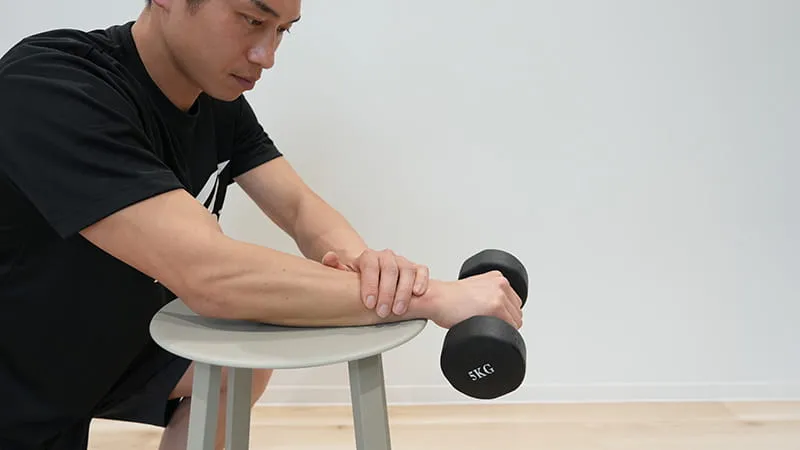
Supination turns the palm upwards; pronation turns it downwards. During supported forearm rotation, the elbow bend stays approximately the same while the palm changes direction. That distinction matters because a dumbbell can also move when you bend the wrist, flare the elbow or roll the shoulder. Those are different movements, even when the weight ends up in a similar place.
Move slowly enough that the hand does not flop into the end position. Briefly settle, then reverse under control. You do not need to hold an extreme position or squeeze harder and harder to make every repetition feel dramatic. Keep a firm, repeatable grip and enough control to stop the turn before the implement pulls you beyond the range you intended.
Watch the elbow and the back of the hand during a light trial. If the elbow leaves the pad, shorten the movement or reduce the load. If the knuckles fold markedly towards the forearm, reset the wrist before continuing. A small amount of natural movement is normal; the useful question is whether the intended forearm turn still explains most of what the dumbbell is doing.
A short recording from in front can show the elbow drifting sideways as fatigue builds. Use that as a practical comparison between early and late repetitions, not a diagnosis of a weak muscle or a structural problem. Stop a set when the movement changes substantially instead of inventing extra clean reps from the final few swings.
Treat grip position as part of the load
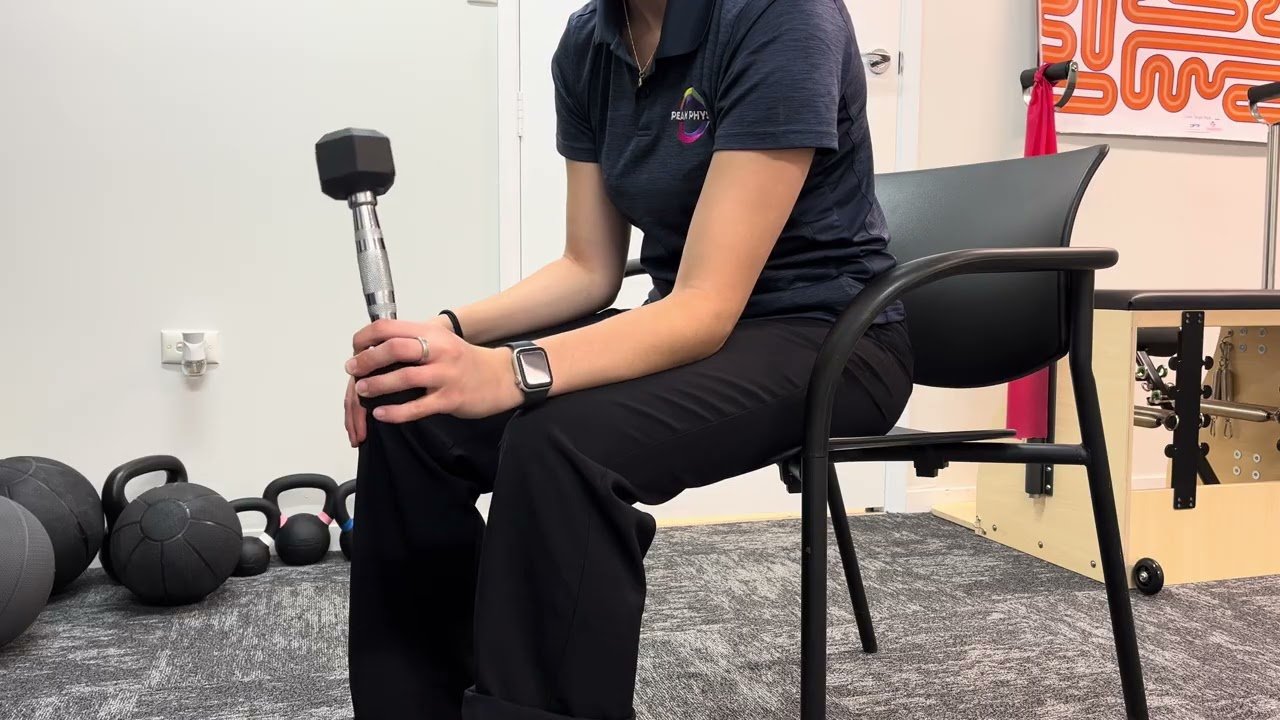
The number printed on a dumbbell does not describe the entire challenge. Gravity acts on the implement, and the distance of its mass from the rotation axis affects how much turning demand you must control. Moving your hand towards one end can create a longer lever than holding the same implement near its middle. That is why a modest weight can feel demanding in an offset grip.
The demand also changes as the implement turns. A weight held upright does not pull the same way as one angled towards horizontal. Avoid assuming that a balanced dumbbell, an offset dumbbell and a hammer provide identical resistance simply because they weigh the same. Compare progress within a consistent arrangement before trying to rank one implement against another.
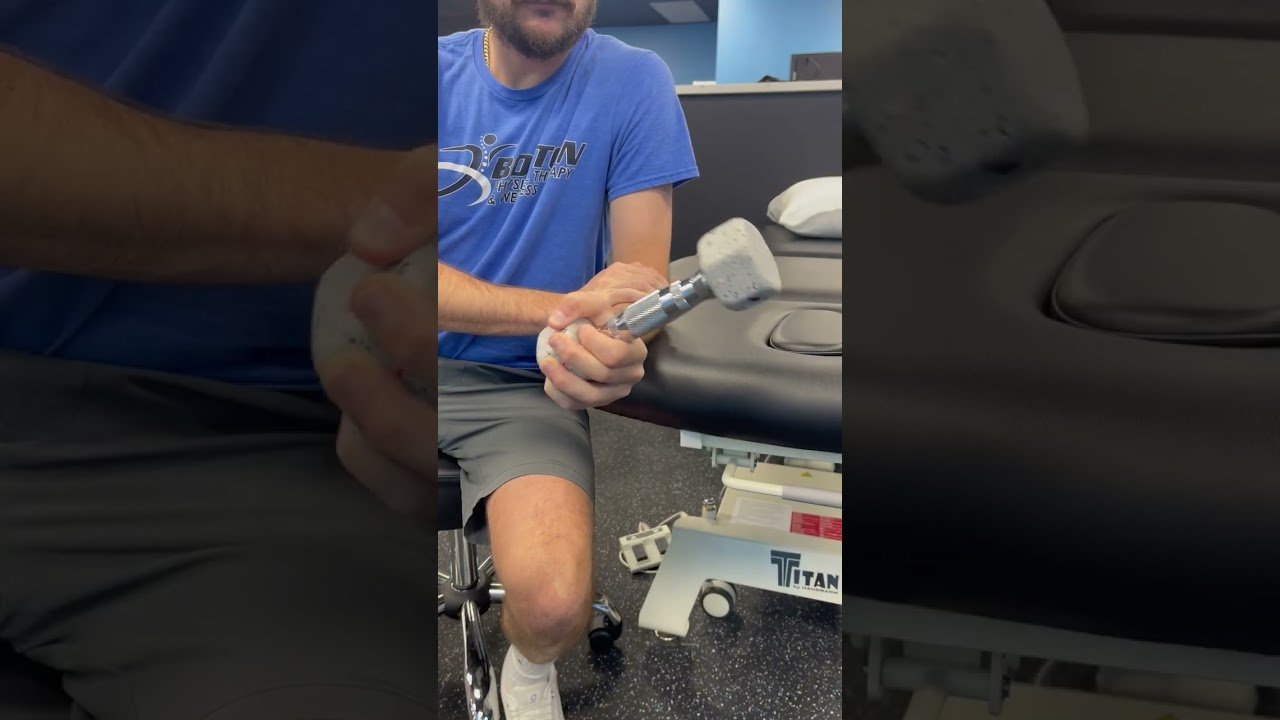
Start conservatively and choose an implement you can hold securely. If you use a handle loaded with removable plates, secure every component according to the manufacturer's instructions before lifting it. Do not improvise an unbalanced assembly with unsecured plates. A small fixed dumbbell is usually easier to organise than a complicated setup assembled just to make the drill look harder.
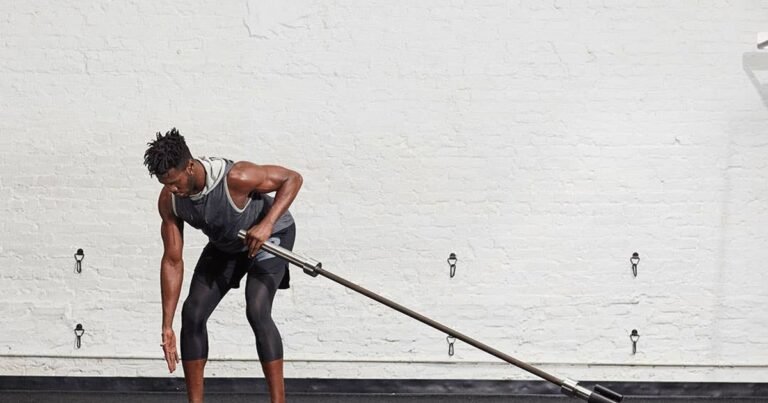
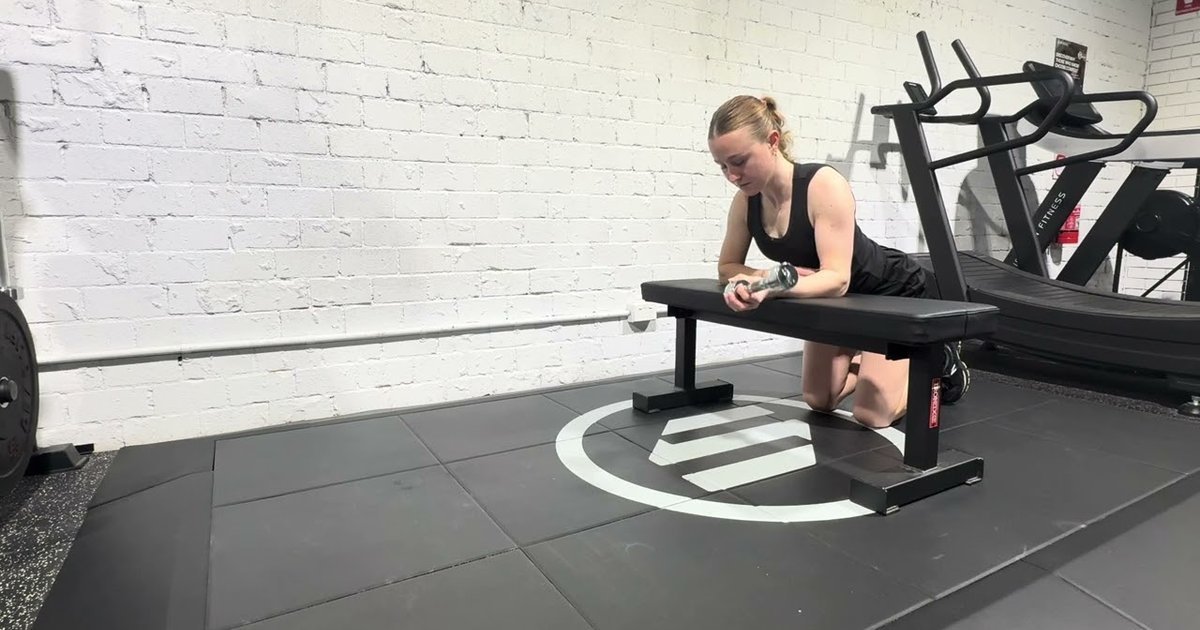
Photographs show different ways people support the arm and hold a weight; a visible weight label is not a starting-load prescription. Select your own manageable resistance. If even the lightest available dumbbell makes you lose control, practise without it or choose another suitable lighter implement rather than forcing the gym's smallest available number.
Separate forearm rotation from other arm work
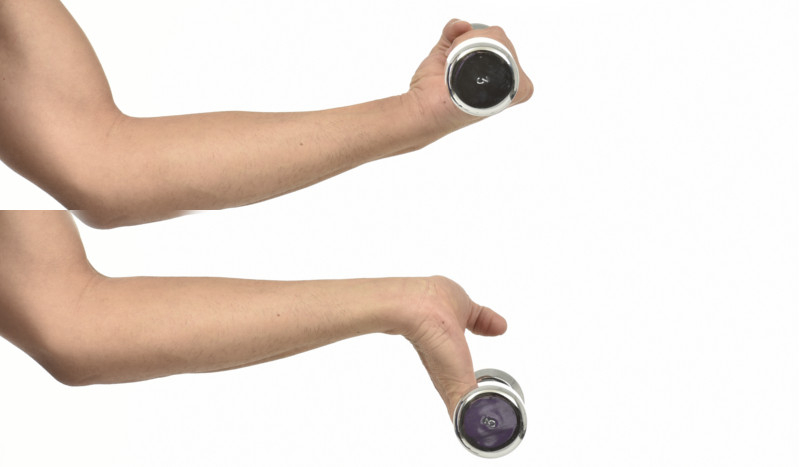
A supported seated version gives you clear feedback about elbow position. Supporting the forearm on the thigh can be convenient when there is no table nearby, although it may leave less clearance. A bench lets you adjust the support arrangement, but it does not automatically make the exercise more effective. Pick the version you can repeat comfortably and keep it consistent long enough to learn it.
A hammer or another appropriately designed lever can change the loading pattern, so treat it as a separate variation. Begin close to the weighted end and with a manageable range rather than jumping straight to a long lever. Keep the surrounding space clear. Do not turn a controlled forearm exercise into a test of how far a tool can swing past the knee.
Forearm rotation also differs from wrist curls, reverse wrist curls, hammer curls and carrying dumbbells. Wrist curls involve bending at the wrist; hammer curls involve bending at the elbow; carries ask you to keep holding a load. They can fit within broader arm or grip training, but performing one does not mean you have performed all the others. Choose exercises according to the task you actually want to practise.
If you are comparing equipment, prioritise a usable light resistance, secure components and enough support clearance. Fixed or adjustable dumbbells and stable benches are possible options. Plates and collars matter only for compatible equipment that actually uses them. A large rack of heavy weights is unnecessary for this drill, and buying more equipment is not a substitute for finding a controlled starting setup.

Equipment Worth Exploring
Explore equipment, accessories and gear from our carefully selected range.


Rubber Hex Dumbbells
Rubber-coated hex dumbbell pairs with a stable shape for home and commercial strength training.




FID Bench MAX
Adjustable bench offering flat, incline, and decline positions + adjustable headrest.


Multi Bench MBX-650 2.0
Adjustable multi-bench with roller adjustment, 15 backrest positions and accessory mounts.

Log the setup before adding harder sets
As a simple learning example, try one or two light sets of eight to twelve comfortable turns per side. Define one repetition as palm-up to palm-down and back, or record the two directions separately. Either method can work for a training log; switching definitions halfway through a programme makes the numbers misleading. These are example starting quantities, not a tested optimum for every lifter.
Write down the implement, its weight, the support used and where your hand sits on the handle. Add a note about the range you could control without the elbow lifting. For example, twelve turns with a centred grip are not directly comparable to twelve turns with your hand near one end. Recording that change avoids mistaking a new leverage problem for a sudden loss of strength.
Progress one variable at a time. You might first make the same range smoother, then add a few repetitions, then make a small resistance change. Moving the grip, extending the range and adding weight together makes it difficult to identify which change was manageable. A larger implement may also need a fresh clearance check even if its weight increase looks small.
Place this work where it does not spoil your main lifting. If hard forearm work leaves you struggling to hold the next rowing set, use fewer sets or move it later. Rotation practice does not guarantee larger arms, better deadlifts or freedom from elbow problems. Its value here is specific: learning to turn and control a manageable load with a repeatable arm position. Stop if the exercise causes pain rather than turning that session into an attempt to treat an injury.

Funny Gym Shirts & Workout Gear
Funny gym shirts, tanks, hoodies and workout gear for lifters who like training hard.

Grip Training Get A Grip Hoodie
Show off your lifting humor in a laid-back “Grip Training” hoodie.

Focus Stoic Bodybuilder Greek God Marble Sculpture T-Shirt
Heavy lifts, good laughs, and a little “Focus Stoic Bodybuilder Greek God Marble” energy.


Every Day Is Arm Day
Make gym days more fun with “Every Day is Arm Day Octopus Gym Meme” style.

Control Your Gains & Your Mind Stoic Sigma T-Shirt
Bring “Control Your Gains & Your Mind Stoic Sigma” humor to your next gym day.

One More Rep Shirt: Motivational & T-Shirt
Make gym days more fun with “One More Rep” style.


Mind Muscle Perfection Brain and Biceps Gym for Science Tank Top
Bring “Mind Muscle Perfection Brain and Biceps” humor to your next lifting session.