Advertising disclosure: This page includes affiliate product links that may earn us a commission, as well as products from our own store.
A batwing row can mean a chest-supported row with a deliberate squeeze, a timed hold with both arms, or a set in which one arm stays raised while the other rows. Those versions share equipment, but they are different tasks. If you record only the dumbbell weight and a repetition count, you can miss the part that made the set difficult. Choose the version first, then make its support position, range and hold standard clear. That turns a demanding back exercise into something you can practice and progress without guessing.
Build a supported setup with room for the weights
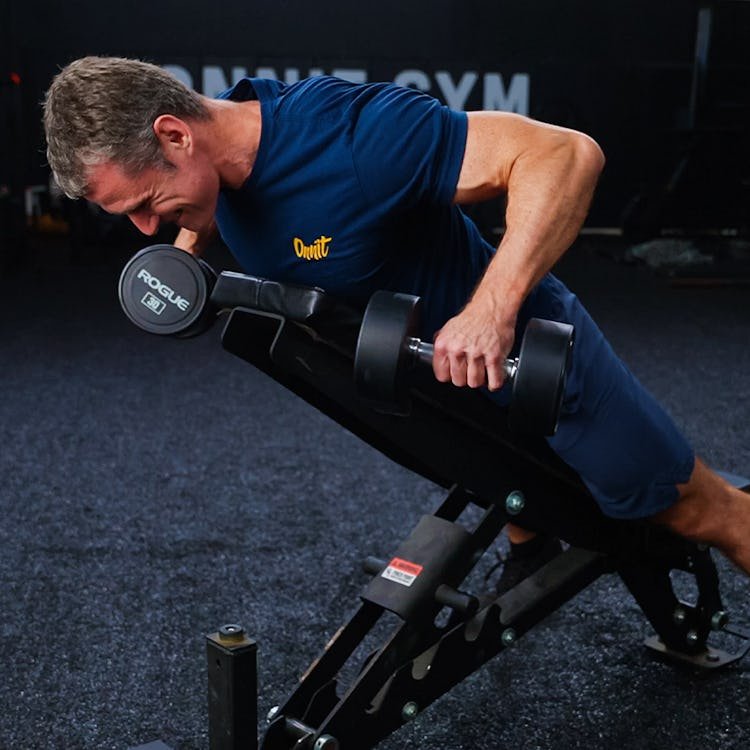
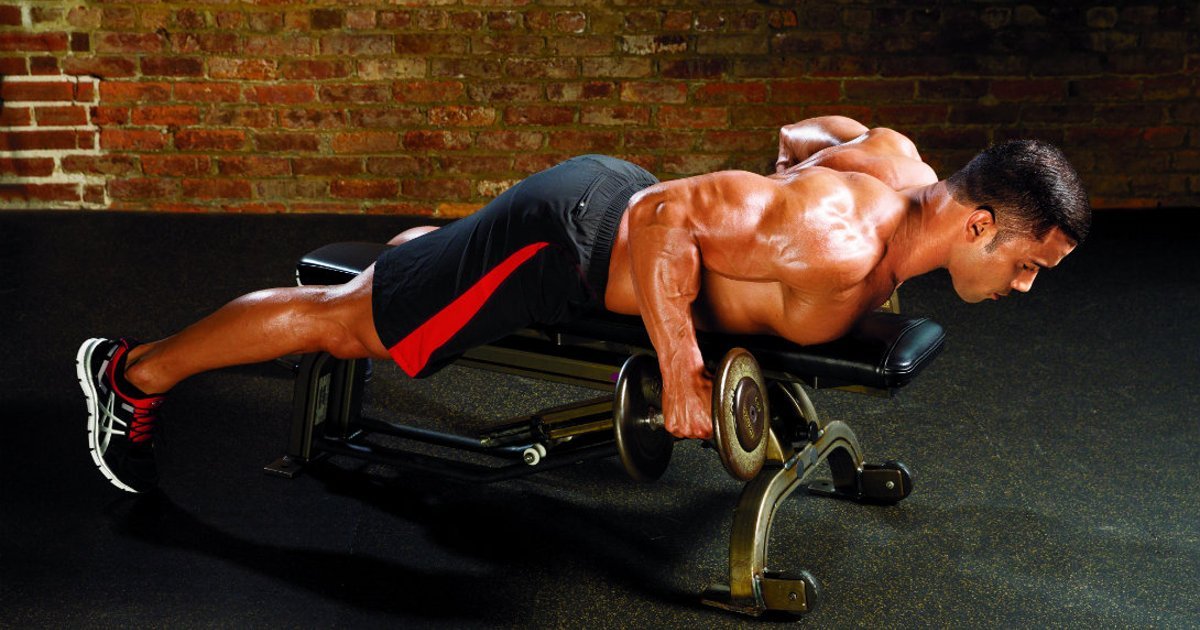
Use a stable bench and a pair of manageable dumbbells. Set the backrest so you can lie chest down, reach the weights and move them without hitting the floor or bench frame. A moderate incline is a practical starting option. A flat bench can also work when the equipment provides enough clearance, but an ordinary low bench may leave long arms or large dumbbells with nowhere to go.
Check the adjustment pin and the bench's footing before you lie down. Place the dumbbells where you can collect and return them safely. Keep your chest supported, position your feet to steady yourself, and leave the neck in a comfortable line with the torso. You should not need to crane your head to watch the weights. A light test set should feel organized before it feels strenuous.
Do not solve a clearance problem by balancing a bench on loose plates or other improvised supports. Change the bench angle, use smaller dumbbells or choose an appropriate purpose-built station. The goal is a dependable platform, not the flattest possible torso angle. If the bench presses uncomfortably against your ribs or prevents a normal breath, adjust the position rather than forcing the set.
Write down the bench setting and the equipment you used. For example, 'third backrest notch, small hex dumbbells, feet on the same floor seam' is more useful than 'incline row.' A different dumbbell shape can change clearance even at the same stated weight. Keep those details familiar when you compare one session with the next.
Learn the held contraction before extending the set
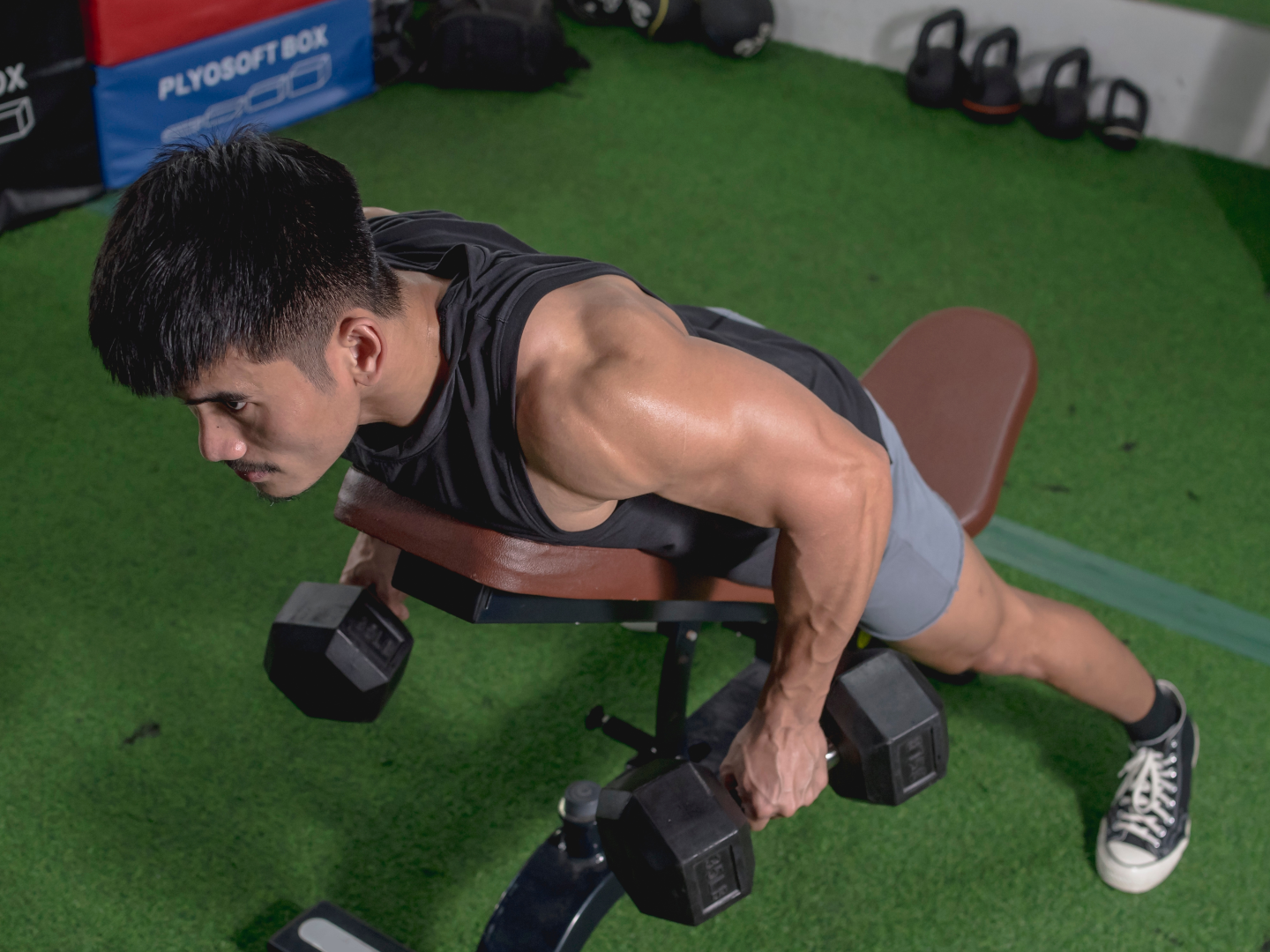
With the chest supported, begin with the weights hanging under control. Row them toward your torso, bending the elbows and allowing the shoulder blades to move with the pull. Find a comfortable top position you can hold without lifting your chest off the pad. A neutral grip is a straightforward starting choice; the handle orientation does not need to become another progression variable immediately.
For a bilateral hold, both arms stay raised together. Start the clock only after you have reached the intended position, and stop it when that position clearly changes. If the dumbbells gradually sink while you keep counting, the final seconds are a different task. Lower the weights under control and reset before the next effort instead of bouncing straight into another hold.
An illustrative first practice might use three short holds of five seconds, with an easy load and enough rest to reproduce the position. That is a teaching example, not an established optimum. Choose a duration you can complete cleanly. You can learn more from a short hold that looks the same throughout than from a long effort that becomes a shrug, a neck extension or a bench-assisted heave.
A side or rear video can help establish your reference. Notice the elbow height, the distance between the shoulders and ears, and whether the chest stays in contact with the bench. You do not need to chase the highest possible elbow position. The useful endpoint is one you can reach comfortably, hold deliberately and recognize again next time.
Treat the alternating version as a separate exercise
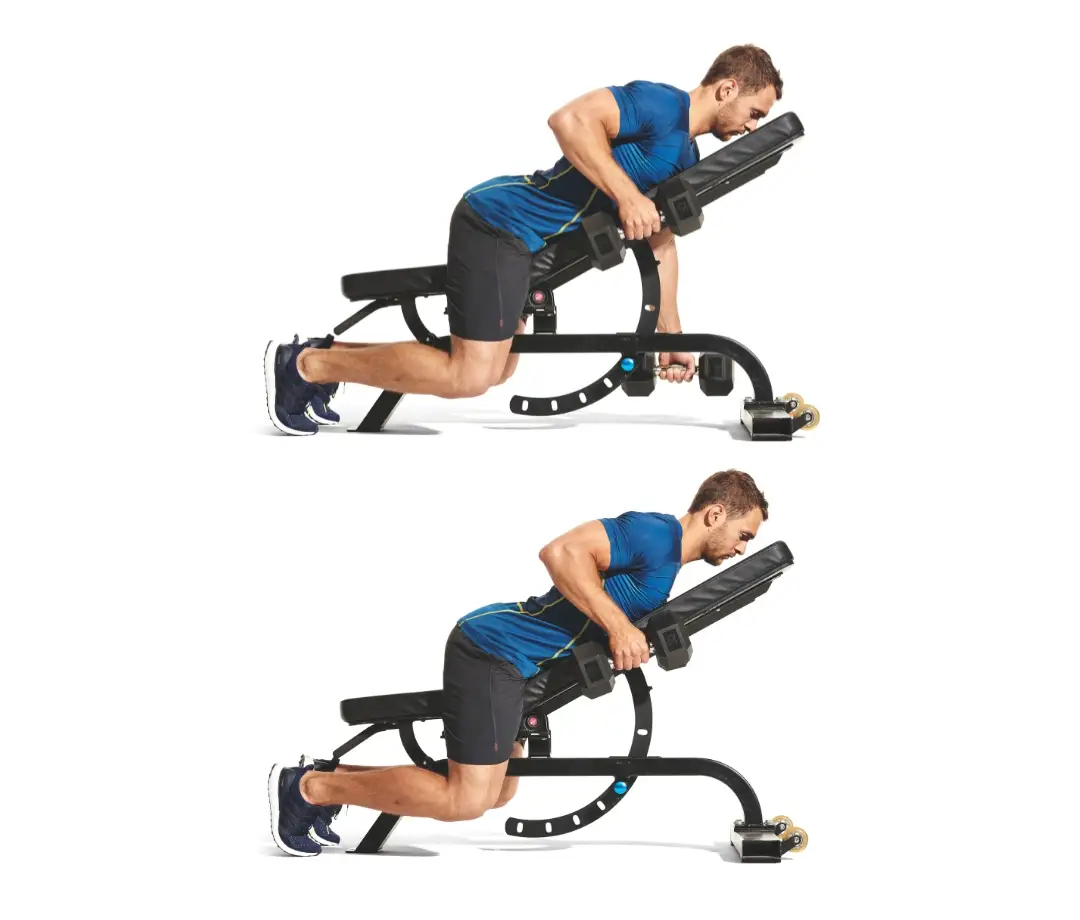
In an alternating batwing set, bring both dumbbells to your chosen top position. Keep one arm there while the other lowers and rows for a small number of controlled repetitions. Then exchange roles: hold the second arm up while the first performs its repetitions. The working arm moves through its range, while the other side has to maintain the hold for as long as that block takes.
This means repetition speed changes the demand on the holding side. Five quick rows and five slow rows do not create the same hold duration. Choose a manageable cadence and keep the blocks reasonably similar. If the stationary dumbbell starts dropping after the third row, shorten the block or reduce the load rather than pretending that the arm is still meeting the original standard.
Label the count clearly. For example, 'four rows per side, opposite arm held, two blocks per side' tells you what happened. An entry saying '16 reps' leaves several questions unanswered: was that total or per arm, did each side hold for the same period, and did you alternate after every rep or after a group? Decide on those details before the set begins.
Start with the side that finds the task harder, then use comparable work on the other side. This is a practical way to keep the prescription organized, not a diagnosis of an imbalance. If one side consistently loses position much earlier, make the task easier and check the setup. Avoid adding extra twisting or chest lift just to make both sides finish a written target.
Keep the row, the pause and the exercise comparison honest
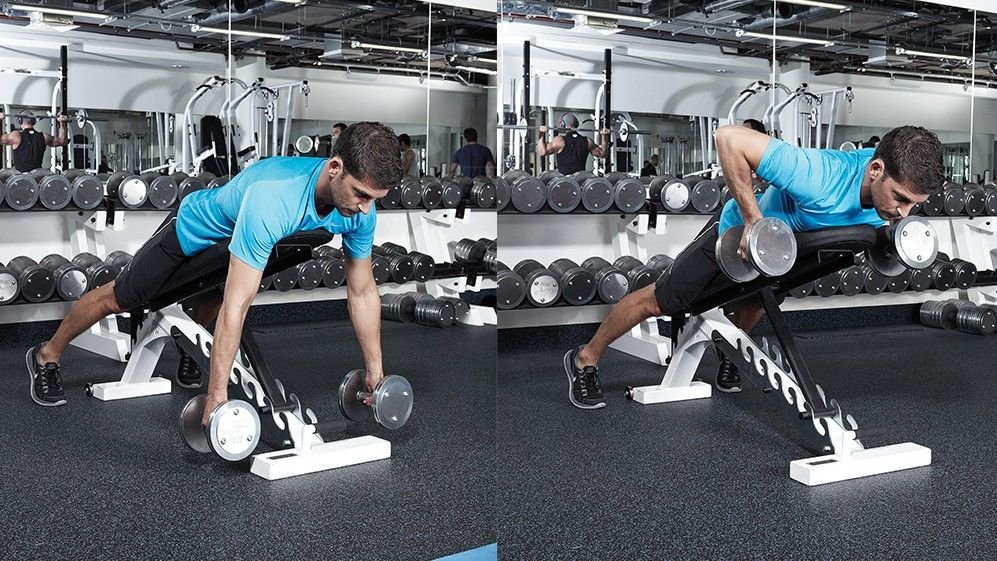
A conventional chest-supported dumbbell row involves repeated lowering and lifting, perhaps with a brief pause at the top. A bilateral batwing hold emphasizes maintaining one position. The alternating version combines moving repetitions with a longer hold on the opposite side. None of those labels establishes that one version grows more muscle than the others. They describe how you organize the work.
The supported position reduces the need to maintain a standing hip hinge, but it does not make every repetition automatic. You can still swing the dumbbells, lift off the pad, rush the descent or shorten the pull. If the bench support is doing its job, you should be able to focus on the intended arm and shoulder-blade movement without turning the exercise into a whole-body bounce.
A strong local effort is useful feedback, but it does not prove you have isolated a single small muscle. Rowing involves several upper-back muscles and elbow flexors, with grip contributing too. A batwing variation can be one way to practice a deliberate finish. It should not be sold as a guaranteed correction for posture, a cure for shoulder pain or a shortcut to an unusually wide back.
Other rowing tools remain valid choices. A suitably adjusted chest-supported machine or a landmine row provides a different loading arrangement; they are alternatives, not identical replacements in your log. If you change the implement, start a separate reference. Likewise, lifting straps can change what limits a set. If you use them, note it and keep that choice consistent when assessing your performance.

Equipment Worth Exploring
Explore equipment, accessories and gear from our carefully selected range.


Rubber Hex Dumbbells
Rubber-coated hex dumbbell pairs with a stable shape for home and commercial strength training.




FID Bench MAX
Adjustable bench offering flat, incline, and decline positions + adjustable headrest.


Multi Bench MBX-650 2.0
Adjustable multi-bench with roller adjustment, 15 backrest positions and accessory mounts.

Leather Lifting Straps
Padded leather straps support grip during heavy rows, deadlifts and pulling exercises.

Choose one progression and a clear place in the workout
Decide whether batwings are light practice or a demanding accessory. For practice before heavier work, keep the effort low enough that it does not turn the warm-up into a fatiguing back session. For accessory training, place the exercise where you can still control the hold and return the weights safely. A timed hold added after several hard pulling exercises will not necessarily match a fresh-session result.
Use one main progression at a time. For bilateral holds, keep the load fixed while you build toward a chosen duration, then increase the weight modestly and shorten the hold again. For alternating sets, first make a chosen number of rows per side reliable at a consistent speed. Increase either the repetitions or the load next, while keeping the other conditions familiar.
Consider a hypothetical two-week comparison. On the first day you complete three five-second holds at one load. The next session you repeat the setup and manage three six-second holds with the same visible position. That is an interpretable improvement. If you simultaneously steepen the bench, change the dumbbells, add straps and allow lower elbows, the longer time tells you far less.
Count the exercise alongside the rest of your pulling work. A held set still requires effort even though the weights are not moving. Start by replacing a little existing accessory work, or use a small amount of easy practice, rather than automatically stacking hard batwing sets onto an already full back day. Watch how your other rows and recovery respond before adding more.
At the end of the session, record the version, bench setting, load, repetitions or hold time, and the first reason you stopped. Those notes help you choose the next adjustment. If the exercise keeps becoming a contest to tolerate an increasingly messy position, simplify it. A conventional supported row with a clear pause may be easier to repeat and more useful for the purpose you actually chose.

Funny Gym Shirts & Workout Gear
Funny gym shirts, tanks, hoodies and workout gear for lifters who like training hard.

Ultimate Meme Shirt Strong & Gymbros T-Shirt
Show some powerlifting attitude with a playful “Ultimate” tee.

Shirt Pull Day – Back & Biceps Meme Top T-Shirt
Heavy lifts, good laughs, and a little “Pull Day Graphic” energy.

Gym Dost Thou Even Pull Medieval Knight Back Day Crewne T-Shirt
Show some gym-day personality with “Dost Thou Even Pull Medieval Knight Back”.

Dumbbell Heartbeat Decal for Water Bottles Laptops Gym Sticker
Bring “Dumbbell Heartbeat” attitude to your water bottle or laptop.

Live Love Lift Muscle Shirt Athletic Vest Workout Gymbr Tank Top
Add some lifting attitude to training with “Live Love Lift”.

Growth Stoic Sigma – Meme Shirt & Leaders T-Shirt
Heavy lifts, good laughs, and a little “Growth Stoic Sigma Bodybuilding” energy.

Consistency Is Key Stoic Greek God Marble Sculpture T-Shirt
Make gym days more fun with “Consistency is Key Stoic Greek God Marble” style.

The Only Difference Between Good And Great Is One T-Shirt
Bring “The Only Difference Between Good And Great” humor to your next gym day.

Be Stronger Than Your Excuses – Motivational T-Shirt
Rep “Be Stronger Than Your Excuses” humor in and out of the gym.

Be Happy Lift Heavy Happy Weights Emoji Weight Plate Hoodie
Show off your powerlifting humor in a laid-back “Be Happy Lift” hoodie.