Advertising disclosure: This page includes affiliate product links that may earn us a commission, as well as products from our own store.
Adding partial repetitions changes what happens inside a set. Before treating a more demanding finish as a better calf routine, distinguish the number of sets from the work those sets contain. Clear exercise choices, controlled movement and a useful training record make that comparison easier to understand.
Read the result before changing your calf routine
A 2026 trial followed 16 untrained men through ten weeks of unilateral standing calf raises. One leg performed conventional full-range sets to failure; the other used half as many sets, extending them with partial repetitions after full-range failure. Training was twice weekly, and total volume-load was matched. Average measured gastrocnemius thickness increased about 8% in both conditions. The extended sets looked better per set, not better for the overall measured growth. This was a small, specific experiment, not a universal prescription for every lifter or exercise.
The practical question is therefore what you want to change in your own routine. Are you trying to reduce the number of separate sets, improve execution, or simply find an interesting variation? Those goals deserve different decisions. A method can be useful without being uniquely effective, and a demanding set can feel different without proving that your long-term results will be better.
Start by describing your existing calf work clearly. Note the exercise, loading arrangement, range you can control and how the set ends. If those details change from session to session, adding another technique makes the comparison harder to interpret. A consistent conventional routine provides a useful baseline before you experiment with a more complicated set structure.
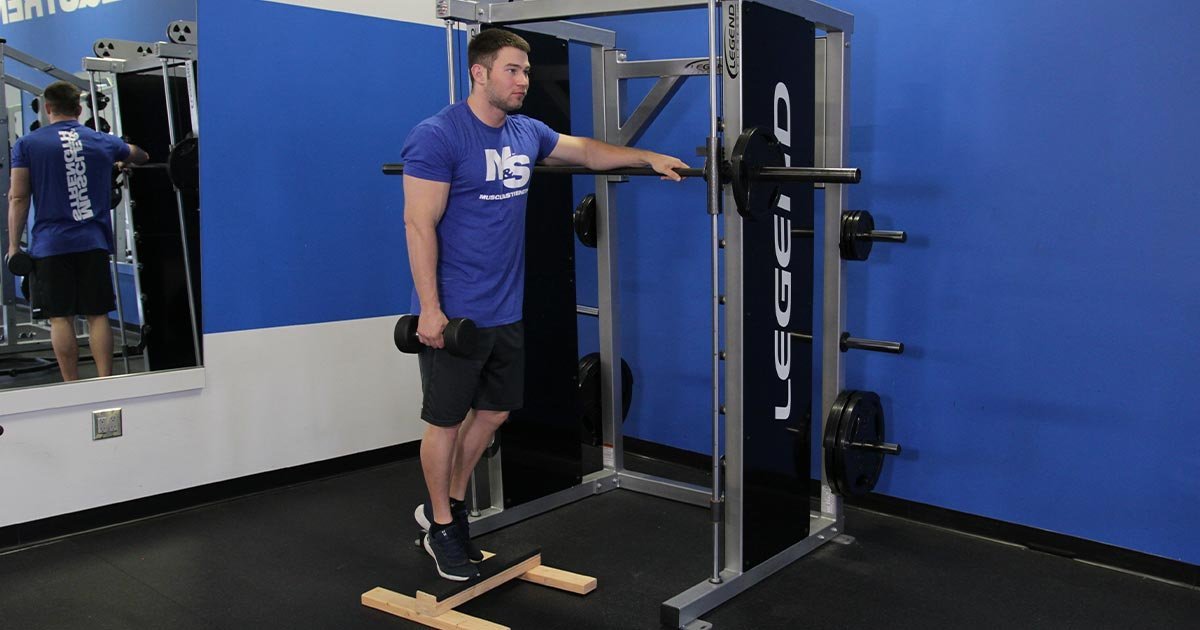
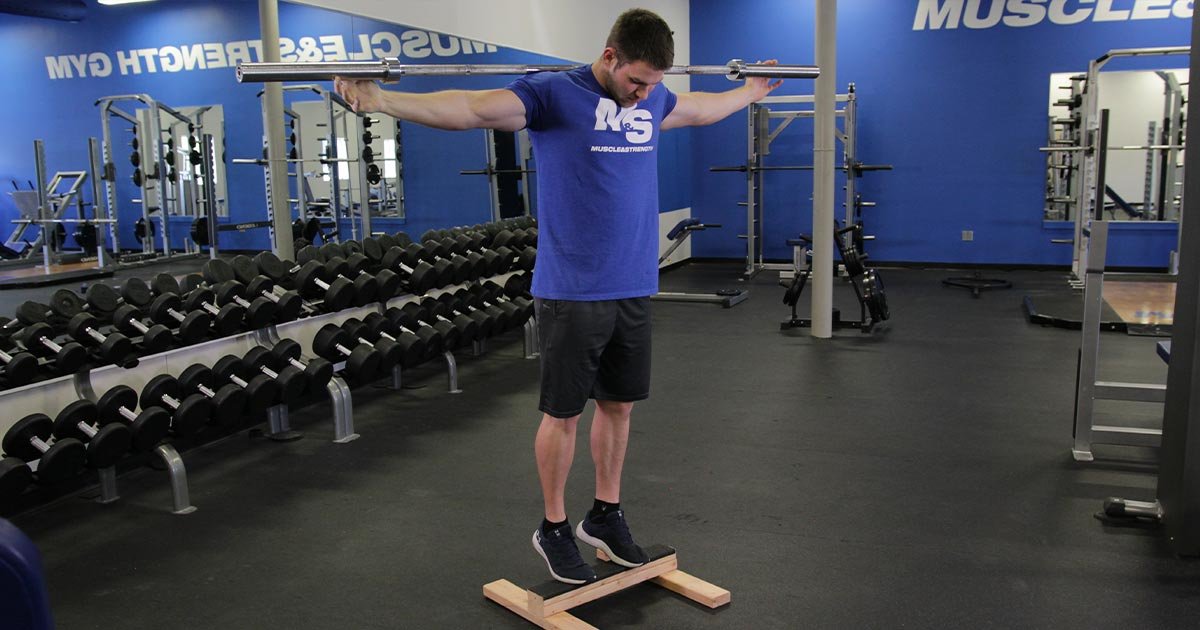
The standing barbell calf-raise photograph illustrates the general ankle movement, not the experimental apparatus or a study participant. A free bar also introduces a balance task. Do not assume that a picture of one version establishes the suitability of another version, particularly when you plan to continue a set while fatigued.
You can take a useful lesson from research without copying its entire protocol. Identify the actual question, the comparison and the outcome first. Then decide whether the idea solves a problem you have. That process is more informative than adopting a technique because a headline describes it as advanced or efficient.
Count the work inside each set
A set is a convenient label, but it is not a fixed quantity of work. Ten controlled repetitions and ten repetitions followed by several additional efforts both occupy one line in a training app if you record only the set count. That makes it easy to mistake a change in packaging for a simple change in dose.
Use a hypothetical example to see the bookkeeping problem. If you perform ten full repetitions followed by eight shorter repetitions, write both numbers down. Do not record the entire sequence as ten reps just because the first part used your usual range. Equally, do not treat all eighteen as identical repetitions when the movement changed partway through.
Volume-load is commonly represented by repetitions multiplied by external load, summed across the work performed. It is useful bookkeeping, but it does not describe every feature of a repetition. Travel distance, support, execution and effort can still differ. Matching one numerical measure does not make two routines mechanically identical in every respect.
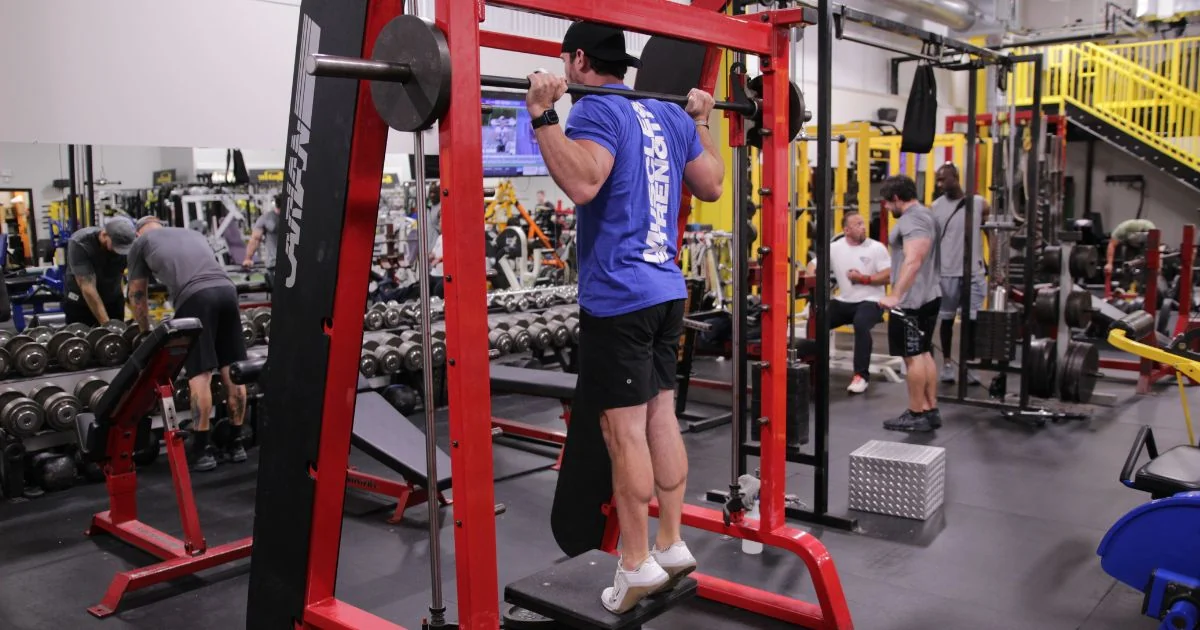
The Smith-machine calf-raise photograph illustrates a different loading arrangement. Record the actual machine and setting if you use one, rather than comparing its displayed load directly with a dumbbell or another machine. A change in equipment can alter the task even when the written weight appears unchanged.
This is why comparisons should state what remained constant. If someone adds more repetitions while keeping the same set count, that is a different experiment from changing set structure while holding an overall measure of work similar. Before deciding what a new routine achieved, check whether you changed the amount of work as well as the way it was organized.
Keep the exercise and the endpoint clear
Full-range and partial-range repetitions need a clear meaning in your log. Choose a controlled movement that fits your available range, then describe any deliberate change. A shorter repetition added intentionally is different from an ordinary repetition that gradually becomes less controlled. Without that distinction, it is difficult to tell whether you followed a plan or simply lost the ability to repeat the movement.
Exercise position also matters. Standing and seated calf raises should not be treated as the same task with a different seat. Separate research comparing the two positions found different gastrocnemius responses. That provides context for keeping the version consistent; it does not prove that every finding from one calf exercise transfers unchanged to the other.
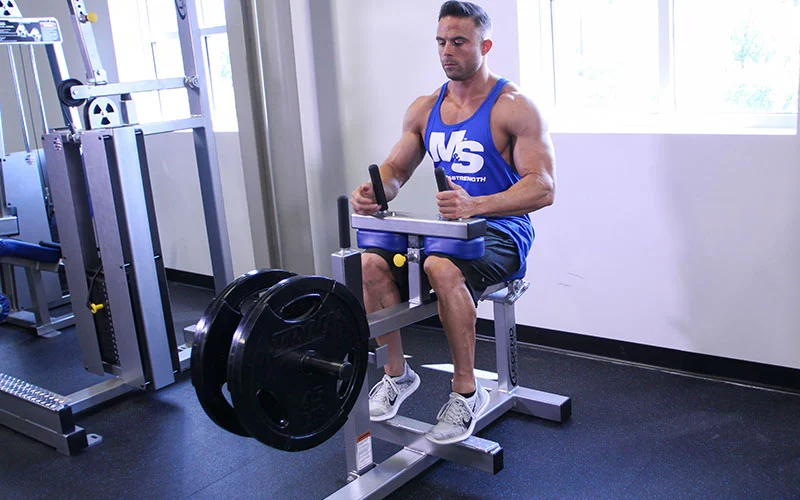
The seated-machine photograph shows a bent-knee arrangement with the load supported above the thighs. It is included to make that distinction visible, not to claim that the main comparison tested this machine. If you use seated work, label it separately from your standing work and track it on its own terms.
Keep the rest of the setup repeatable too. Use the same foot support, the same intended movement and a load you can handle without bouncing or shifting into another exercise. If the support feels unstable or your position changes unexpectedly, stop and resolve that issue. Fatigue is a poor reason to accept a less secure arrangement.
Pain is not a useful target for an extended set. Stop an exercise that causes pain and seek appropriate advice if the problem persists. A beginner who is still learning the movement has a different immediate priority from an experienced lifter testing a familiar variation. Clear, controlled repetitions come before adding an elaborate finish.
Choose a setup you can end safely
Continuing a set changes the practical demands at its endpoint. Before trying any extension technique, consider how you will stop, unload or return the equipment when the intended movement is no longer available. If the answer relies on a hurried improvised escape, choose a different setup or keep the conventional version.
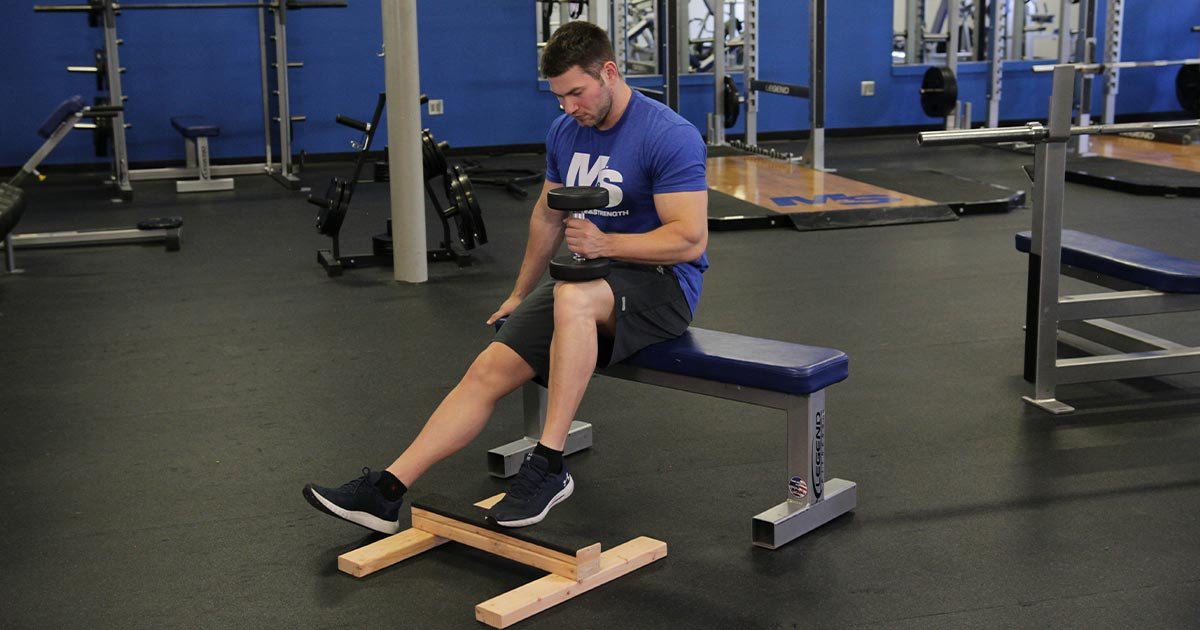
A supported single-leg calf raise with a dumbbell is one possible variation to learn at manageable effort, not an automatic replacement for every machine protocol. Balance, grip and the support you use can become limiting factors. Adding repetitions does not help you evaluate the calf work if your main challenge has become staying upright or holding the weight.
The seated one-leg dumbbell photograph shows another arrangement, with a bench and the load resting above the knee. It illustrates why equipment details belong in the record. It is not evidence that seated dumbbell work reproduces the same loading as a standing machine, nor a recommendation to use whatever furniture or raised surface happens to be nearby.
Select equipment according to the actual version you intend to perform. Dumbbells, a stable bench, suitable loading plates and secure collars can be useful in different setups, but they are not interchangeable parts of one universal calf station. Follow the equipment instructions and check that the support is intended for the job. A squat wedge is not automatically an appropriate calf block.
Treat a new variation as a learning task first. Make the entry, normal repetitions and exit predictable before adding fatigue. If you are unsure about technique or how to end the set, a qualified trainer can help assess the arrangement. You do not need an extended set to make a training session worthwhile.

Equipment Worth Exploring
Explore equipment, accessories and gear from our carefully selected range.


Rubber Hex Dumbbells
Rubber-coated hex dumbbell pairs with a stable shape for home and commercial strength training.

Multi Pull Smith Rack MPHR-780
All-in-one rack with a Smith machine, functional trainer, lat pulldown and low row.


FID Bench MAX
Adjustable bench offering flat, incline, and decline positions + adjustable headrest.


Review the routine rather than chasing a harder finish
Keep calf work in the context of the whole training week. A session may already contain squats, lunges, leg presses or other demanding work. Those exercises are not the same as direct calf training, but they affect the time and attention available in the session. Plan where the calf work belongs instead of treating it as an unrecorded extra whenever you happen to have energy left.
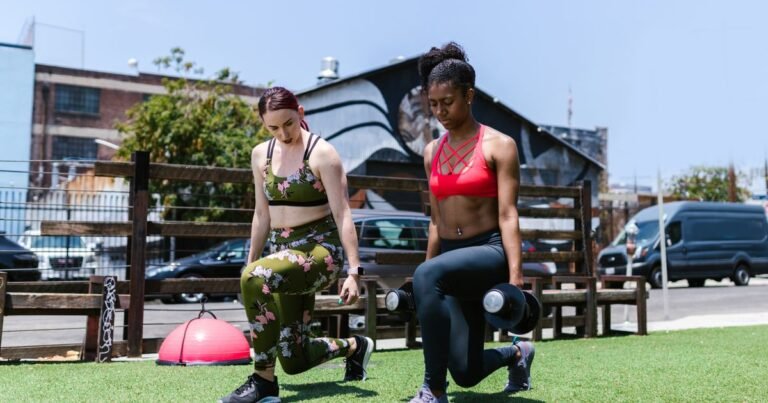
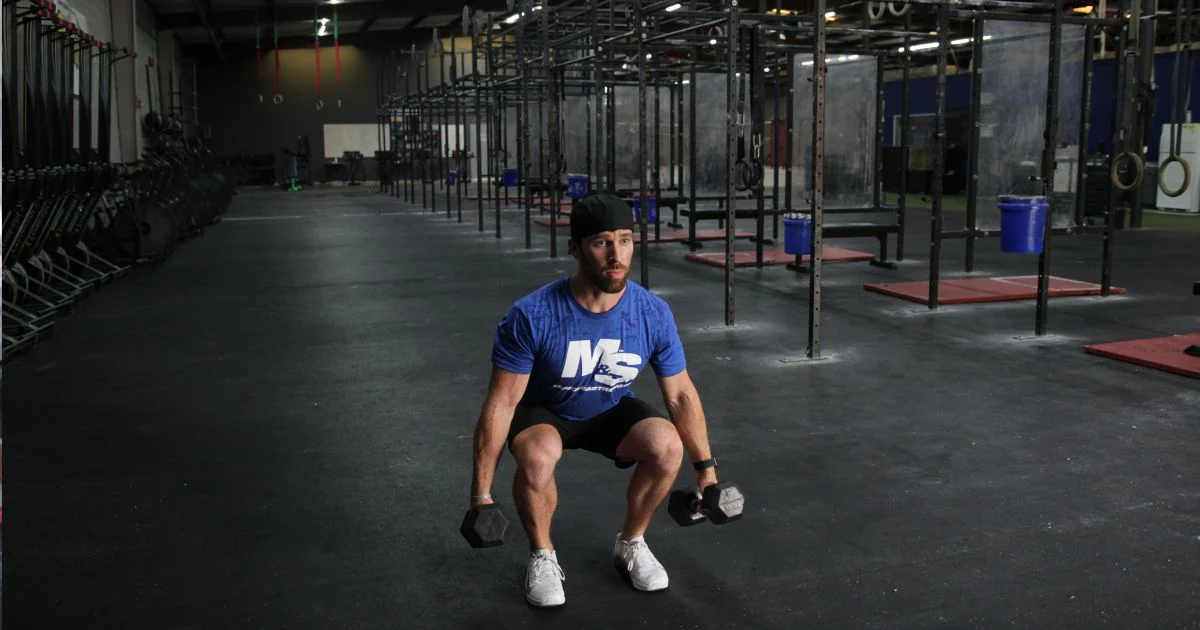
The dumbbell-squat photograph illustrates that broader leg-session context, not an exercise tested in the calf comparison. Do not transfer a beyond-failure idea to a squat simply because both exercises train the lower body. The setup, consequences of a missed repetition and ability to end the movement safely are different.
If you decide to test a change, keep enough of the routine stable to understand it. Record the exercise, load, full repetitions, any additional partial repetitions and the recovery between sets. Add a brief note about execution and how the following session felt. That creates a more useful history than writing only that the workout was intense.
Assess the change over repeated sessions rather than one unusually good pump. Can you repeat the setup, maintain control and fit the work into the rest of the program? Are you making appropriate progress without turning every calf session into a competition to tolerate more discomfort? Those questions help you judge whether the variation is useful for you.
Keep the conclusion proportionate. A different way of organizing a set is an option to evaluate, not a requirement to replace all conventional training. Preserve the parts of your routine that are clear, repeatable and productive. Add complexity only when you can explain what it changes and how you will judge the result.

Leg Day Shirts & Workout Gear
Leg-day gym shirts and workout gear for lifters who never skip squats, lunges and lower-body punishment.

Never Skip Leg Day Chicken Legs Meme Sweater & Bros T-Shirt
Show some gym-day personality with “Never Skip Leg Day”.

Never Skip Leg Day – NSLD Fried Chicken Meme Hooded Pul Hoodie
Stay casual and show some leg-day attitude with “Never Skip Leg Day”.

Shirt Never Skip Leg Day Flamingo Meme – Gymbros, & T-Shirt
Rep “Never Skip Leg Day Flamingo Meme” humor in and out of the gym.


Leg Day Is Calling You Squats & Deadlifts Meme Vest Tank Top
Your gym-day look, with a playful “Leg Day Is Calling You” twist.

Negative Leg Day Review Not Recommended 1 Star T-Shirt
Keep things casual with a little “Negative Leg Day Review” attitude.


Never Skip Mass Day Greek Mythology Booty T-Shirt
Make gym days more fun with “Never Skip Mass Day” style.

Leg Day Thou Shalt Not Skip Leg Day Medieval Knight Pul Hoodie
Show off your medieval humor in a laid-back “Leg Day” hoodie.

Legday – Squats & Deadlifts , Meme Top Bros & T-Shirt
Bring “Legday” humor to your next gym day.