Advertising disclosure: This page includes affiliate product links that may earn us a commission, as well as products from our own store.
Front-Foot Elevated Split Squats: Step Height, Knee Travel and a Six-Week Plan
A low step can turn a familiar split squat into a deeper, demanding leg exercise. The front-foot elevated version is useful when you want controlled quad and glute work without making balance or heavy barbells the main event. Here is how to build the setup, track honest progress and decide when another variation suits you better.
Why raising the front foot changes the rep
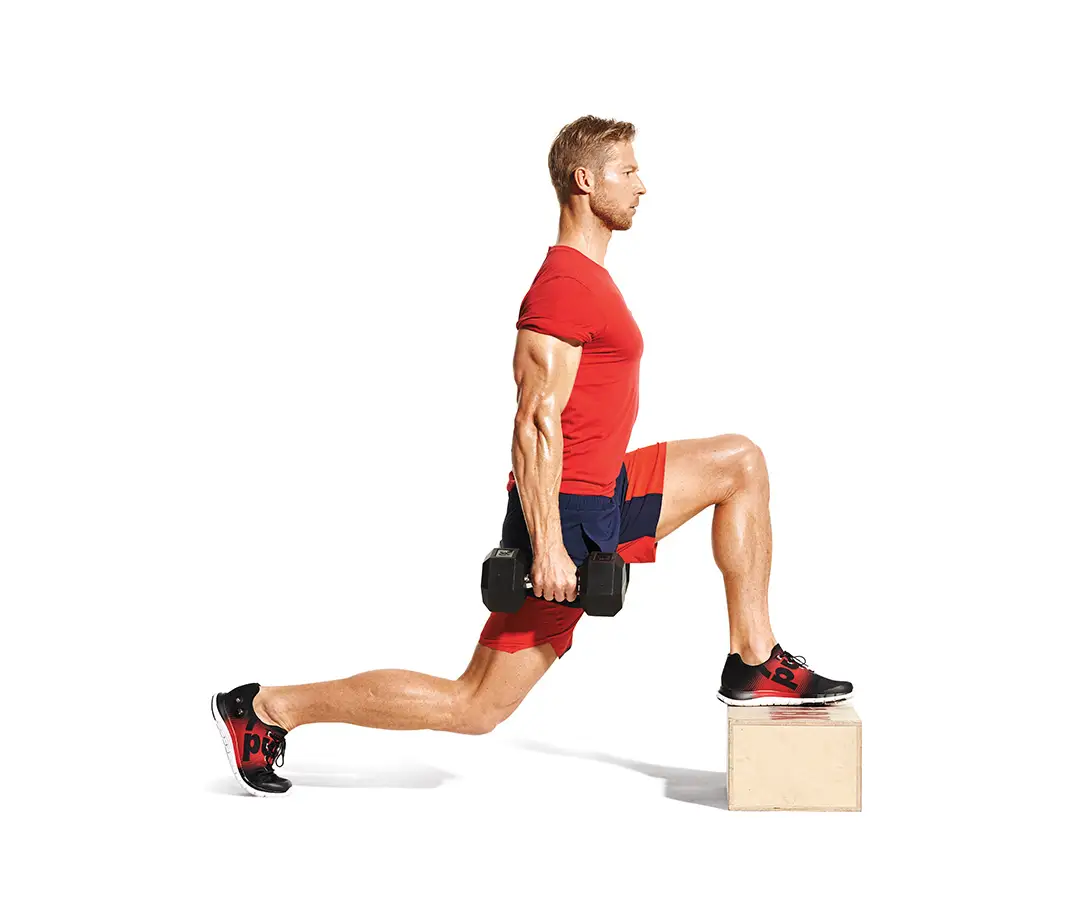
The front-foot elevated split squat looks like an ordinary stationary lunge with one small difference: the working foot stands on a low, secure surface while the rear foot stays on the floor. That small height change can let the back knee descend below the level of the front foot. The front hip and knee can then move through more flexion before the platform or floor becomes a limit. It is a way to make the working range longer, not a contest to see who can balance on the tallest box.
Your quadriceps straighten the working knee and your glutes help extend the hip as you stand. The rear leg contributes balance and can help with propulsion if you push hard through its toes. That is why a good split squat feels different when you deliberately keep most of your effort on the front leg. The hamstrings, calves and trunk assist with position, but neither hamstring soreness nor a huge step is proof that the exercise is working better.
More range can make a light load feel challenging, especially when you control the bottom. It does not automatically mean greater muscle growth than a conventional split squat, and the additional movement only helps if you can use it without pain or collapse. Unilateral and bilateral lower-body training can both build muscle; which lift improves most also depends on which pattern you practice. Use this exercise because you can execute and progress it, not because one stance has magical muscle-building properties.
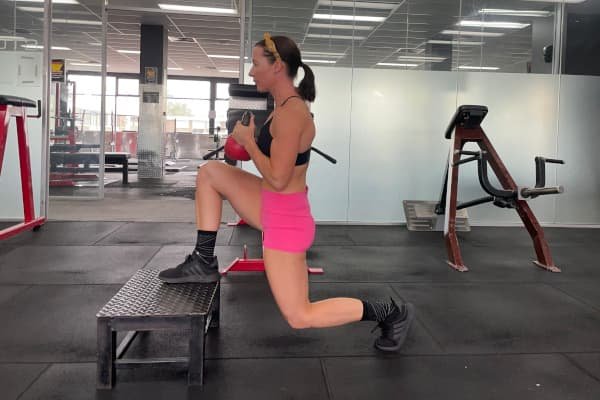
Watch the side view of a clean repetition: the front foot remains fully supported, the knee can travel naturally in line with the toes, the pelvis lowers between the legs and the rear heel stays lifted. Different limb lengths will make two good repetitions look different. Judge them by control, stable contact and repeatable depth rather than by one universal torso or shin angle.
Set your platform height, stance and hand support
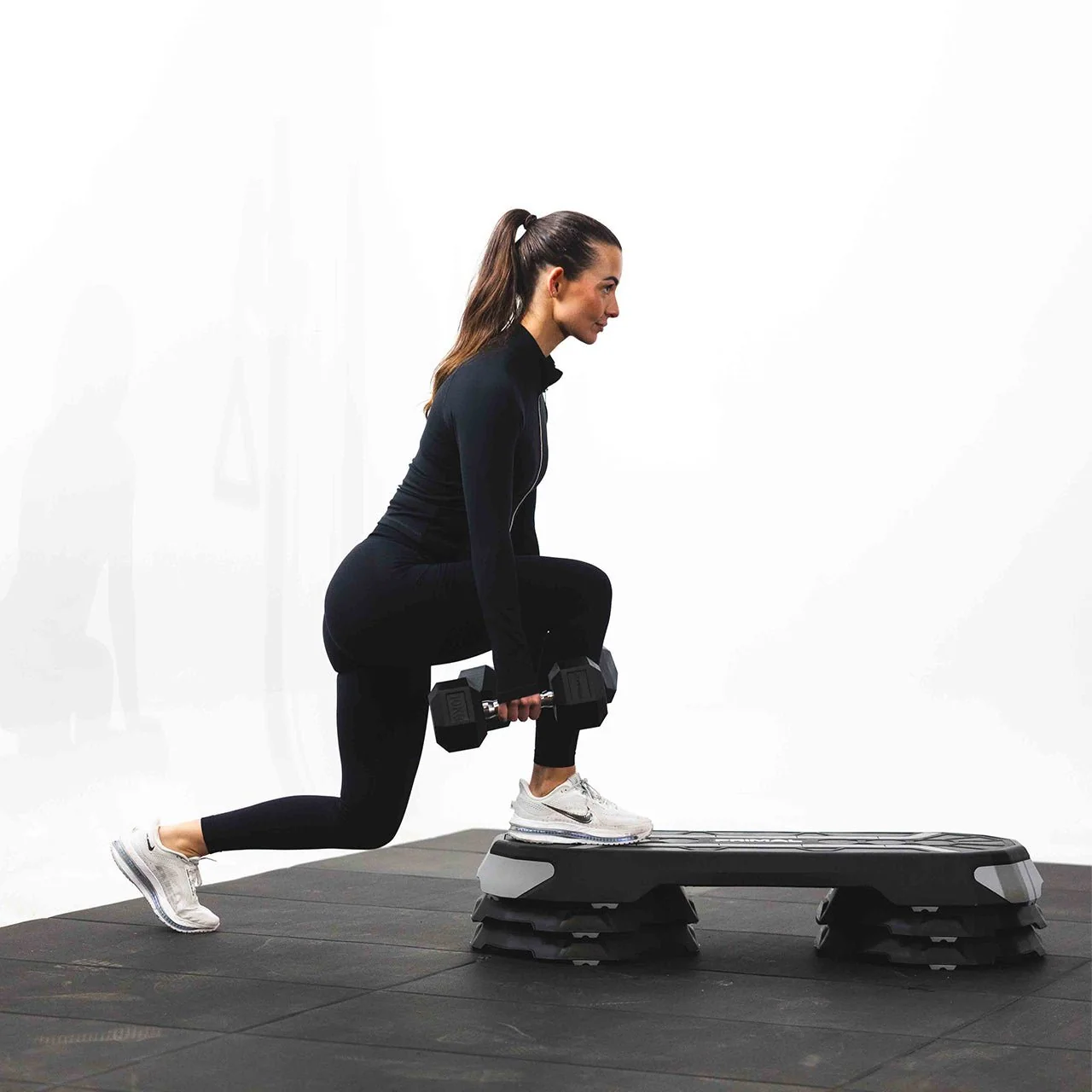
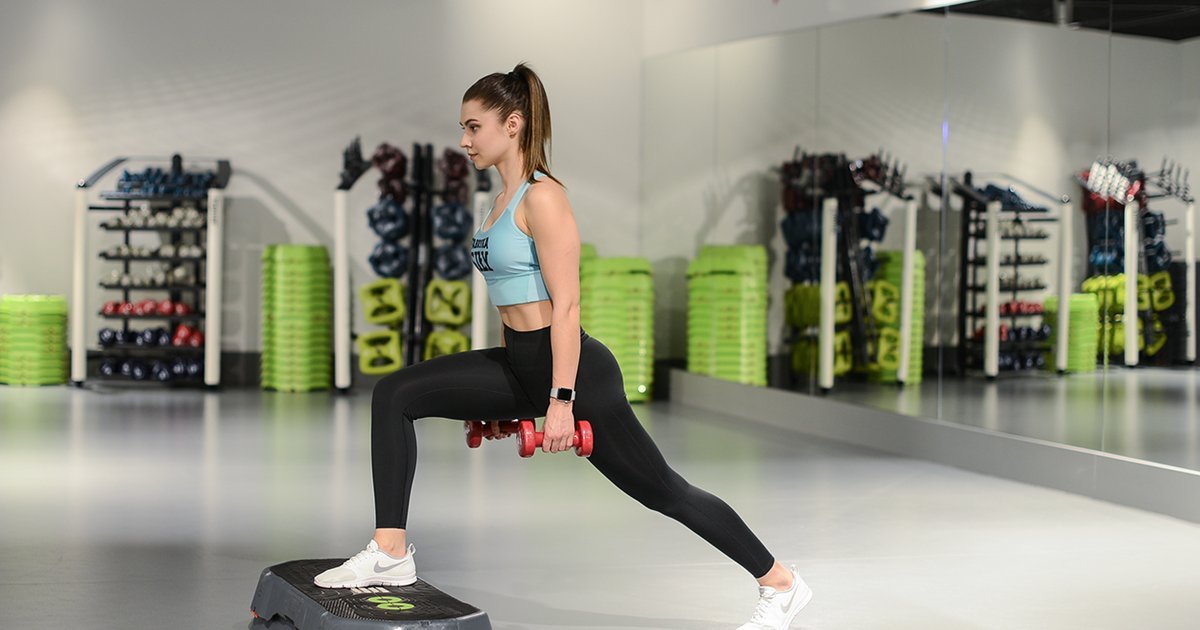
Start with a step or tightly stacked bumper plate about 5–10 centimetres high, not a wobbling box balanced on mats. Choose a surface broad enough for the whole shoe and resistant to sliding. Position it on a level floor with sufficient clearance for the rear knee and both dumbbells. If the front heel hangs off, the step moves or the rear foot strikes the platform, fix that before adding weight.
Place your front foot squarely on the step, then step backward far enough to lower in a mostly vertical path without the rear knee crowding the front heel. Think of two train tracks rather than a tightrope: leave some side-to-side space between feet so you can control the pelvis. You should be able to hold the bottom briefly while the back foot stays on its toes and the front foot remains flat. If you have to pitch violently forward or twist your hips, adjust the distance in small increments.
Do a bodyweight set first. Stand near a rack upright or a stable rail and use one hand lightly for balance if needed. Hand support is not cheating when the objective is leg tension. It may let you work the quads harder than constantly catching a wobble. Let the free arm or the dumbbell hang naturally instead of pulling your shoulder backward. Hold a pair of dumbbells only when bodyweight reps have a repeatable range.
Use a simple baseline test: six slow repetitions on each side with identical step height and stance, then a five-second steady hold at a comfortable bottom position. If your rear foot keeps stepping around, lower the step or widen the stance before thinking about heavier loads. Do not let a narrow balancing act consume the set’s effort.

Equipment Worth Exploring
Explore equipment, accessories and gear from our carefully selected range.


Rubber Hex Dumbbells
Rubber-coated hex dumbbell pairs with a stable shape for home and commercial strength training.

Cast Iron Kettlebells
Textured cast-iron kettlebells for swings, squats, carries, and full-body training.


Grip Plates
Rubber-coated weight plates with handholds for loading barbells and machines.
Knee travel, depth and a controlled tempo
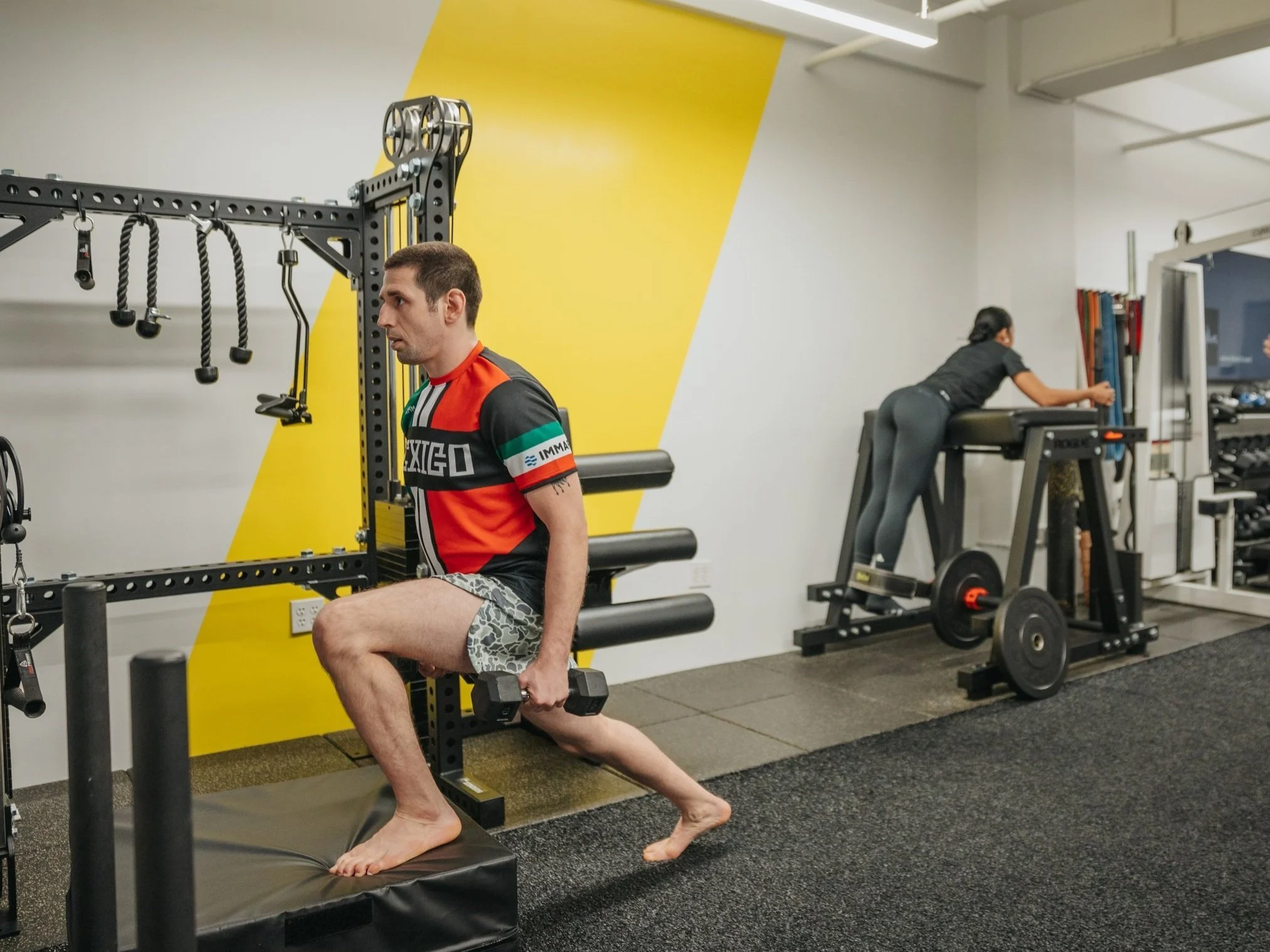
Inhale and brace, then lower over roughly two or three seconds. Bend both knees as your pelvis moves down. It is usually fine for the front knee to travel past the toes if that is the position your ankle and leg proportions allow comfortably. The important checks are that the foot stays planted, the knee follows the general direction of the toes, and the range is controlled. A rigid rule that the knee must never pass the toes can unnecessarily distort this exercise.
Stop the descent at the deepest position you can own without a hard drop, a front heel lift or an uncomfortable pinch in the front hip or knee. The rear knee may approach the floor but does not have to strike it. Pause for a moment if that helps you remove momentum. Push through the whole working foot to stand. Keep the final inch smooth rather than bouncing off a locked joint. Exhale near the harder part of the ascent and reset your brace between repetitions.
A more upright torso often increases the relative challenge around the working knee; a modest natural forward lean can involve the hip differently. Neither is a moral rule. The biggest mistake is changing the torso angle every rep so the first repetitions look like a quad movement and the last look like a hurried forward fall. Film a set from the side once, note your controlled depth and use that as your own reference.
If the leading knee drifts inward under fatigue, reduce the load and focus on stable foot pressure rather than forcing an exaggerated outward push. If the rear calf does all the work, check that you are not launching upward from the trailing toes. If you lose balance at the bottom, take a light hand support. Stable, repeated tension beats a dramatic extra centimetre of range.

Leg Day Shirts & Workout Gear
Leg-day gym shirts and workout gear for lifters who never skip squats, lunges and lower-body punishment.


Motivation – Squats & Booty Builder Leg Day – Strong T-Shirt
Bring “Gym Motivation” humor to your next gym day.

Leg Day Leg Sweater Squats & Meme T-Shirt
Bring “Leg Day” humor to your everyday gym style.

Leg Day Gains | LEGO Inspired Workout Decal for Water B Sticker
Bring “Leg Day Gains” attitude to your water bottle or laptop.

Legendary Leg Day – Squat Meme Vest Muscle Shirt For At Tank Top
Add some leg-day attitude to training with “Legendary Leg Day”.

I Love Squats – Valentine's Day Leg Day Meme Decal for Sticker
Put “I Love Squats” gym humor on your laptop, bottle, or gym gear.

Squat Here | Edgy Workout Sweater | Gym Humor Meme Crew T-Shirt
Bring “Squat Here” humor to your everyday gym style.

Funny Squat Inspector Gym | Edgy Leg Day Meme Muscle Sh Tank Top
Show some personality between sets with “Squat Inspector”.

Never Skip Leg Day – NSLD Meme Fried Chicken Jumper Pul T-Shirt
Add a playful “Never Skip Leg Day” touch to your casual rotation.
Choose bodyweight, dumbbells or barbell loading
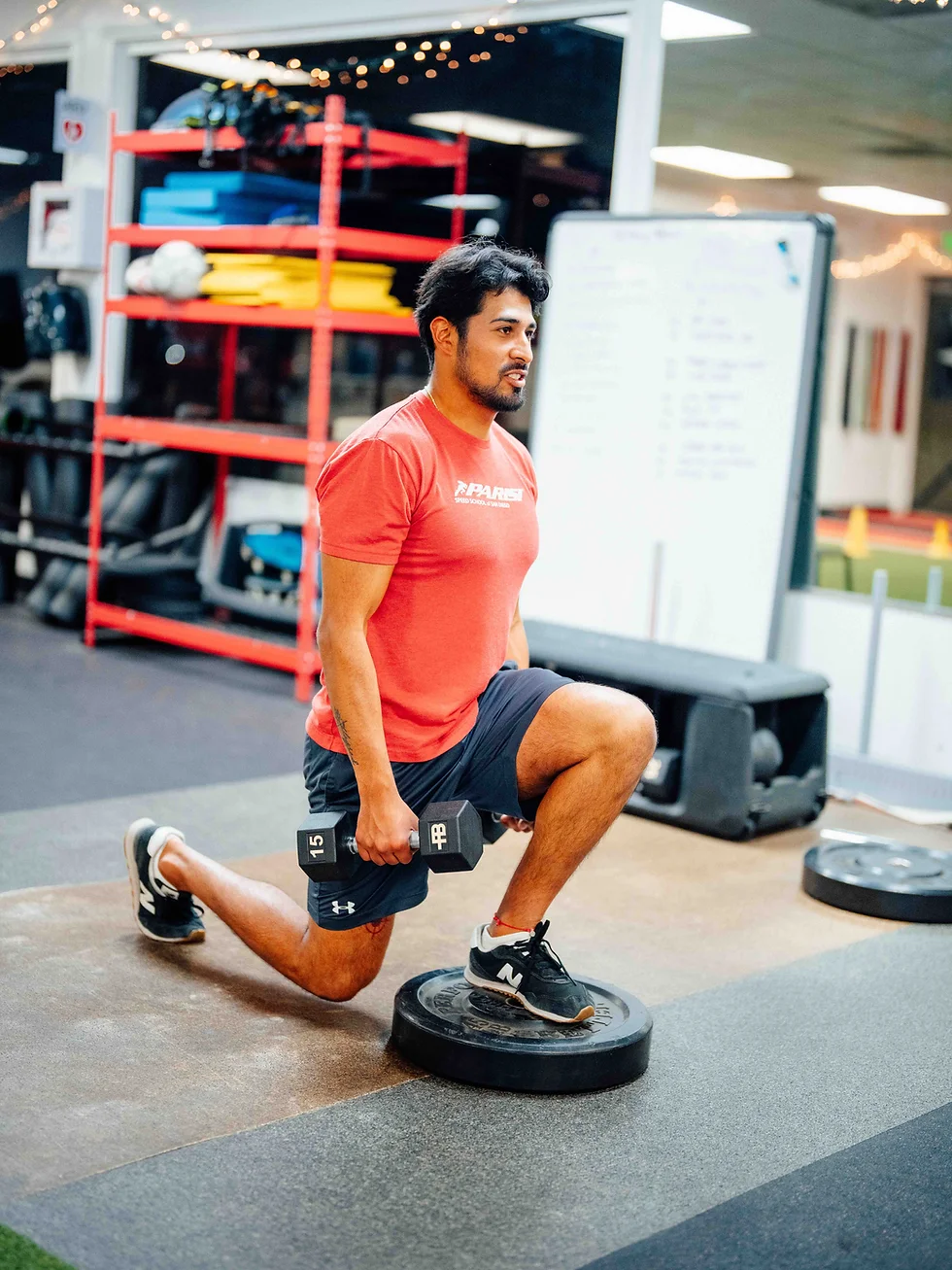
Bodyweight is the right starting load if the extra depth is unfamiliar. Once you can perform controlled sets of eight to twelve repetitions per side, a dumbbell held in each hand is often the easiest progression. You can add mass in modest increments without placing a bar above an unstable stance. A single contralateral dumbbell is another option, but it changes the trunk challenge; log it as a separate variation.
For some lifters a goblet-held dumbbell feels more balanced, although grip and breathing may become limiting before the legs. Two dumbbells beside the hips tend to simplify the setup, especially when you want the front thigh rather than the upper back to be the training limiter. Straps may help only if grip is consistently ending a set prematurely; they are not needed for ordinary introductory loads.
A barbell across the upper back is possible but increases the consequences of a missed step or loss of balance. Use it only with an appropriate rack, safeties, predictable foot positions and experience. The Smith machine may give a more fixed path, but the fixed bar route still must suit your stance; it should not force painful joint positions. A hand-supported dumbbell version can be a smarter hypertrophy choice than either if it allows better leg output.
Do not compare the load of front-foot elevated split squats to a walking lunge, a regular stationary split squat or a rear-foot elevated Bulgarian split squat as though they are interchangeable. The stance, supported height and range change the difficulty. Use the same shoe, step and hand support whenever you make a week-to-week performance comparison. The most productive variation is the one you can load steadily without losing the characteristic deeper movement.
Equipment Worth Exploring
Explore equipment, accessories and gear from our carefully selected range.

GymPin Squat Wedges
Non-slip 15-degree squat wedges help elevate the heels for deeper quad-focused squats.

Studio V-Squat
Plate-loaded V-squat machine for supported lower-body strength training.

Leg Press/Hack Squat BPR-790
Convertible 45-degree leg press and hack squat machine with a broad footplate and band pegs.

Compact Leg Press CLP-700
Compact reverse-style leg press with a moving seat carriage and an adjustable footplate.

Squat Harness
Wearable harness for hands-free cable squats, sled work, and lower-body training.

Competition Plates
Competition-style bumper plates for Olympic lifts and loaded strength training.


Pro Sled System
Heavy-duty push-pull training sled for loaded conditioning, speed, and strength work.
A six-week plan for quads and glutes
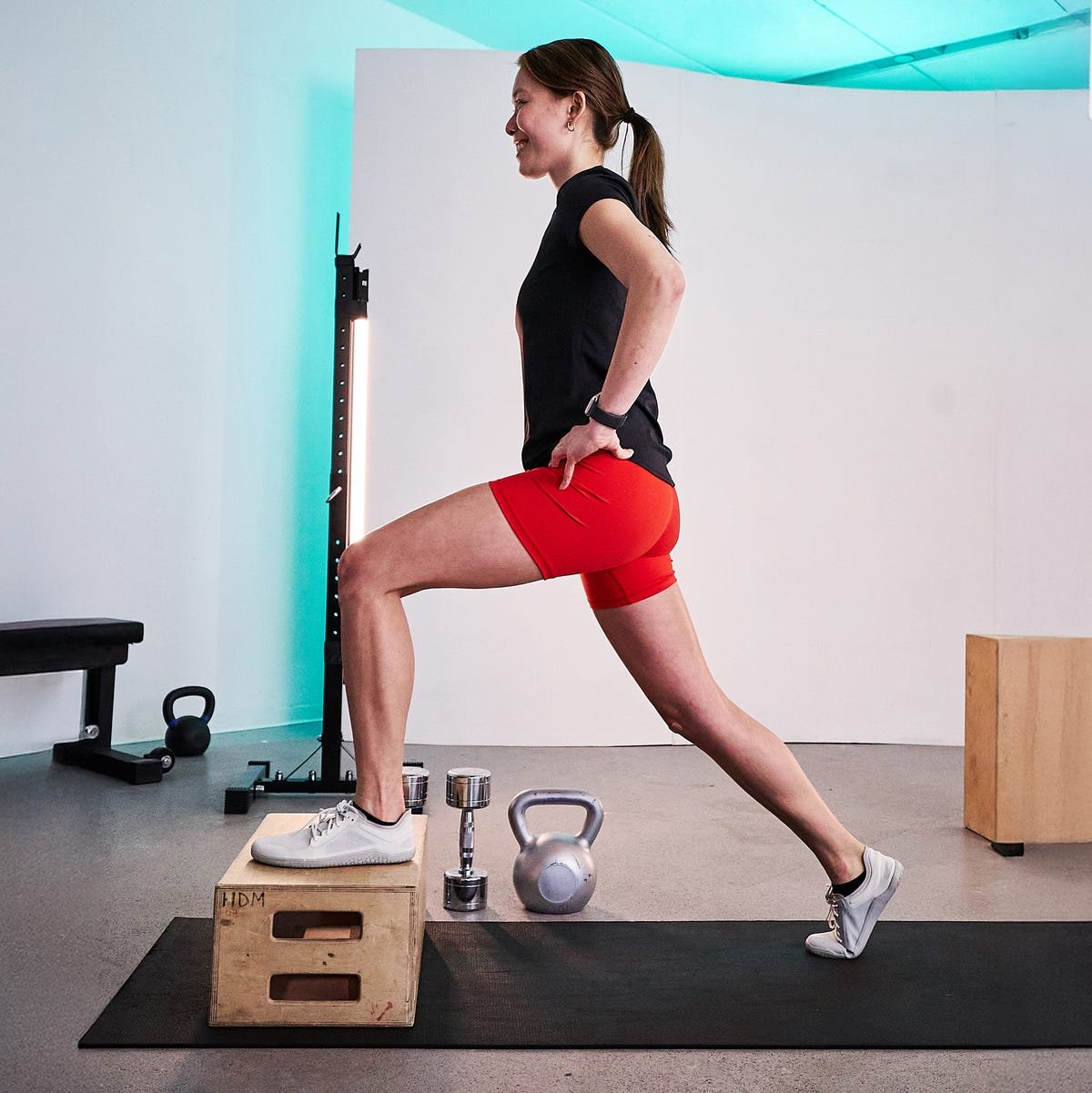
Train this variation once or twice per week after the main heavy lift, or put it first if unilateral leg strength is the priority. Start with two working sets of eight repetitions per side and leave about two or three controlled repetitions in reserve. Rest roughly ninety seconds to two minutes after both sides; use more if you need it to keep the next set technically identical. Always count a left-and-right pair as one set for each leg, not as two mysterious extra sets.
During weeks one and two, establish your stance and increase from eight toward ten clean repetitions with bodyweight or light dumbbells. During weeks three and four, use three sets of eight to ten per side. When all three are stable at the top of that rep range, increase both dumbbells a small amount and return to the lower end. In weeks five and six, maintain three sets of eight to twelve per side and add either a little weight or a single repetition when both legs meet the form standard. Never progress height, load and depth all at once.
Pairing with another leg exercise depends on your programme. After a heavy squat or leg press, two sets may be enough. After Romanian deadlifts, place split squats in the middle of the session and pay attention to balance on tired legs. If you already do hard Bulgarian split squats, there is little reason to stack many high-effort unilateral sets purely for variety. Account for the work in your weekly quad and glute volume.
A useful sample Tuesday session is three squat working sets, two front-foot elevated split-squat sets and two calf-raise sets. A second weekly session could pair a hip hinge with two or three slightly lighter split-squat sets. This is an example, not a universal prescription. Adjust frequency, effort and total sets to your recovery and the rest of your training. Most importantly, record load per hand, repetitions per side, platform height and whether you used hand support.
Troubleshoot discomfort, balance and progress stalls
If your knees feel uncomfortable, first reduce the elevation and range to one you can control, then test a slightly shorter or longer stance. Pain is not a signal to force additional depth. A comfortable knee moving forward over the toes is different from sharply worsening pain. Stop and seek professional advice for persistent pain, swelling, instability or a new injury rather than trying to solve it by changing one cue.
An unstable ankle or tired foot may be the real limiter. Use a wider split stance, secure flat shoes and a firm step. A little fingertip support can quickly tell you whether leg strength or balance is ending the set. If your back hip feels strained, shorten the step or reduce how far you descend. There is no extra prize for dropping below a range you can repeat with control.
Plateaus are often measurement problems. A taller platform, a narrower stance, deeper lowering or removing hand support can make the same dumbbells significantly harder. Conversely, a heavy pair with shallow repetitions may represent less useful work than a lighter pair taken to consistent depth. Choose one adjustment at a time, record it and allow a few sessions before judging whether the movement is improving.
The front-foot elevated split squat is worth keeping when it provides a predictable working range, substantial effort in the front thigh and glute, and a clear way to progress. If getting into place is awkward or you cannot find a stable platform, an ordinary split squat, a supported lunge or a leg-press variation may serve your legs better. Good programming uses an exercise as a tool, not as a mandatory badge of seriousness.
Powerlifting Shirts & Lifting Gear
Powerlifting shirts and gym gear for squat, bench and deadlift lifters who live for heavy numbers.


Don'T Fart Squats & Leg Day Meme Hoodie
Show off your leg-day humor in a laid-back “Don't Fart Squats” hoodie.

Squatbucks Gym Coffee Funny | Starbucks Parody Workout T-Shirt
Keep things casual with a little “Squatbucks Gym Coffee” attitude.

Heavy Squatter Meme Squats & Gains Leg Day Wizard Top T-Shirt
Heavy lifts, good laughs, and a little “Heavy Squatter” energy.

9 Plates Squat Club Meme Shirt – Essential & T-Shirt
Show some leg-day attitude with a playful “9 Plates Squat Club” tee.


Leg Day Is Calling You Squats, Deadlifts & Gains T-Shirt
Rep “Leg Day Is Calling You” humor in and out of the gym.

The Quadfather Leg Day Meme Top & T-Shirt
Bring “The Quadfather” humor to your next gym day.

Squat Bench Deads Shirt – Gains & Meme Top T-Shirt
Bring “Squat Bench Deads” humor to your next gym day.

Legday – Squats & Deadlifts , Meme Top Bros & T-Shirt
Bring “Legday” humor to your next gym day.