Advertising disclosure: This page includes affiliate product links that may earn us a commission, as well as products from our own store.
The reverse pec deck looks like an ordinary chest-fly machine used backward, but that simple change turns it into one of the easiest ways to train the back of your shoulders without asking your lower back to stabilize a bent-over position. For lifters chasing fuller delts, the attraction is not a magic machine. It is a repeatable horizontal arm movement that lets you concentrate on the posterior deltoid, control the return and measure progress.
Good rear-delt training still needs context. A reverse fly is not a heavy row, a rear-delt pump is not proof of muscle growth, and the best grip is the one that keeps your shoulders comfortable while delivering a consistent arc. Here is how to set up the machine, compare it with cables and dumbbells, and build six weeks of useful work around your existing training.
What the reverse pec deck actually trains
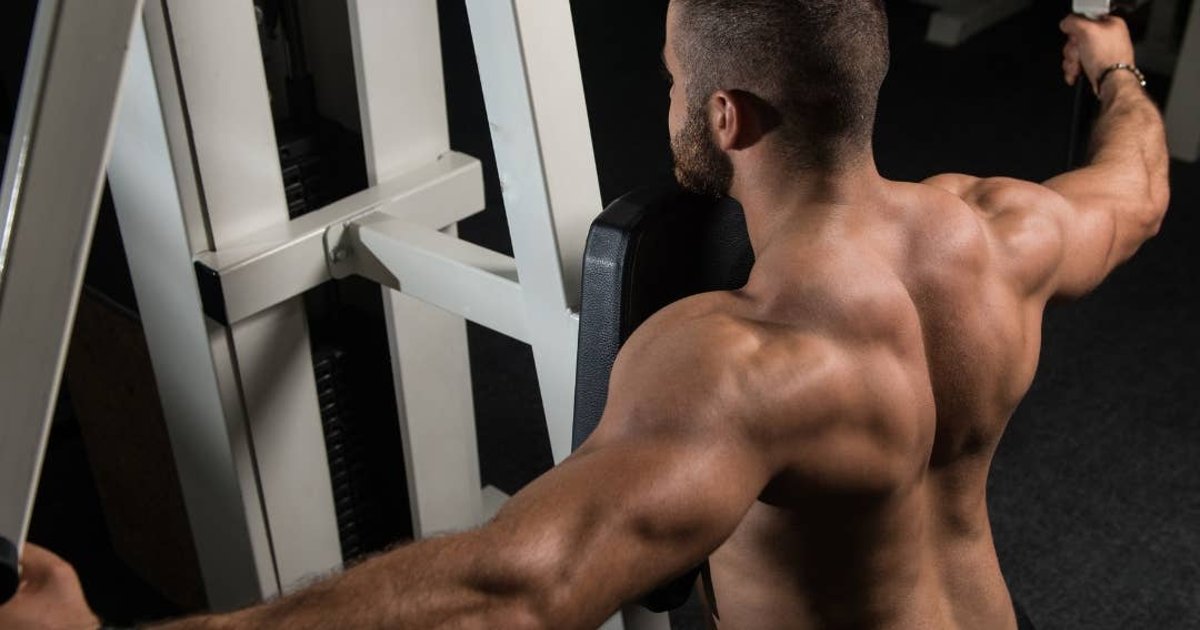
The posterior deltoid sits on the back of your shoulder and contributes when you take the upper arm outward and backward relative to the torso. The machine places the arms in front of you, then supplies resistance as they open into a wide arc. The middle trapezius and rhomboids can help move the shoulder blades, while other upper-back and rotator-cuff muscles provide control. That makes it more accurate to call the movement rear-delt focused than completely isolated.
There is an interesting laboratory clue. In one comparison involving 12 men with at least a year of lifting experience, the reverse pec deck generated greater recorded posterior-deltoid activity than a seated row and an inclined pulldown during the tested sets. It also produced considerable middle-deltoid activity. Those measurements help explain why the movement belongs in a shoulder program, but they cannot tell us how many millimeters of muscle you will gain over months of training. Electrical activity measured during a workout is not a substitute for a long-term hypertrophy study.
Think about what your rows and pulldowns already do. They can contribute plenty of upper-back work, yet their elbow path, shoulder angle and load distribution are different from a fly. A few well-executed rear-delt sets provide a useful complementary direction of resistance without turning shoulder day into a second exhausting back day.
Set the seat, handles and chest pad before loading weight
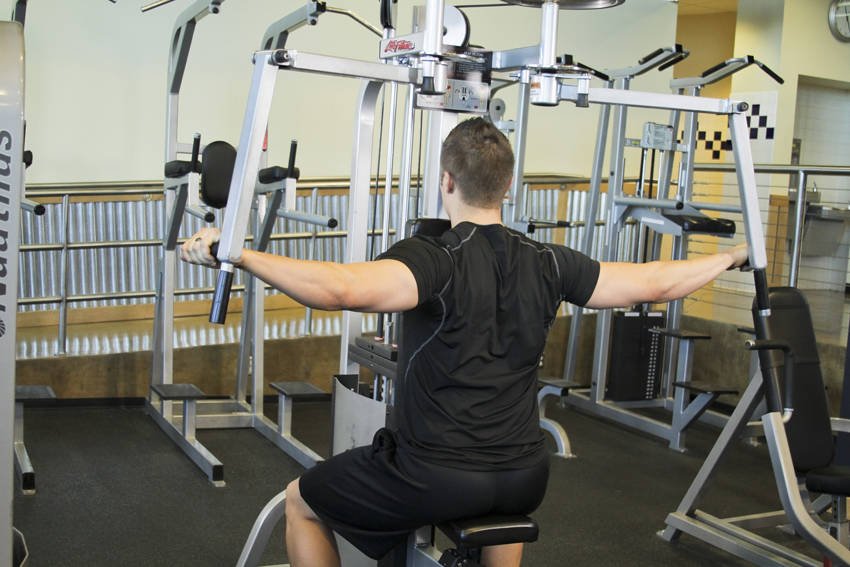
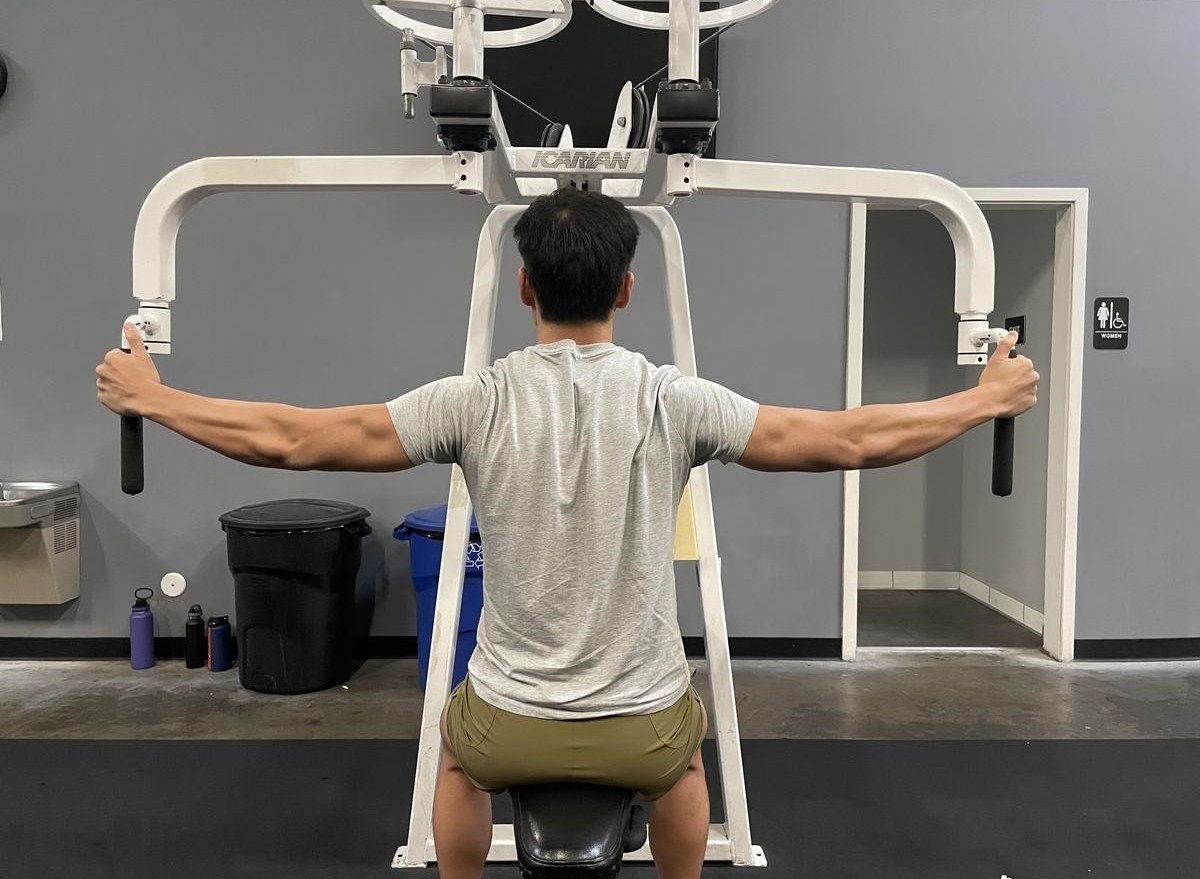
Begin by checking the machine’s own adjustment diagram. Many commercial pec decks have rotating arms or separate rear-fly handles; some rear-delt stations use pads for the elbows instead. Select the reverse-fly starting position and sit facing into the chest support. Adjust the seat until the handles are approximately at shoulder height. Keep both feet planted or resting on the provided foot supports so the torso stays quiet.
Set a starting position where your hands can reach forward without forcing the shoulders into a painful stretch. Take a neutral grip if the station offers vertical handles, or a pronated grip if that version feels better. Keep a small, mostly constant bend in each elbow. Do not lock the joints rigidly or turn the movement into an elbow-flexion exercise.
Exhale as you guide the upper arms outward and backward in a wide arc. Keep the sternum near the pad and the neck relaxed. Finish around the point where the arms are roughly in line with the torso or slightly behind, if that range remains smooth. Bring the handles forward over roughly two seconds instead of allowing the weight stack to crash. A calm return is part of the repetition, not a rest break.
Before the first working set, perform five slow light repetitions and observe three things: whether your shoulders shrug, whether the chest leaves the pad, and whether the elbows bend much more at the end. If any of those happen, reduce the load or shorten the arc slightly. Recording the seat number and handle setting makes your progress easier to compare next week.

Equipment Worth Exploring
Explore equipment, accessories and gear from our carefully selected range.
VOLTRA
Compact digital cable trainer with smooth, adjustable resistance.

Go-Tone Pro
Portable digital cable trainer with up to 66 lb (30 kg) of adjustable resistance.

VForce Wall Trainer
Space-saving wall-mounted functional trainer with pivoting cable arms and variable resistance ratios.

VForce 2IN1
Half rack and pivot-arm functional trainer with switchable 1:1 and 2:1 pulley ratios.

VForce 3IN1
All-in-one rack combining an adjustable Smith machine, functional trainer, and free-weight station.

GymPin D Cuffs
Adjustable wrist cuffs with textured grips for supported cable-machine exercises.

GymPin Ergo Handles
Pair of ergonomic cable handles shaped for comfortable triceps and pulling exercises.
Horizon Grip
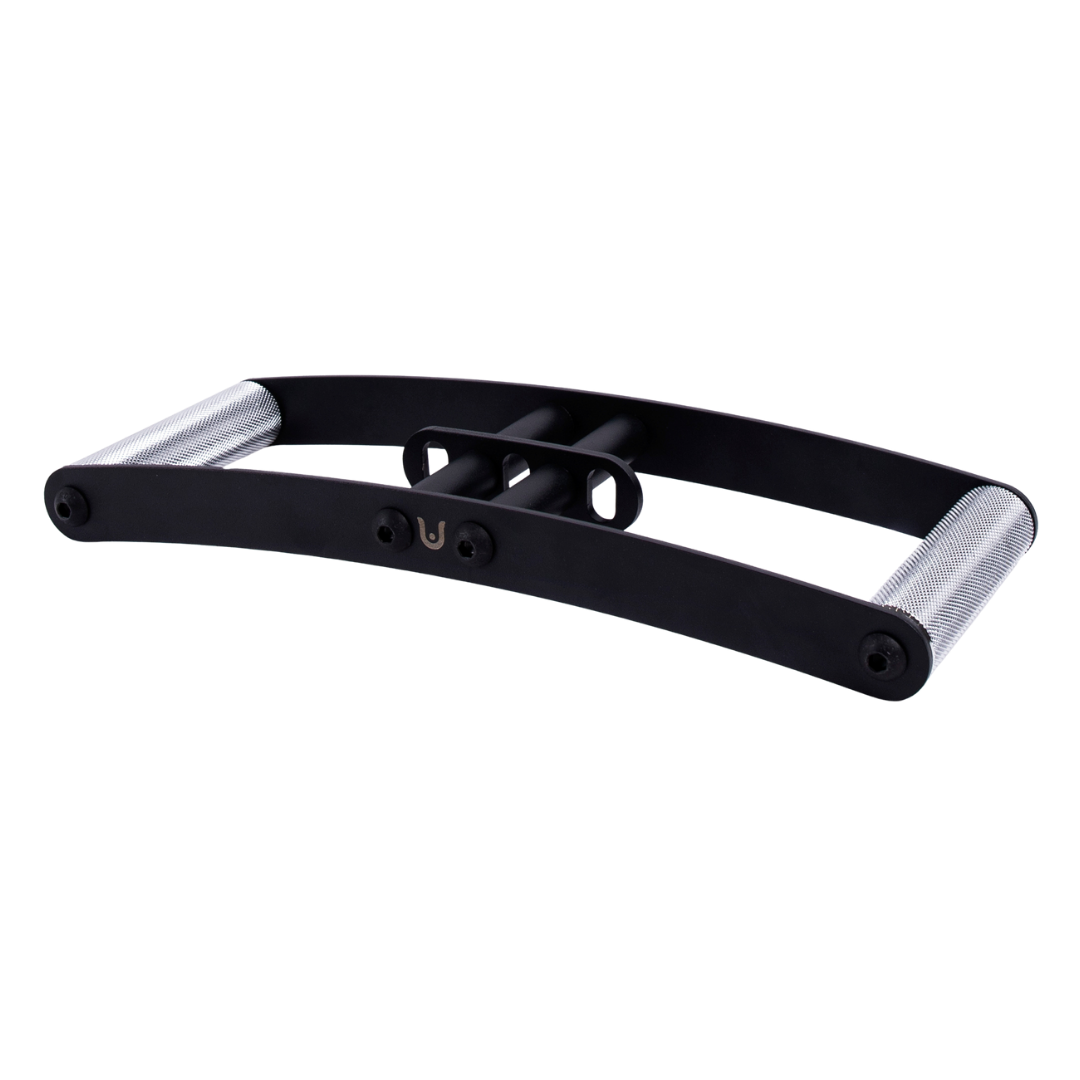
Ergonomic V-style cable grip for rows and back training.

Five mistakes that steal the work from your rear delts
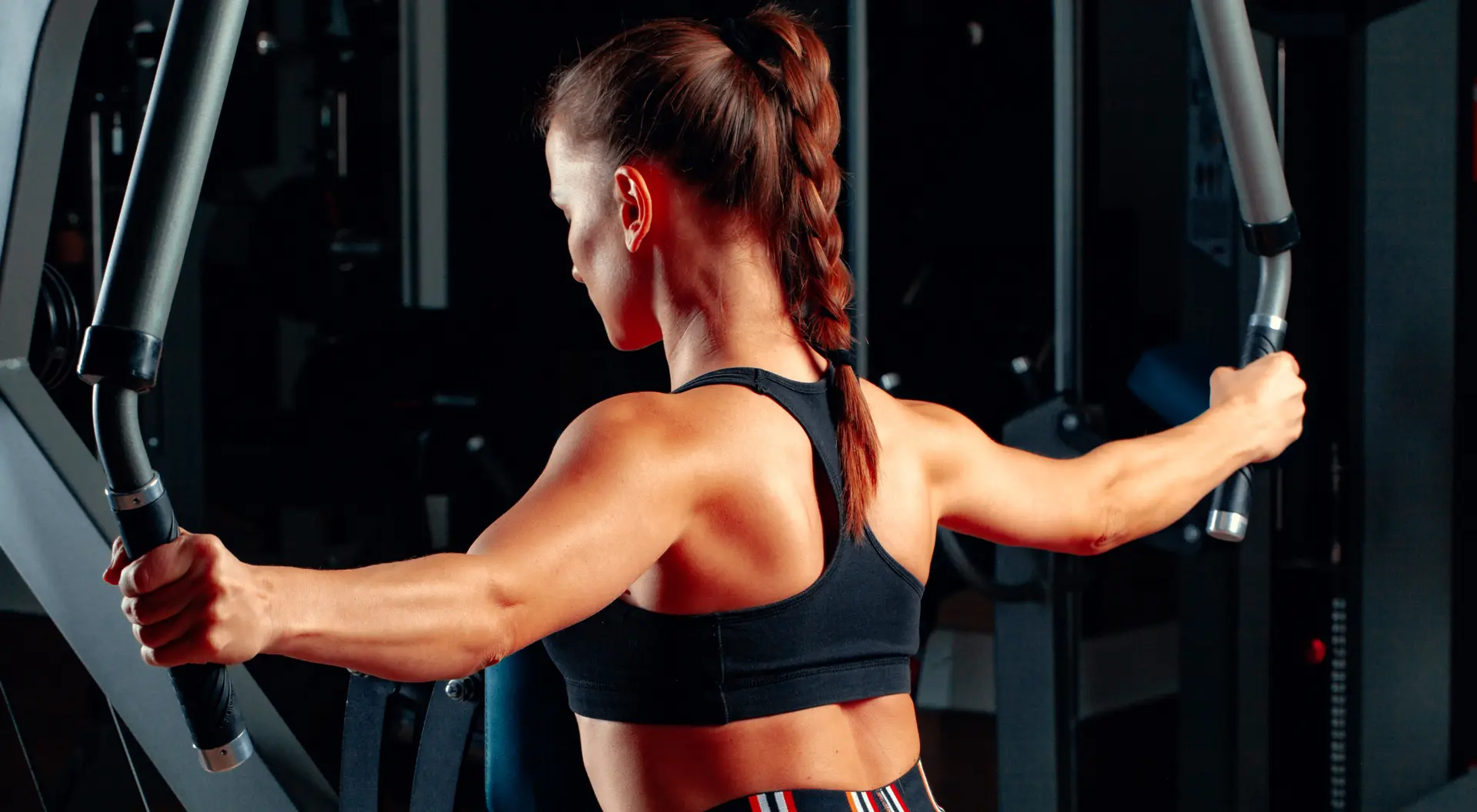
Loading for a row. When a fly becomes a heavy heave, the torso rocks and the elbows fold. The rear delts still contribute, but you are no longer repeating the same exercise. Pick a load you can control for at least ten honest repetitions before adding plates or stack pins.
Shrugging the shoulders. Reaching toward your ears often makes the movement feel more like a trap exercise. Allow natural shoulder-blade motion, but do not deliberately elevate your shoulders to move a weight you cannot otherwise manage. A relaxed neck and a level arm path are practical checkpoints.
Forcing a deep finish. The handles do not need to travel far behind the body. Some machine paths encourage excessive shoulder extension at the end, which may feel uncomfortable in the front of the shoulder. Stop at the last pain-free position that lets the upper arms open smoothly, rather than chasing an exaggerated squeeze.
Changing the elbow angle on every rep. Pulling the elbows toward your ribs makes the motion resemble a row; straightening and bending them repeatedly introduces unnecessary variation. Hold a comfortable soft bend and let the shoulder joint create the arc.
Rushing the return. A swinging weight stack makes it difficult to judge effort and maintain the same range. If the first five reps are controlled and the last five are a different-looking exercise, the set was too heavy or too close to the point where your technique fell apart. End the set with one or two technically solid repetitions left when appropriate.
Sharp pain, catching or unstable shoulder sensations are a reason to stop and reconsider the movement rather than push through. Shoulder comfort takes priority over any theoretical muscle-activation advantage from a particular handle.

Bodybuilding Shirts & Workout Gear
Bodybuilding shirts, tanks and gym gear for lifters chasing muscle, size, symmetry and the pump.


Shirt – The Empire Lifts Back , & Back Training Gains T-Shirt
Bring “The Empire Lifts Back” humor to your next gym day.

Funny Yoda Gym | Train Back You Must Bodybuilding Meme T-Shirt
Bring “Funny Yoda Gym” humor to your everyday gym style.

Black Panther Big Back Gym Funny Workout Crewneck Pullo T-Shirt
For laid-back days and superhero humor: “Black Panther Big Back”.


Nice Traps Big Back – Halloween Horror Jigsaw Meme Vest Tank Top
Add some Halloween attitude to training with “Nice Traps Big Back”.

Venomous Gains Gym Hoodie
Show off your lifting humor in a laid-back “Venomous Gains” hoodie.

Back To The – Sci-Fi Futuristic & Gains – Meme Top T-Shirt
Make gym days more fun with “Back to” style.
Reverse pec deck versus a cable rear-delt fly
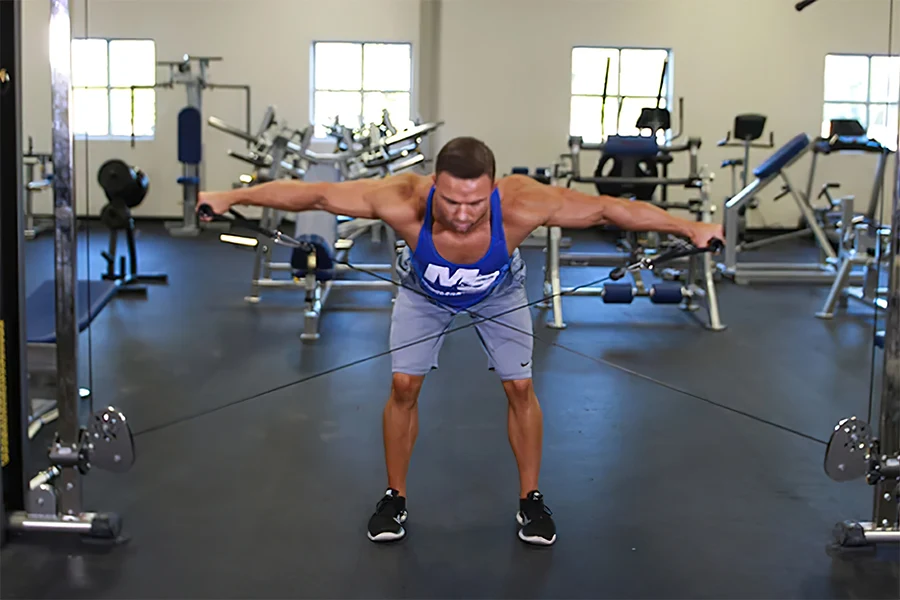
Cables can reproduce horizontal arm movement while giving you more freedom to choose the start point, height and line of pull. In a cross-cable rear-delt fly, the hands begin toward the opposite sides and separate across the body. Some lifters prefer this adjustable path because they can fine-tune shoulder comfort. Others find it harder to keep their torso from turning as the handles move.
The machine’s advantage is repeatability. The chest pad stabilizes the torso, the handle track is predetermined, and adding load often requires only one pin change. That makes it a sensible choice when you want to compare the same movement week after week. Its limitation is that not every machine’s geometry fits every lifter equally well. A tall person or someone with unusually long arms may find the handle path awkward even after adjusting the seat.
With cables, choose a moderate weight and move both arms through a similar arc, avoiding a big torso twist. A single-arm variation can help you identify which shoulder position is comfortable, but it does not require you to invent an artificial stretch at the end. For most people, machine flies and cable flies can be treated as alternatives rather than mandatory exercises to perform back-to-back.
Both can be useful alongside a rowing movement, but a rear-delt fly should not replace all your rows. Your back still benefits from exercises with a longer elbow pull and different muscle demands. Choose the fly variation you can repeat cleanly with available equipment, and track progress rather than assuming the more complicated setup must be superior.
Dumbbell reverse flyes: free weights and chest support
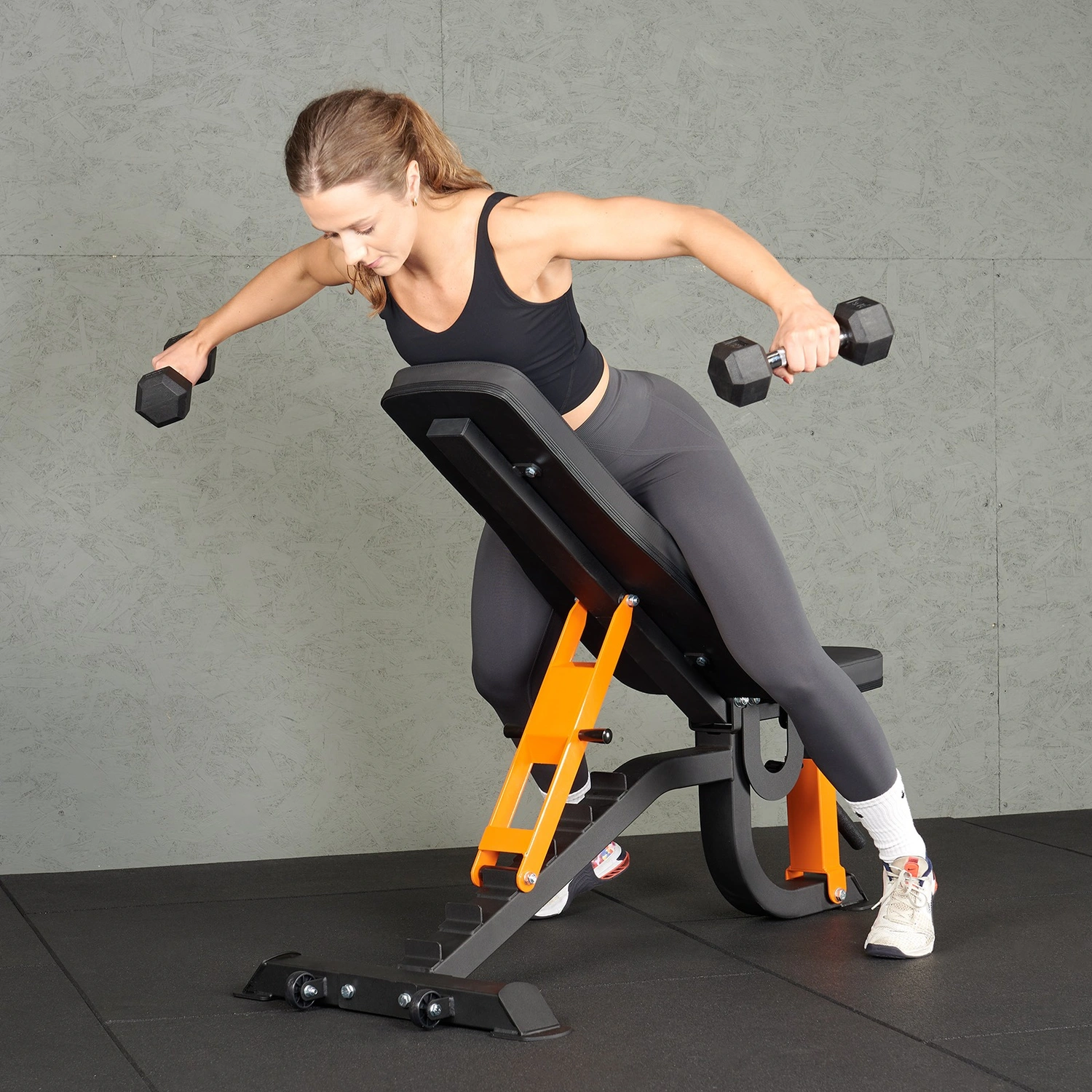
Dumbbell reverse flyes need only a pair of weights, yet their resistance feels different. With a bent-over fly, gravity pulls the weights downward and the moment arm changes as the upper arms rise. The hip hinge can become the limiting factor before the rear delts are fully challenged, particularly late in a workout or after hard deadlifts.
Chest support solves much of that distraction. Set an adjustable bench at a comfortable incline, lie chest-down and lift the dumbbells outward with a soft elbow bend. Choose a weight light enough that you can control the lowering phase without bouncing off the bench. The bench angle and hand path determine where the exercise feels hardest, so use a consistent setup rather than shifting the bench every week.
In a small comparison of upper-body isolation exercises, different implements produced different muscle-activation patterns during reverse flyes. In that experiment, dumbbells produced greater average posterior-deltoid activation than elastic bands in some phases, while bands increased activation of certain other muscles. This is one useful comparison of exercise conditions, not proof that bands cannot grow your rear delts or that dumbbells always outperform a good machine.
If a machine is comfortable and available, keep it. If you dislike its path, a chest-supported dumbbell fly or cable fly can replace it. If all you have are light weights, progress by improving your range, controlling the return, adding repetitions, and eventually increasing resistance rather than swinging heavier dumbbells for a shorter movement.
Equipment Worth Exploring
Explore equipment, accessories and gear from our carefully selected range.


Rubber Hex Dumbbells
Rubber-coated hex dumbbell pairs with a stable shape for home and commercial strength training.





FID Bench MAX
Adjustable bench offering flat, incline, and decline positions + adjustable headrest.

VForce Lat Tower
Wall-mounted cable tower with pivot arms and adjustable 1:1 or 2:1 pulley ratios.

VForce 3IN1 Max
Six-post all-in-one rack with Smith machine, functional trainer, and variable-force cables.

Original GymPin
Adds Olympic plates to compatible cable-machine weight stacks for extra resistance.
Where rear-delt work belongs in a complete lifting week
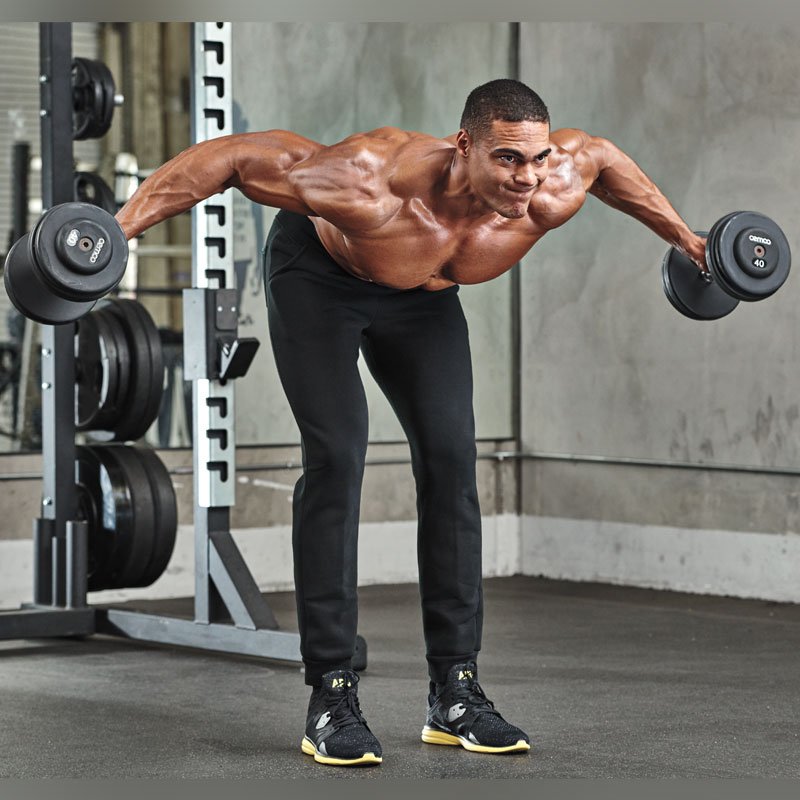
The rear delts help with many pulling tasks, so count the work you already do before piling on isolation sets. Heavy rows, some pull variations and dedicated reverse flyes place different demands on the back of the shoulder. Someone doing two hard upper-back sessions may need only a few direct rear-delt sets; someone focused mainly on benching and front-delt pressing may have a clearer gap to fill.
A practical starting point is two weekly rear-delt exposures with two or three controlled sets each. You can do machine flyes at the end of a pull session, after your main rows, or during a shoulder session after a compound press. The exercise is generally not a maximal-strength test, so sets of roughly 10–20 repetitions let you accumulate useful work without treating every small increment of weight as a personal record.
Keep the whole picture balanced: horizontal rows for upper-back strength, pulldowns or pull-ups for vertical pulling, lateral raises for the side delts, and pressing for the front of the shoulder. Face pulls can be a separate higher-rep option when you enjoy their cable path, but they are not a proven cure for posture problems. Likewise, a strong rear-delt pump does not automatically fix shoulder pain.
When your pulling volume is already high, evaluate recovery before adding more. If your rear delts are still sore when the next session arrives, the quality of your rows falls, or repetitions regress for multiple workouts, hold the number of sets steady instead of automatically increasing them. Sustainable progress comes from enough work that you can actually recover from.
Funny Gym Shirts & Workout Gear
Funny gym shirts, tanks, hoodies and workout gear for lifters who like training hard.


Gym Dost Thou Even Pull Medieval Knight Back Day Crewne T-Shirt
Show some gym-day personality with “Dost Thou Even Pull Medieval Knight Back”.

Back Sabbath Back Day Funny Gym Hoodie
Bring “Back Sabbath Back Day” gym humor to lazy days and post-workout plans.

Demon Back Big Back Sweater & Lat Gains Meme T-Shirt
Add a playful “Demon Back” touch to your casual rotation.

Lat Man Big Back – Decal With Huge Lats – Meme Back Sticker
Bring “Lat Man Big Back” attitude to your water bottle or laptop.

Heavy Metal Gym Trooper Eddie Crewneck Pullover for Bod T-Shirt
Add a playful “Heavy Metal Gym Trooper Eddie” touch to your casual rotation.

Strong Back Bodybuilder Tee
Show some lifting attitude with a playful “Strong Back Bodybuilder” tee.


Unbreakable Gains Back Tee
Make gym days more fun with “Unbreakable Gains: Strong Back Greek God” style.
A six-week reverse pec deck progression you can actually track
Use the same machine, seat setting and comfortable grip for this block when possible. Train the reverse pec deck twice a week with at least one day between exposures. Do a warm-up set first and select a working weight you can lift for twelve tidy repetitions with approximately two repetitions in reserve. A rep counts only if you keep chest contact, elbow angle and the main movement arc consistent.
| Weeks | Session A | Session B | Main goal |
|---|---|---|---|
| 1–2 | 2 × 12–15 | 2 × 12–15 | Learn the setup and add clean reps before load. |
| 3–4 | 3 × 12–15 | 2 × 12–15 | Add one set if recovery and form stay good. |
| 5–6 | 3 × 10–15 | 3 × 12–20 | Use the smallest load increase after reaching each range’s top with control. |
Rest around 60–90 seconds between sets, or longer if breathing or fatigue is clearly limiting the next set. Avoid grinding a final repetition that turns into a shrug. When you reach the upper end of the prescribed rep range on every set, increase resistance by the smallest practical step and work upward again from the lower end. If the stack jumps are too large, keep the weight constant while you improve repetition quality.
For example, imagine week one is two sets of twelve at the same pin. The next session might be thirteen and twelve. A few sessions later you reach fifteen and fifteen without rocking. Only then do you move to the next pin and rebuild from twelve. That is progressive overload without letting the machine’s numbers dictate sloppy movement. At week six, compare your original load and repetitions at the same seat position, not how intense the burn felt.
The reverse pec deck earns its place because it makes a small, targeted movement easy to practice. Get the setup right, use the shoulder motion instead of body English, and choose either machines, cables or dumbbells according to comfort and consistency. Stronger controlled repetitions over time are more actionable than trying to decide which fly variation is supposedly perfect.