Heavy weights and light weights can both challenge a muscle, but they do not make every part of the body respond in exactly the same way. A 2026 experiment looked beyond the familiar questions of strength and muscle size. Instead, it examined the small molecules circulating in the blood after eight weeks of leg training. The researchers found some changes shared by both loading approaches and an exploratory pattern that appeared to distinguish the heavy and light groups.
That sounds like the beginning of a personalized blood test for your workout. It is not. The study involved only 17 young men, and the most striking load-specific result came from a statistical combination of metabolites rather than a single clinically useful marker. The useful story is more subtle: two routines can produce overlapping training benefits while leaving different biochemical fingerprints. Here is what was actually measured, why the findings matter, and how to choose loads in a real gym without turning a preliminary laboratory result into a fitness rule.
The eight-week experiment: 80% versus 30% of maximum
The trial enrolled 17 healthy young men and assigned nine to a high-load group and eight to a low-load group. Both trained twice weekly for eight weeks. Their exercise menu was intentionally narrow: a 45-degree leg press and a bilateral leg extension. Each exercise involved three working sets, with a brief warm-up beforehand. The heavier group used about 80% of its tested one-repetition maximum, while the lighter group used about 30%.
Both groups performed working sets to the point at which another complete concentric repetition was no longer possible. That detail matters. Thirty percent of maximum is not an effortless recovery session when a set continues until muscular failure. The lighter load generally requires many more repetitions and a longer period of local fatigue. The heavy sets deliver greater force per repetition but fewer repetitions before the same endpoint.
The researchers reassessed training loads partway through the program, so the prescribed percentages could track changes in ability. Participants rested roughly 90 seconds between sets and two minutes between exercises. The investigators also standardized the conditions around blood sampling, including a fasting interval and a controlled meal. That reduces some avoidable variation, although it cannot remove every influence of diet, sleep or individual metabolism.
This was a study of two specific lower-body training protocols, not a comparison of every conceivable heavy and light routine. It did not test upper-body exercises, a full home-gym program, older adults or women. The small sample makes its biochemical observations interesting starting points, not universal predictions for how your own blood will change.
What the blood samples revealed after training
The investigators used nuclear magnetic resonance spectroscopy to examine serum samples collected under standardized conditions before and after the training period. Think of the method as a broad survey of measurable small molecules rather than a test for one hormone or one magical muscle-building compound. They reported 10 metabolites meeting nominal significance thresholds across the analyses, with five showing changes in both loading groups before correction for multiple testing. After the stricter false-discovery-rate adjustment, only 3-hydroxyisovalerate remained significant in both groups, while acetone remained significant in the high-load group.
Those shared molecules included 3-hydroxyisovalerate, 3-hydroxybutyrate, acetone, isobutyrate and lactate. Together they pointed toward pathways involved in amino-acid turnover, ketone-body metabolism and energy use. A blood measurement, however, is not a direct measurement of muscle protein synthesis. The concentration of a circulating metabolite reflects several tissues, production and clearance processes, and the timing of the sample.
The most attention-grabbing finding came from combining information across metabolites. An exploratory model using choline, glucose and alanine separated the high- and low-load conditions with a reported area under the curve of 0.94. None of those three metabolites, examined alone in conventional between-group testing, had shown a statistically significant difference. The pattern was visible in their relationship, not as an obvious rise or fall in a single blood value.
That is scientifically plausible and statistically delicate. A model can fit a tiny dataset remarkably well without performing nearly as well on new people. The authors used internal validation methods, but an independent cohort is still needed. No lifter should interpret an ordinary glucose result, or a commercial blood panel, as proof that a particular training load is better for hypertrophy.

Equipment Worth Exploring
Explore equipment, accessories and gear from our carefully selected range.


FID Bench MAX
Adjustable bench offering flat, incline, and decline positions + adjustable headrest.


Safety Squat Handles
Barbell squat handles that reduce shoulder positioning demands during high-bar squats.

Why different chemistry does not mean different muscle gains
Resistance training creates more than one stimulus. Mechanical tension, repetition duration, recruitment patterns, fatigue and energy demand can vary substantially between a heavy set of six and a lighter set of twenty-five. It would be surprising if every measurable blood molecule followed precisely the same path under both conditions. Yet a difference in a biological signal is not automatically a difference in the outcome you care about.
Broader training research has repeatedly found that muscle growth can occur across a wide range of loads when sets are sufficiently challenging. A systematic review comparing low- and high-load training found broadly similar hypertrophy outcomes, while heavier loading generally offered an advantage for improving one-repetition-maximum strength. A larger network analysis likewise found meaningful strength and muscle-size benefits across many reasonable prescriptions, with heavy multiset programs ranking especially well for maximal strength.
There is no contradiction. Two workouts may stimulate comparable increases in muscle size through partially different physiological routes. Likewise, two blood profiles can look different without showing that one person has built more muscle. The 2026 metabolomics experiment was not a definitive trial of long-term muscle growth, injury risk, glucose control or athletic performance. Its serum results should not be substituted for direct measurements of those outcomes.
For a home-gym lifter, the sensible distinction is between what a laboratory marker suggests and what your training log demonstrates. Increasing a controlled working weight, adding repetitions at the same load, and maintaining useful range of motion provide practical feedback. A complex biochemical signature is currently a research tool, not a reason to abandon an effective routine.

Funny Gym Shirts & Workout Gear
Funny gym shirts, tanks, hoodies and workout gear for lifters who like training hard.


Consistency Is Key Stoic Greek God Marble Sculpture T-Shirt
Make gym days more fun with “Consistency is Key Stoic Greek God Marble” style.

Safety Practice Safe Sets Hooded Jumper Top Hoodie
Show off your bodybuilding humor in a laid-back “Gym Safety” hoodie.

Lift Eat Sleep Repeat Meme & Lifting Vest Tank Top
Show some personality between sets with “Lift Eat Sleep Repeat”.

Perseverance Stoic Sigma Marble Statue – Meme Shirt & T-Shirt
Heavy lifts, good laughs, and a little “Perseverance Stoic Sigma Marble Statue” energy.

Lift Like A Viking – Norse Meme Workout Pullover Crewne T-Shirt
Show some gym-day personality with “Lift Like A Viking”.

Stronger Than You Wonder Woman Inspired Hooded Pullover Hoodie
Stay casual and show some superhero attitude with “Stronger Than You”.

Iron Knight Motivational Decal Meme Sticker
Give your everyday gear a playful “Iron Knight” twist.

One More Rep Shirt: Motivational & T-Shirt
Make gym days more fun with “One More Rep” style.

– Dost Thou Even Hoist Sir? Vest & Tank Top
Add some lifting attitude to training with “Dost Thou Even Hoist Sir?”.
Training to failure made the comparison demanding
The low-load group did not simply wave around easy weights. Both groups pushed working sets to concentric failure. At 30% of maximum, that can mean a long and uncomfortable set. Local burning, breathing effort and the temptation to shorten the final repetitions may all become more prominent as a set drags on. Heavy sets create their own challenges: high force, greater need for stable setup and more technical consequences if a repetition stalls.
This design helps explain why very different loads can still provide a strong muscle-building stimulus. But it does not establish that every set must end in failure. Reviews comparing failure with non-failure training have not consistently found a superior strength or hypertrophy result from pushing every set to the absolute endpoint. Proximity to failure, total work, exercise choice and recovery all matter.
When training alone, failure is also a safety decision. A hard leg extension set is not the same practical risk as failing a heavy barbell squat without appropriately positioned safeties. Cable systems, adjustable dumbbells and machines can provide useful alternatives, but they still require secure equipment, controlled technique and realistic load choices. Stop if form deteriorates sharply, and do not use pain as a target.
A workable approach is to leave about one to three good repetitions in reserve on most demanding compound sets, then occasionally push a lower-risk isolation movement closer to failure. That is a coaching framework, not a protocol tested by the 17-person serum study. The main point is to create a repeatable stimulus rather than chase maximum discomfort because a laboratory experiment happened to use failure sets.
Choosing heavy or light weights for your actual goal
If the primary goal is getting stronger at a heavy squat, press or deadlift, practice with challenging loads that resemble the performance you want to improve. Strength is partly specific to the movement, load and skill being trained. Someone who only performs very light sets may build muscle but still need time under heavier weights to express that muscle as a confident maximal lift.
If the priority is muscle size, both moderate and lighter loads can work when the sets are challenging and enough quality work accumulates over time. Lighter training may suit an exercise with limited equipment, a day when a heavy setup is impractical, or an isolation movement that feels more controlled with a smaller load. It is not automatically easier; high-repetition failure sets can be exhausting and time-consuming.
Think about the equipment you actually own. Adjustable dumbbells and plates make it straightforward to progress through a range of loads. A cable trainer can offer controlled resistance for rows, presses and isolation work, while a rack and bench expand heavier compound options. None of those products creates a superior metabolic response simply by existing. Exercise selection, safe setup and the ability to increase the challenge over time are what matter.
There is also no need to classify each session as exclusively heavy or light. Many effective routines combine a few relatively heavy compound sets with moderate-repetition accessories and occasional lighter finishers. The best blend is the one you can recover from and repeat consistently while your performance trends upward.
Equipment Worth Exploring
Explore equipment, accessories and gear from our carefully selected range.
VOLTRA
Compact digital cable trainer with smooth, adjustable resistance.

Go-Tone Pro
Portable digital cable trainer with up to 66 lb (30 kg) of adjustable resistance.


GymPin Ergo Handles
Pair of ergonomic cable handles shaped for comfortable triceps and pulling exercises.

Belt Squat Collar
Heavy-duty collar adapter for compatible belt-squat and landmine bar setups.

GymPin Squat Wedges
Non-slip 15-degree squat wedges help elevate the heels for deeper quad-focused squats.
A practical four-week heavy-and-light training experiment
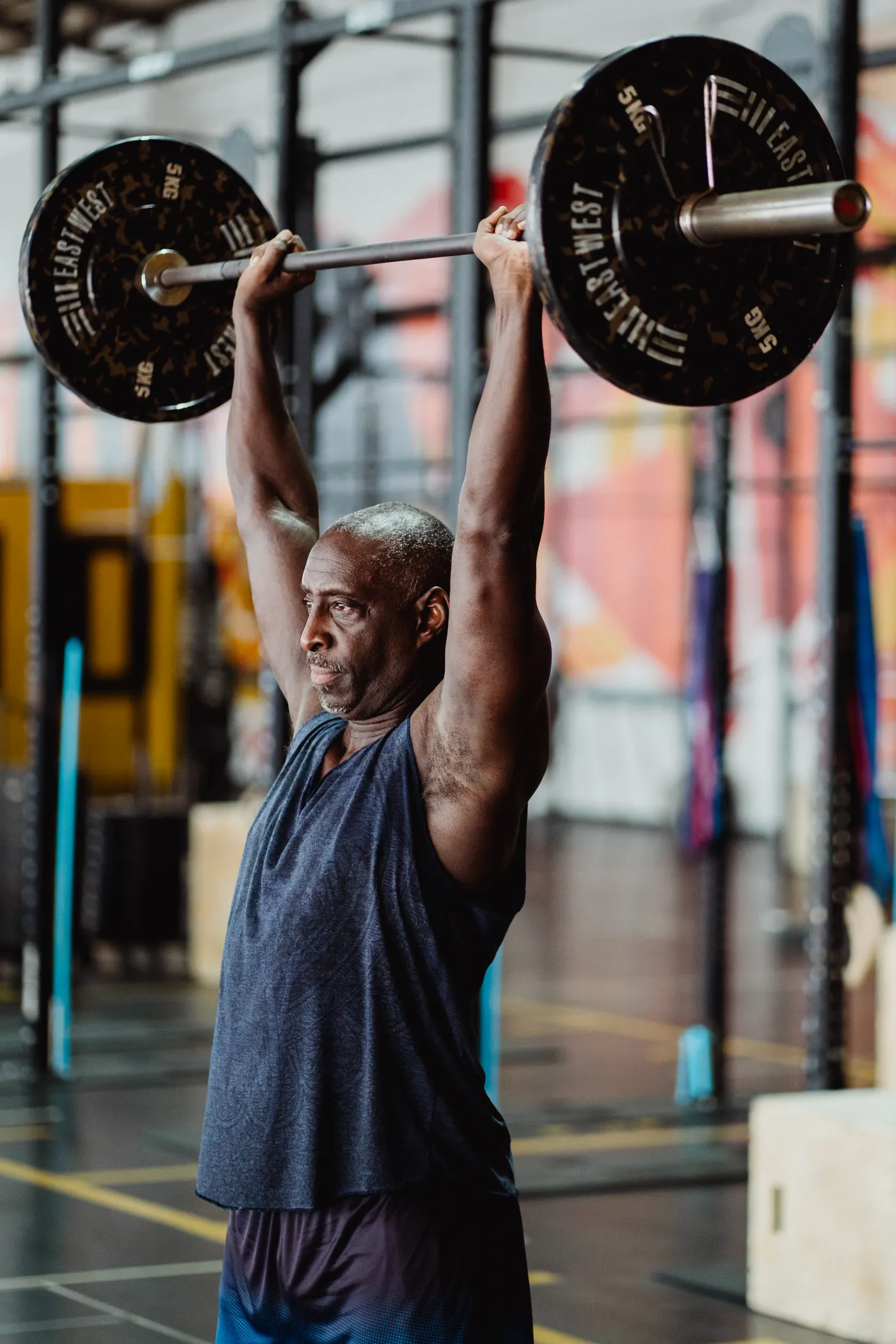
Use the next month to compare how two loading styles feel and perform in your own gym, without pretending to reproduce a metabolomics laboratory. Keep the exercises stable and log the load, repetitions, approximate repetitions in reserve, rest periods and any unusual discomfort. A simple two-day full-body schedule works well as a starting point for many healthy adults who already know the movements.
Session A: choose a squat or leg-press pattern, a horizontal row and a press. After warm-ups, perform two or three controlled working sets of roughly six to ten repetitions for each. Add a hinge or carry if time and recovery permit. Rest long enough to repeat technically sound efforts, commonly around two minutes for demanding compounds.
Session B: use a hinge or hip-extension pattern, a pulldown or supported row, and a press variation. Work mainly in the 12- to 20-repetition range with a lighter load. Finish with a manageable leg-extension, curl or lateral-raise variation if available. Stay near, but not necessarily at, muscular failure. Longer sets should still use full controlled repetitions.
In week one, establish repeatable weights and technique. In week two, add a repetition where form permits. In week three, make a small load increase on exercises that have reached the top of their target range. In week four, compare performance and fatigue rather than forcing another increase everywhere. This is a practical progression template, not a clinical prescription or a promise that one month will transform muscle mass. Anyone returning from injury or managing significant medical limitations should adapt the plan with qualified guidance.
Powerlifting Shirts & Lifting Gear
Powerlifting shirts and gym gear for squat, bench and deadlift lifters who live for heavy numbers.


Nice Rack Meme Power Rack Top & Gymbros T-Shirt
Rep “Nice Rack Gym Meme” humor in and out of the gym.

Gymhead Skull Plate Vest Tank Top
Add some powerlifting attitude to training with “Gymhead Skull Plate Funny Powerlifting”.


Time to Lift Tee
Bring “If You're Reading This It's Time To Lift” humor to your next gym day.

I Want You To Lift Heavy – Patriotic Uncle Sam Workout Sticker
Bring “I Want You To Lift” attitude to your water bottle or laptop.

Platehead Skull Decal Water Bottles & Gear Meme Sticker
A fun “Platehead” touch for bottles, laptops, and lockers.

Ultimate Meme : Power Rack Shirt & Home Gains T-Shirt
Show some lifting attitude with a playful “Ultimate Gym Meme” tee.

No Days Off for Daily Workouts, Lifting, and Fitness Di Hoodie
Keep it laid-back with a little “No Days Off” attitude.

I Wanna Lift All Night Sweatshirt
Add a playful “I Wanna Lift All Night” touch to your casual rotation.
What the study cannot prove, and the useful takeaway

Seventeen participants is a small starting point for developing a reliable biomarker, especially when the proposed signature relies on machine-learning analysis of several variables. The sample included only young men, the intervention lasted eight weeks, and training consisted of leg press and leg extension. There was no independent validation group showing that the same blood signature could correctly classify unfamiliar people, much less predict who would gain more muscle.
Even a strong internal classification score should be read carefully. The reported 0.94 area under the curve reflects discrimination within the study’s analysis, not a 94% chance that a random gym member benefits more from heavy weights. The result also does not imply that choline, glucose or alanine supplements should be manipulated to imitate a training effect. Those molecules participate in many ordinary physiological processes, and the researchers did not test a supplementation strategy.
The clearest contribution is conceptual. Heavy and light resistance training can produce shared metabolic adaptations while leaving potentially distinct patterns in circulating molecules. This may eventually help researchers understand why different training programs feel different or interact with individual biology. That future depends on larger samples, multiple populations, better external testing and direct links between the blood signals and meaningful outcomes.
Until then, the decision is refreshingly practical. Use heavier sets to build confidence and skill under heavier loads; use lighter challenging sets when they suit the exercise, equipment or recovery demands. Monitor progress, avoid unnecessary failure on risky lifts, and train often enough for the work to accumulate. The blood chemistry is interesting. The quality of your next several months of training is still more important.