Advertising disclosure: This page includes affiliate product links that may earn us a commission, as well as products from our own store.
A farmer’s walk looks almost suspiciously simple: pick up two heavy objects and go somewhere. In practice, the result depends on the first lift, how steadily you walk, the space you have available and whether the weight stays in your hands until the end of the course. A carry that becomes a hurried shuffle is a different task from a controlled twenty-metre walk. This guide treats the lift, the walk and the setdown as one repeatable training exercise, then shows how to progress without sacrificing the rest of your strength session. No special strongman kit is necessary to learn the pattern.
Pick up the weights like a lift, not a scramble
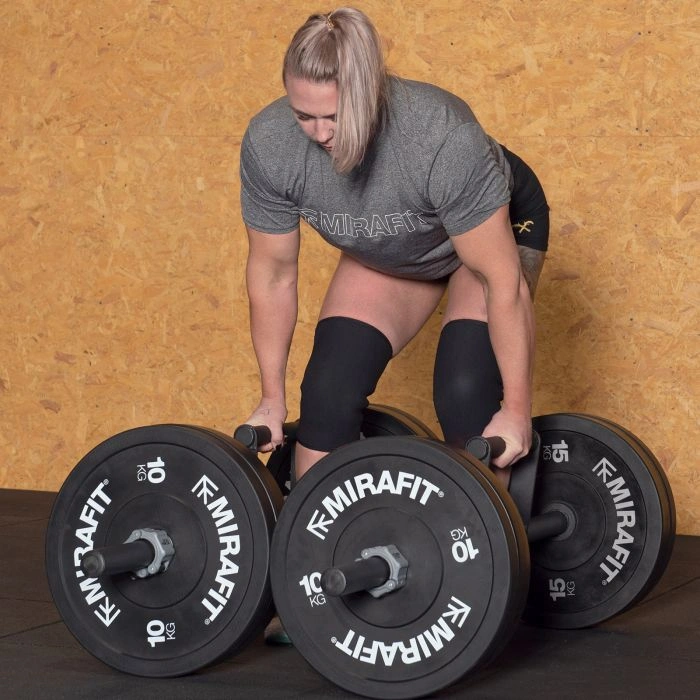
Begin by clearing a straight route and a safe place to put the weights down. Mark the finish with a cone, tape or a visual point you can recognize without turning your head. Place matching dumbbells or kettlebells at your sides with handles facing a position your wrists can actually reach. If you use long plate-loaded farmer handles, check that the plates and collars are secure and that both handles are balanced front to back. Equipment stability matters before you take the first step.
Stand between the implements rather than reaching them far out in front of your toes. Bend through the knees and hips as much as their handle height requires; keep the weights close to the sides of your legs. Wrap each hand fully around its grip, take a deliberate brace and stand by pushing through the floor. Imagine doing two small, simultaneous deadlifts, not yanking the implements off the ground with your shoulders. The weight should clear the floor without twisting you to one side.
When you reach standing, wait for both implements to settle. This brief pause makes a poor pickup obvious: one handle may be angled sharply, the torso may already be tilted or the wrists may feel close to opening. Correct what you can while standing, or put the implements down and start lighter. A crooked initial position rarely improves when you add walking speed. Start with a load you can lift and lower under control, even if you could hold something heavier for a few seconds.
The finish is part of the lift too. Stop walking, settle your feet, bend knees and hips, and guide the implements down into the designated space. Do not swing them forward toward your shoes or drop them beside another person. On a shared gym floor, a predictable setdown is just as important as the distance covered.
Set a line and walk under control
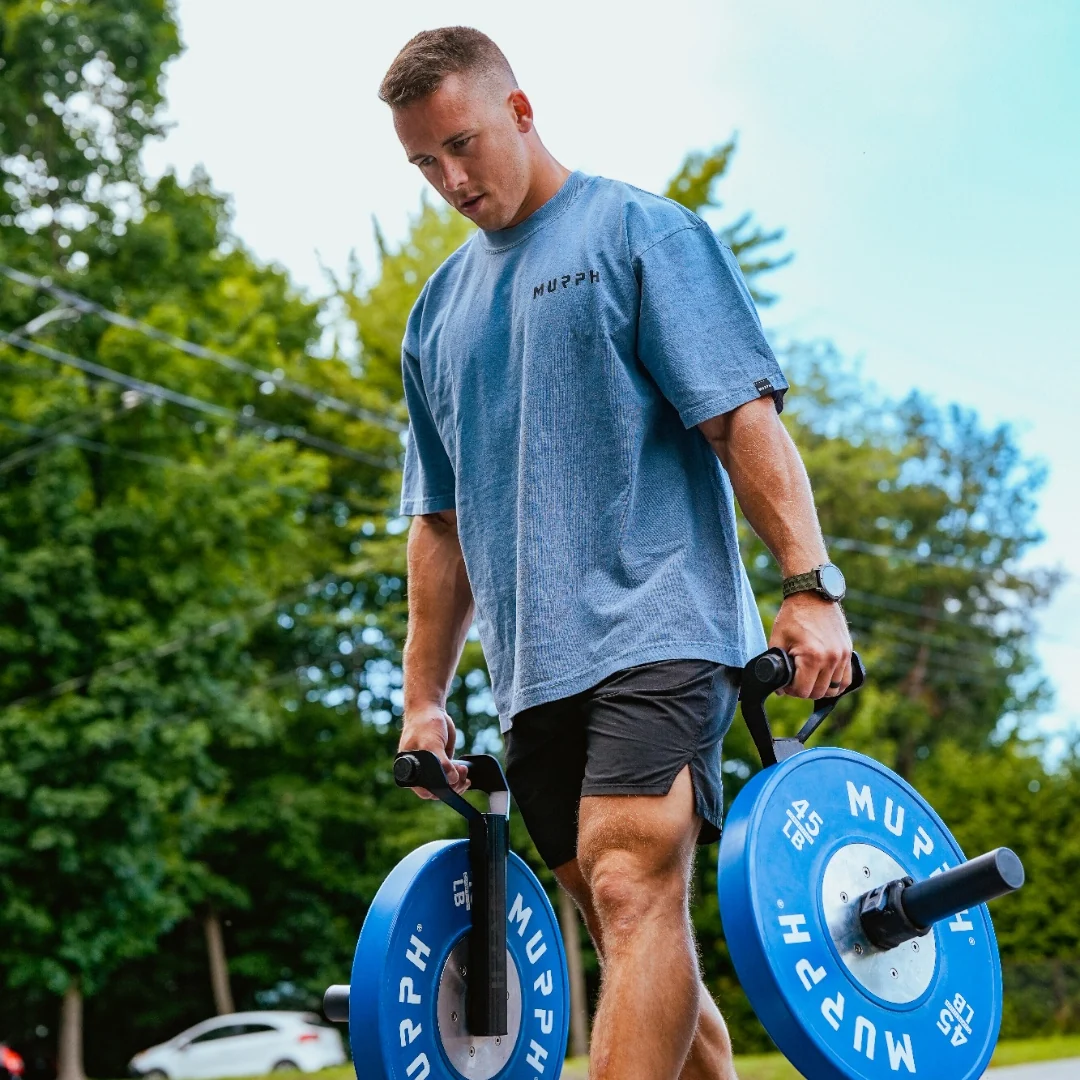
Once the weights are clear, take your first step without lunging forward. Let your arms hang, keep your gaze level and maintain enough abdominal tension that your ribs and pelvis do not drift apart. Your shoulders need not be forced into an exaggerated military posture. Aim instead for a stable upper back and two loads that remain near your sides, rather than striking your thighs with every stride.
Shorter, measured steps are a useful starting point. Very long steps can make the weights oscillate, particularly if handles swing or bells hang below the hands. Very quick steps introduce their own challenge: you may cover more ground while losing control of the trunk or misjudging a turn. A smooth pace that you can repeat is more useful for basic progression than racing someone else across the gym. Breathing should continue; a carry is not a reason to hold your breath for an entire long lane.
Watch for simple technical signals. If one weight consistently moves ahead of the other, check your grip and stride before assuming that your legs are uneven. If your torso leans farther forward each few metres, you may be increasing speed or exceeding a manageable load. If your arms start flexing to keep the weights from hitting you, reconsider implement clearance. These are adjustments to the task, not reasons to chase a picture-perfect silhouette at any cost.
Use one defined route and record the actual distance, not a rough guess based on how long your gym aisle looks. For a crowded room, a short ten-metre lane can work: complete a single length, set the weights down safely, then reset. Repeated brief lengths may be more consistent than weaving around benches and people. When your goal is conditioning, time is a valid measure as well, but log whether it was continuous walking or a series of interrupted efforts.
Choose dumbbells, kettlebells or purpose-built handles
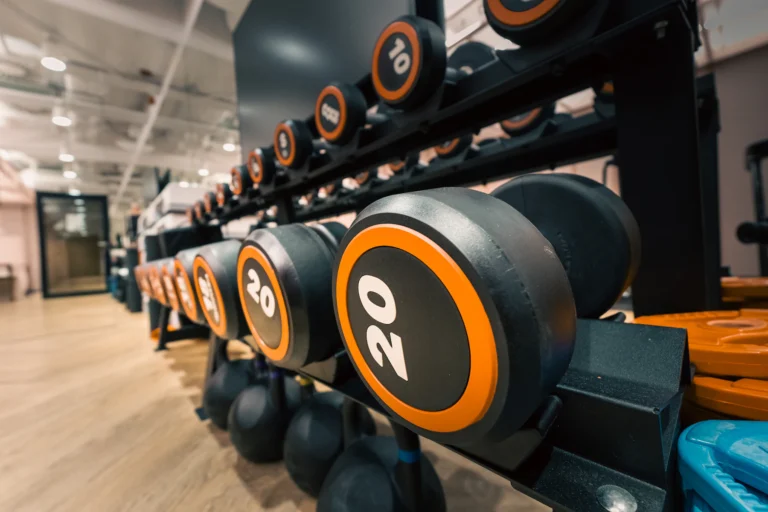
Dumbbells make the simplest entry point because many gyms already have matching pairs. They are easy to select and put back, and their relatively compact shape makes it easier to move through a narrow lane. Their limit is often the available weight range or the shape of the grip. A large fixed dumbbell may strike your leg or restrict your stride even when you can hold the weight. That is a clearance problem, not necessarily a weakness in your trunk.
Kettlebells offer a different hanging balance and handle shape. Their mass sits below the handle, and they may swing if the walk becomes jerky. They can be particularly practical for a modest starting load and a short measured route. A handle that feels comfortable for swings is not automatically comfortable for prolonged static gripping, so test the carry before committing to long sets. The object you choose determines part of the difficulty, and changing from dumbbells to kettlebells should be logged as a new variation.
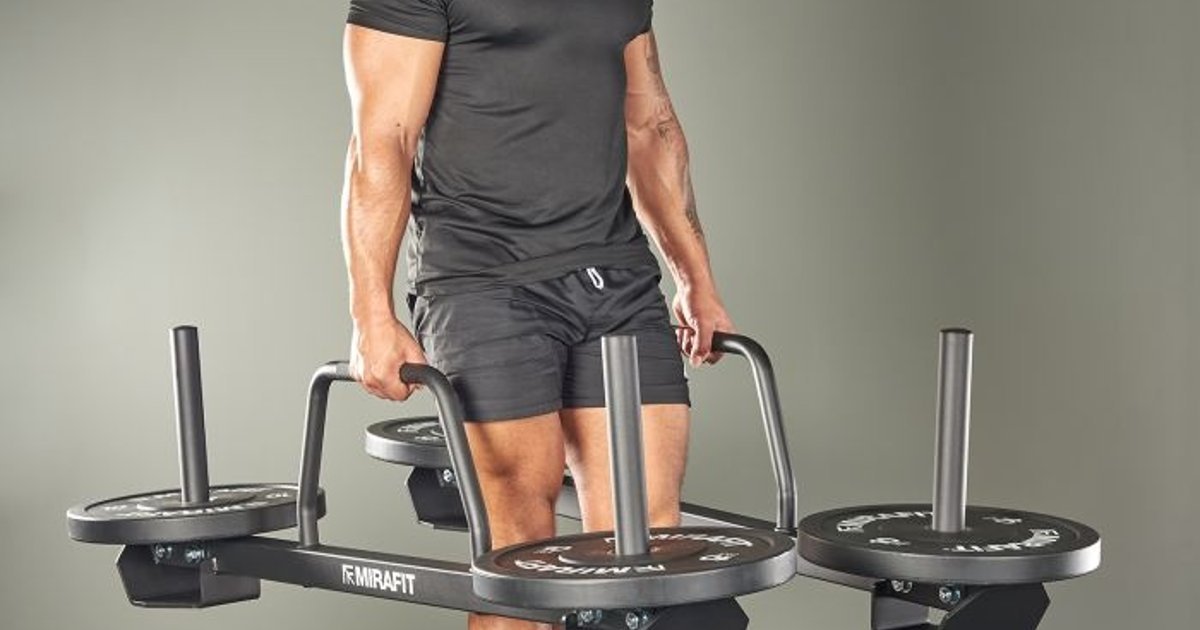
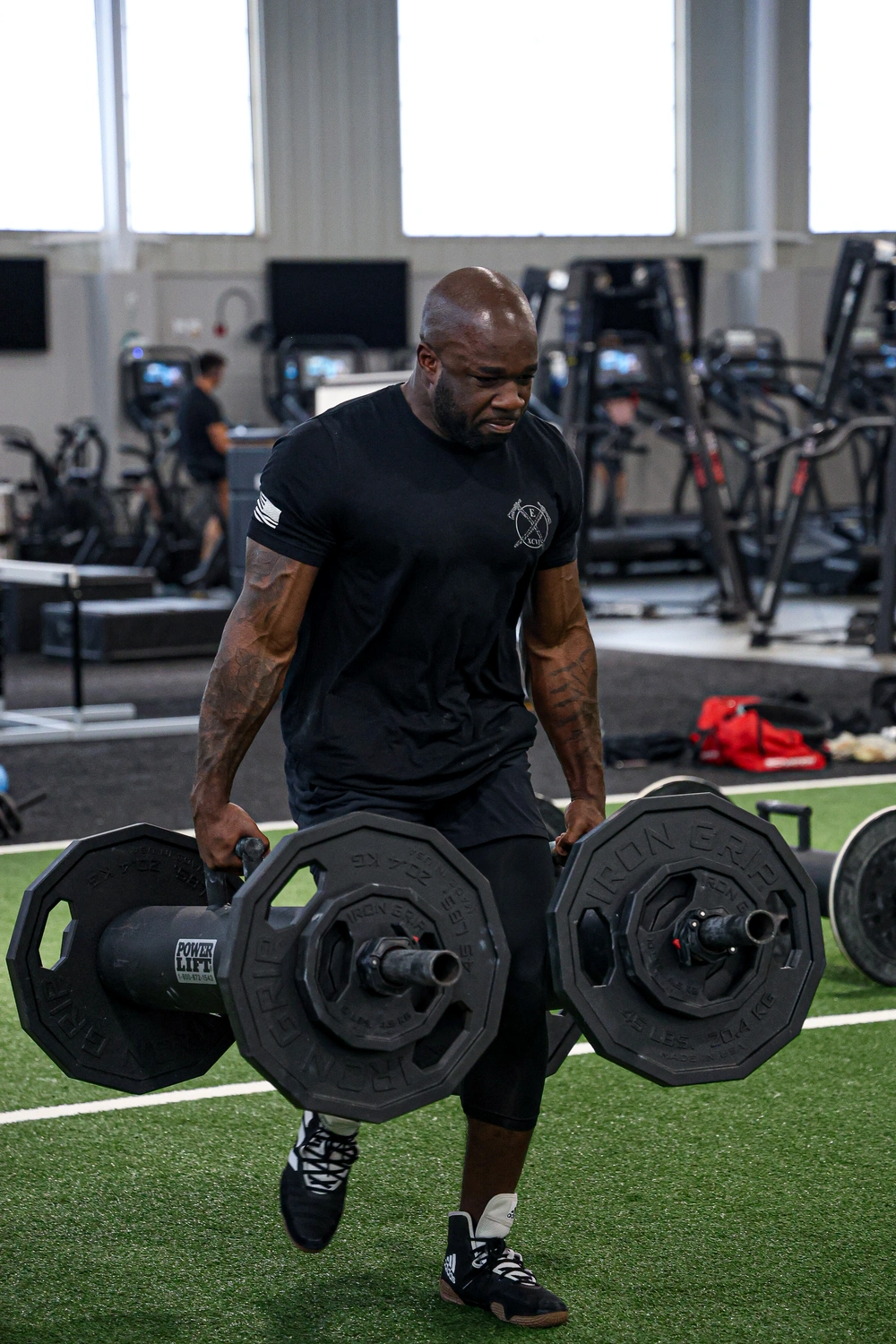
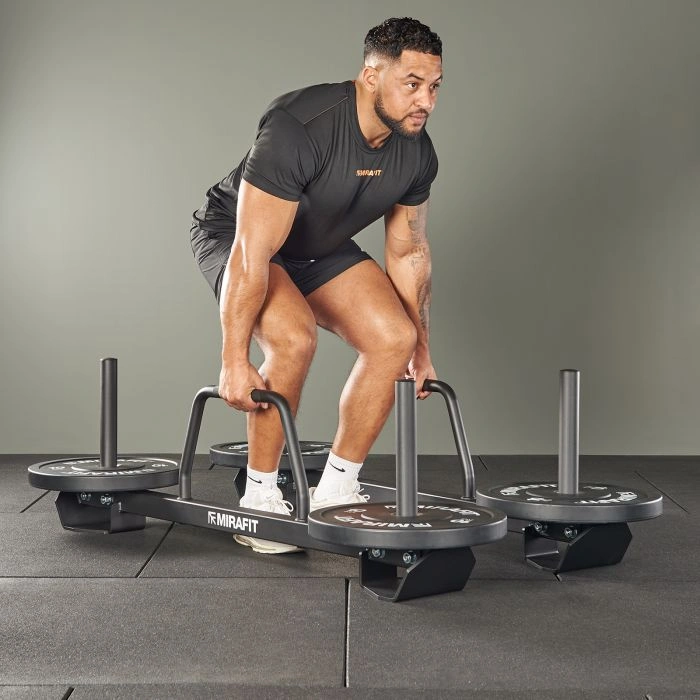
Plate-loaded farmer handles are built for carries and can be loaded beyond typical free-weight pairs, but their dimensions and starting height vary substantially. Some have horizontal loadable shafts, others upright posts. Taller grip heights change the pickup, while long shafts demand more room at the sides and during a turn. Use suitable collars for the specific sleeve diameter rather than assuming ordinary barbell clips will fit. If a pair feels unstable during the first few steps, check its loading arrangement instead of merely gripping harder.
A trap or open hex bar can also support a loaded walk when the room permits, though its frame changes how the load moves around your legs. It is not a direct substitute for two independent handles in a narrow aisle. For a compact home gym, choose the setup that offers a clear route and an uncomplicated setdown before chasing the heaviest theoretical capacity. The right choice is the one you can repeat safely and measure consistently.

Equipment Worth Exploring
Explore equipment, accessories and gear from our carefully selected range.


Rubber Hex Dumbbells
Rubber-coated hex dumbbell pairs with a stable shape for home and commercial strength training.


Cast Iron Kettlebells
Textured cast-iron kettlebells for swings, squats, carries, and full-body training.


Open Hex Bar
Open-frame trap bar with multiple handles for deadlifts, carries, and lower-body training.


Manage turns, grip limits and one-sided carries
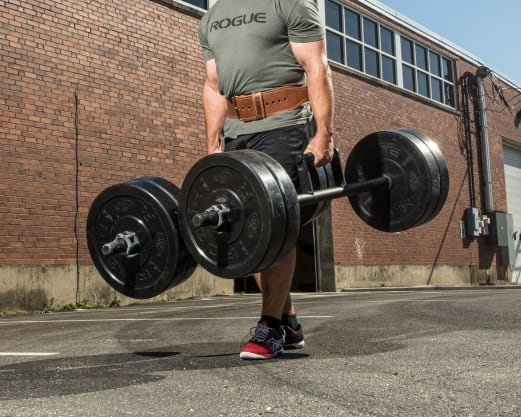
Turning is where a tidy straight-line carry can suddenly become a chaotic exercise. With heavy, long farmer handles, an abrupt pivot risks swinging the ends into your legs or another object. Slow before the marker, make several small steps around it, and re-establish your line before accelerating. If the available floor is too tight for a turn, finish each length with a controlled setdown and restart in the opposite direction. Counting a stop-and-reset as an uninterrupted carry would exaggerate your endurance, so record it accurately.
A farmer’s walk challenges grip, but your goal may be overall loaded walking rather than a grip-only test. Decide which limit you want. If the hands open before your gait or trunk is challenged, try shorter distances with a consistent load. If grip is the primary target, avoid changing to lifting straps halfway through a set and then comparing that result with an unassisted effort. Straps can change the task. Chalk, glove material, sweat and handle diameter likewise affect comparisons; note any meaningful equipment change.
The one-sided suitcase carry is not simply a lighter farmer’s walk. Carrying weight on one side asks the trunk to resist a different sideways bending demand. Begin with a considerably manageable load, use the same distance for each hand, and watch for a shoulder hike, hip drift or shortened step on one side. Do not infer that an uneven load is automatically safer because the combined kilograms are smaller. Two-hand and one-hand carries deserve separate records.
If you want to train faster race-style walking, first establish stable pickups, predictable turns and a clear lane. Speed can be its own later progression, but do not add speed, load and distance simultaneously and expect to know which change made a set harder. A controlled carry is an excellent base even if your eventual goal is a fast strongman event.
Use a four-week progression without sabotaging the rest of the session
A practical first block can be built around two sessions per week, provided recovery and your existing workload allow it. Start with two matching implements that permit tall walking, stable grips and an unhurried setdown. For strength-focused practice, a short course with adequate rest makes technique easier to monitor. For conditioning, slightly longer but lighter efforts may be more appropriate. These are coaching examples rather than proven universal loading prescriptions, and they are not instructions to attempt an all-out maximum.
Week 1: Complete three carries of roughly 15–20 metres, with enough rest to perform each pickup well. Record load per hand, implement type and whether your route includes a turn. Start conservatively. If the course is shorter, record the number of lengths and any setdowns rather than treating each as the same distance by default.
Week 2: Keep the same load and add a small amount of distance to each clean carry, such as five metres, only if the previous week’s gait and grip stayed consistent. Alternatively, preserve the original distance and make the pickup and setdown more repeatable. Improvement can mean less oscillation at the same load, not only an extra number in the log.
Week 3: Return to the original distance and test a modest increase in load if you can still maintain control. A heavier pair is not a successful progression if you must slam it down mid-course. Keep the same route and rest periods so the comparison means something. If your available dumbbells jump too sharply in weight, repeat the existing load and sharpen execution rather than forcing the next pair.
Week 4: Repeat the cleanest successful prescription from the first three weeks and compare pickup quality, pacing, finish control and grip security. If tiredness is high from other training, reduce total carries instead of turning the week into a compulsory test. The block should leave you able to train again, not become a weekly grip-failure contest.
Placement in the workout matters. Heavy carries before rows or deadlifts can tire your hands and influence the lifts that follow. Put them after your priority pulling work when grip freshness is essential. Alternatively, on a separate conditioning day, moderate carries can be a central exercise. Track the training context and do not compare a fresh carry to one performed after an hour of heavy pulls. Progress is more convincing when the setup, route, rest and preceding fatigue are sufficiently similar.

Functional Fitness Shirts & Workout Gear
Functional-fitness shirts, tanks and workout gear for athletes who train strength, conditioning and everything in between.


Vitruvian Kettlebell Tee
Heavy lifts, good laughs, and a little “Vitruvian Man With Kettlebells” energy.


Kettlebell Skull Tee
Heavy lifts, good laughs, and a little “Kettlebell Skull Gym Meme” energy.

Hybrid Athlete Strength & Endurance Tank
Add some lifting attitude to training with “Hybrid Athlete”.

Earth Kettlebell Meme Shirt – Lifting The Earth T-Shirt
Show some lifting attitude with a playful “Earth Kettlebell” tee.

Kettlebell Heartbeat Decal for Water Bottles Laptops Wo Sticker
Put “Kettlebell Heartbeat” gym humor on your laptop, bottle, or gym gear.

Gym Equation Kettlebell Makes Me Happy Design Workout a Hoodie
Make your off-duty look more fun with “Gym Equation”.

Lift Together Grow Stronger Buddies Friendship Workout T-Shirt
Make gym days more fun with “Lift Together Grow Stronger” style.

OnlyGains Kettlebell Meme Sweater Meme T-Shirt
Keep things casual with a little “OnlyGains” attitude.