Advertising disclosure: This page includes affiliate product links that may earn us a commission, as well as products from our own store.
Tate Press: Learn the Elbows-Out Path Before Adding Weight
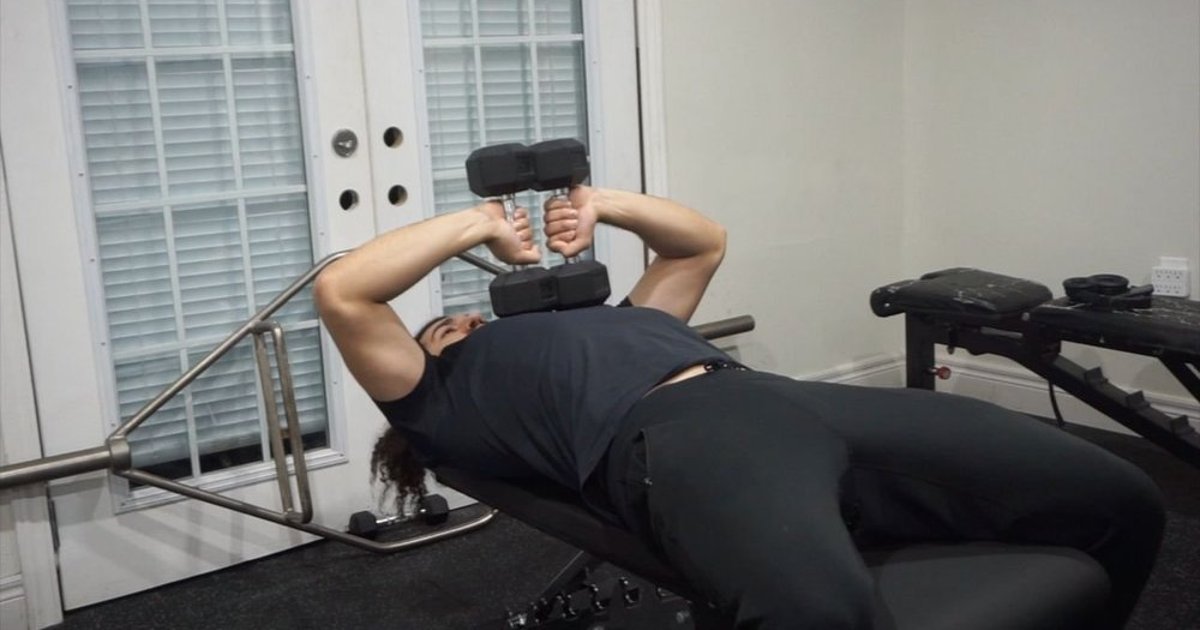
The Tate press can look like a dumbbell bench press that went off course. That resemblance is misleading. Its defining task is to bend and straighten the elbows while the dumbbells move inward toward the chest, rather than lowering the upper arms into an ordinary pressing pattern. The distinction is easier to learn with modest weights than to discover midway through a heavy set.
Use it as an optional triceps accessory, with a setup and range you can repeat. It does not need to replace every other triceps movement, and its unfamiliar angle is not evidence that it is automatically better. A useful first goal is simply to make the intended movement recognizable from the first repetition to the last.
1. Establish support before you practise the movement
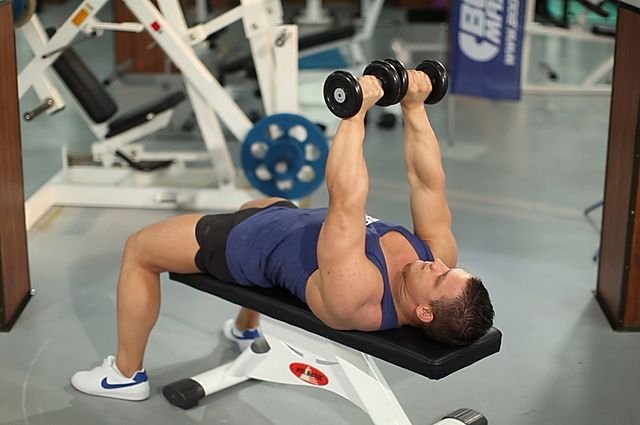
Begin on a stable flat bench with your head and torso supported and your feet placed securely. Choose dumbbells light enough to position without a struggle. Once lying down, bring them above the chest with the arms extended and palms facing toward the feet. The hands start close together rather than spread wide as they might be in a conventional dumbbell press.
Before bending the elbows, hold that position briefly. Check that you can keep the weights steady without repeatedly shifting the shoulders or arching farther to find balance. If you cannot establish a controlled start, use a lighter pair. The setup is part of the exercise, not a separate challenge that should leave you tired before the first repetition.
Plan the finish as well. At the end of a set, bring the weights back to a stable position and use a controlled method of sitting up or accepting assistance. Do not wait until your arms are exhausted to work out where the dumbbells will go. Keep the area beside the bench clear of spare weights and other people.
Flat support is a sensible reference point while learning. An incline changes the relationship between your torso, upper arms and the weights. If you later choose a small incline, record the setting and treat it as a variation. Comparing repetitions across different bench positions without noting the change can make apparent progress difficult to interpret.
For equipment, prioritize a secure bench and dumbbells you can handle comfortably. Adjustable handles and compatible small plates may make progression more manageable, but only use loading components approved for that particular system. A collar intended for an Olympic bar is not automatically suitable for a dumbbell handle.

Equipment Worth Exploring
Explore equipment, accessories and gear from our carefully selected range.


Rubber Hex Dumbbells
Rubber-coated hex dumbbell pairs with a stable shape for home and commercial strength training.




Multi Bench MBX-650 2.0
Adjustable multi-bench with roller adjustment, 15 backrest positions and accessory mounts.


Grip Plates
Rubber-coated weight plates with handholds for loading barbells and machines.
2. Let the elbows bend outward while the hands travel inward

From the supported starting position, bend the elbows so they point outward as the hands descend toward the upper chest. The dumbbells change orientation as the forearms move; they do not simply drop vertically like two loose objects. Keep their ends close together and control the arc. Then extend the elbows to return the weights above the chest.
The difference from a standard press is worth rehearsing with very light dumbbells. In a normal dumbbell bench press, the upper arms move down and away from the starting position before the weights are pressed up. In the Tate press, keep attention on the elbow-bending task and avoid converting every difficult repetition into that familiar press.
Use a range that allows control. A gentle approach toward the chest is different from letting the weights land on it and using the torso as a launching pad. If a particular dumbbell shape makes the path awkward, reduce the load or choose another triceps exercise. There is no benefit in forcing two bulky heads past each other to reach an arbitrary depth.
Keep the wrists from collapsing as the angle changes. Your grip should remain secure throughout the descent and return. If maintaining the hand position becomes the main struggle, stop and adjust before continuing. Increasing the weight will not clarify a movement that is still inconsistent with a lighter pair.
Think of the first sessions as learning a repeatable path. Several controlled repetitions are more informative than a long set in which the hands drift, the dumbbells separate unpredictably and the upper arms begin moving in different directions. The set ends when you can no longer reproduce the task you intended.
3. Choose your version and keep it consistent
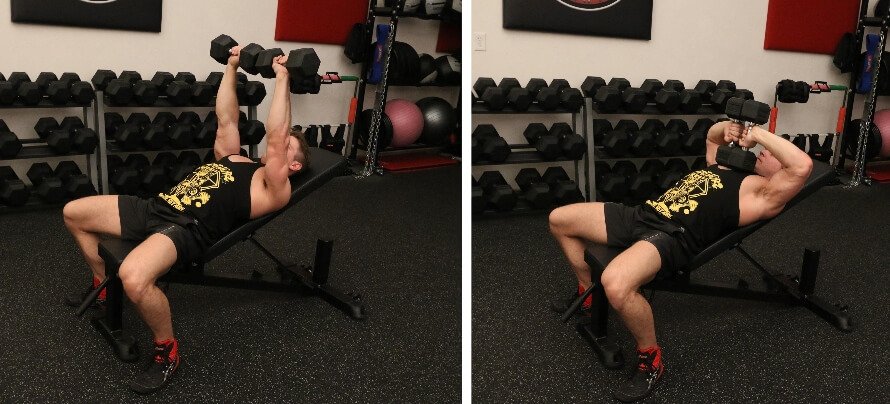
Demonstrations of the Tate press do not all use the same bench angle, contact point or amount of movement at the shoulder. That does not require an argument about a single perfect-looking repetition. It does require deciding what you are practising and keeping those details stable enough to compare your own sessions.
Choose a flat or modestly inclined setup, a manageable lower position and a controlled finish. Record whether the dumbbell ends stay lightly together or just close throughout the movement. If contact forces an uncomfortable wrist angle with your equipment, do not squeeze the bells together harder merely to match a photograph.
Make one adjustment at a time. For example, changing the incline and load simultaneously leaves you unable to tell which caused a difference in control. Keep the same weights while testing a different bench position, then decide whether that variation deserves its own place in the log. Do not compare it directly with an older entry as though nothing changed.
A short video from the same angle can help you observe consistency. Look for the weights reaching a similar lower position, the elbows bending rather than the whole repetition turning into a press, and the torso remaining supported. Video cannot diagnose discomfort, but it can reveal that the final repetitions differ substantially from the first.
The exercise should be judged by the task you can perform, not by how unusual it looks. If it feels awkward after reducing the load and simplifying the setup, another accessory may be a better fit. You do not need to master every available variation to train the triceps effectively within a broader programme.
4. Place it beside your pressing work, not on top of everything

The Tate press is commonly used as assistance work for the triceps. That role does not prove that adding it will increase a particular bench-press result. A stalled press can involve several factors, including the programme, technique, recovery and the difficulty of the attempts being compared. Treat a new accessory as a testable choice rather than a guaranteed correction.
If you already have pressing and multiple triceps exercises, consider substituting a small amount of Tate-press work instead of adding an entire extra block. This makes it easier to judge whether you tolerate and enjoy the movement without also changing the total session dramatically. Keep the main work identifiable rather than letting accessories expand without a purpose.
For an initial trial, two controlled sets after your main pressing work can be enough to learn how the exercise behaves. Pick a repetition target that lets you stop with several good repetitions still possible. That is a practical starting example, not an optimal dose established for every lifter. Your existing workload and response should guide the next decision.
Do not interpret joint discomfort as proof that an unfamiliar angle is reaching a neglected muscle. Stop a painful set. If the problem persists with a lighter, simpler setup, select a different movement and seek appropriate guidance when needed. Claims that any one triceps exercise is universally easy on the elbows are too broad to make useful decisions for an individual.
Arm-day, push-day and dumbbell designs suit the training context below, but the merchandise is optional. It has no bearing on whether this accessory fits your programme or improves your pressing.

Bodybuilding Shirts & Workout Gear
Bodybuilding shirts, tanks and gym gear for lifters chasing muscle, size, symmetry and the pump.

Donut Dumbbell Donuts Barbell Bulk Diet Sticker
A fun “Donut Dumbbell Donuts Barbell” touch for bottles, laptops, and lockers.

Pizza Dumbbell Barbell Bulk Diet Sticker
Stick a little “Pizza Dumbbell Barbell” humor on your favorite gear.

Shirt Lovers – I Love Valentine'S Day – Dumbbell & T-Shirt
Rep “for Gym Lovers” humor in and out of the gym.

Dumbbell Meme Shirt – Essential & Gymbros Seeking T-Shirt
Make gym days more fun with “Dumbbell Gym Meme” style.


Dumbbell Heartbeat Crewneck Pullover Sweater Workout Fa T-Shirt
Add a playful “Dumbbell Heartbeat” touch to your casual rotation.

Gym If You're Reading This It's Arm Day Drake Parody & T-Shirt
Keep things casual with a little “If You're Reading This It's Arm Day Drake” attitude.

Lift Eat Sleep Repeat Hoodie
Make your off-duty look more fun with “Lift Eat Sleep Repeat”.

Welcome to the Gun Show for Big Biceps and Gains | Rock Tank Top
Add some lifting attitude to training with “Welcome to the Gun Show”.
5. Progress the repeatable version you actually trained

Write down the bench setting, weight per hand, repetitions and any deliberate pause. Include a simple note about the lower position or the reason a set ended. A log that says only “Tate press, heavy” hides the details needed to compare the next workout. Keep warm-up attempts separate from the working sets you intend to track.
Suppose you begin with two sets of ten using a light pair and finish every repetition with a similar path. A sensible next target might be another clean repetition, rather than an immediate increase in weight. Once the planned repetitions are repeatable across sessions, try the smallest appropriate load increase and reassess the same movement.
If the heavier pair changes the exercise into an ordinary dumbbell press, it has not demonstrated progress in the version you were tracking. Return to the previous load or reduce the repetition target while learning to control the new one. Similarly, do not count a shorter descent as an improvement without recording that the range changed.
Review the accessory alongside the rest of the session over several weeks. Does it remain manageable after the main work? Can you recover and repeat it? Does it add useful variety without crowding out exercises that already serve you well? Keep it when the answers support it, and replace it when another option better matches your needs.
The useful outcome is not a mandatory new exercise. It is a clearer triceps-training choice: supported setup, controlled elbow extension, consistent logging and gradual changes that preserve what you intended to train.