Advertising disclosure: This page includes affiliate product links that may earn us a commission, as well as products from our own store.
Lateral Step-Downs: Control the Heel Tap, Keep Your Knee on Track and Build Single-Leg Strength
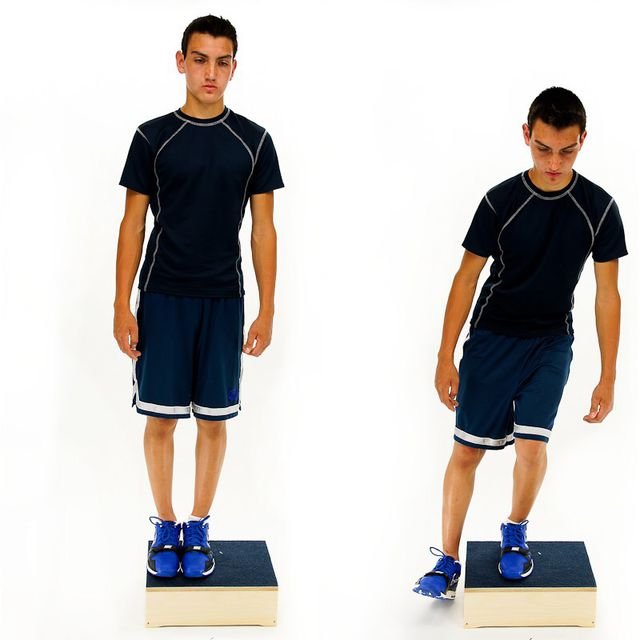
A good lateral step-down looks almost uneventful. One foot stays planted on a short step while the other heel moves slowly toward the floor, touches lightly, and comes straight back up. But that quiet lowering phase exposes something heavy squats can hide: whether one leg can control the knee, hip and pelvis without bouncing, tipping or borrowing momentum from the free foot.
This is not a magic knee-fixing exercise or a replacement for hard leg training. It is a precise single-leg accessory that can make your training more deliberate. Here is how to select the right step, make every repetition honest, recognize common cheats, and progress without turning a balance drill into a circus act.
1. What the lateral step-down trains and what it does not prove
Stand on one leg and slowly bend the supporting knee: your quadriceps produce force to resist the descent. The gluteal muscles help control the hip and pelvis, while the calf and foot help manage pressure and balance. The free leg is mostly a measuring stick. It tells you how far you have descended, not how much work you should do with that foot.
Unlike a step-up, the useful part of a step-down is deliberately slowing your body’s downward movement. That makes eccentric control the most obvious training demand, although the return to standing also requires concentric strength. You can move through only a shallow bend and still make the working leg do real work if you resist gravity throughout the lowering phase.
Coaches also use step-downs to observe differences between sides. A heel tap can reveal a pelvis that drops, a foot that rolls inward, or a knee that changes direction under load. These observations are useful for deciding what to practice, but one imperfect repetition is not a medical diagnosis or proof that an injury is inevitable. Bodies are allowed to move differently; the aim is repeatable, comfortable control, not a frozen textbook pose.
For lifters, think of the movement as a quality-focused accessory after squats or as a low-load warm-up. It complements harder exercises rather than automatically outranking them for muscle growth.
2. Choose a step height that lets the working leg do the job
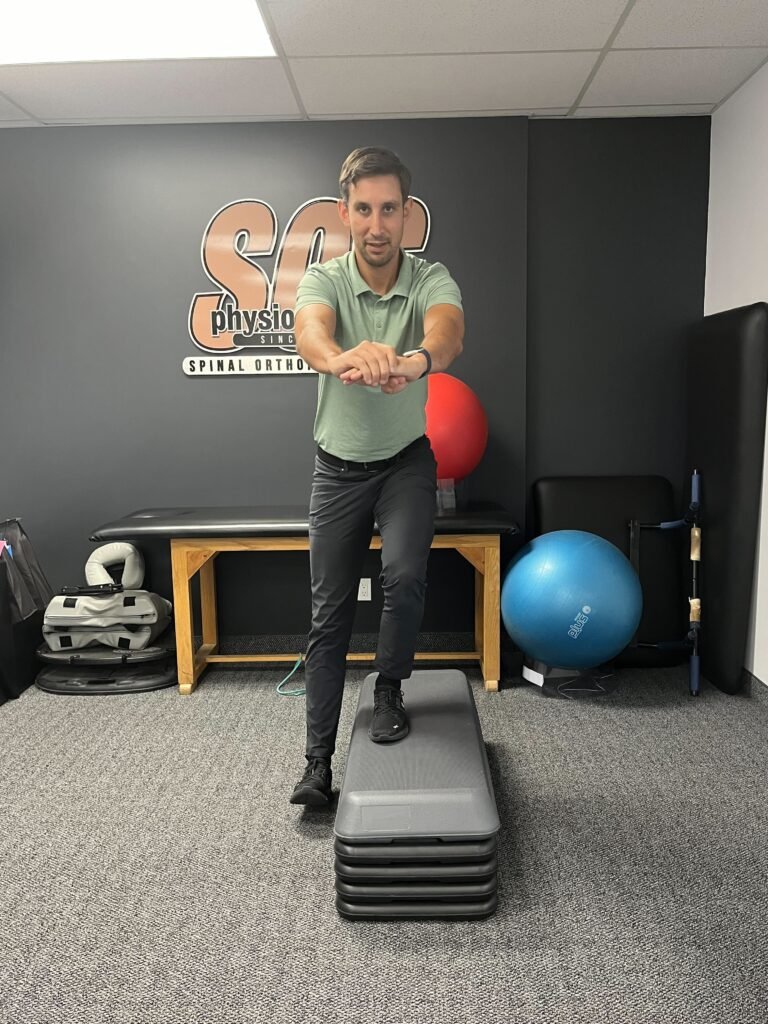
Start with a genuinely low, stable surface. A roughly 10–15 cm step works as an initial experiment for many healthy adults, but it is not a mandatory height. A low aerobic step or sturdy platform is better than a tall, wobbly bench. The appropriate height is one that lets your free heel approach the floor while you keep the standing foot planted and avoid dropping the last few centimetres.
Stand sideways near the platform edge so one foot is supported and the other leg hangs beside it. Keep the entire working foot on the step; moving onto the toe can turn the drill into a calf-dominant balancing act. Place your hands on your hips to notice pelvic tilt, reach your arms forward for balance, or hold a stable support lightly if you would otherwise wobble. The torso may incline slightly forward naturally. You do not need to force a perfectly vertical chest.
Choose a surface that will not slide, rock, buckle or tip when you shift weight. Check the floor around it too: the free heel needs a clear landing spot. A bench can be useful later, but its height often makes beginners twist, push off the floor or shorten the motion. Lower is not an embarrassing regression; it is how you maintain the intended muscular challenge.
Test two or three unweighted repetitions on each side before starting your sets. If you have to drop sharply, push off the floor, or tilt the pelvis to reach the floor, reduce the step height or stop short of heel contact.

Equipment Worth Exploring
Explore equipment, accessories and gear from our carefully selected range.


Rubber Hex Dumbbells
Rubber-coated hex dumbbell pairs with a stable shape for home and commercial strength training.


Cast Iron Kettlebells
Textured cast-iron kettlebells for swings, squats, carries, and full-body training.



3. Make the heel tap a touch, not a second push-off
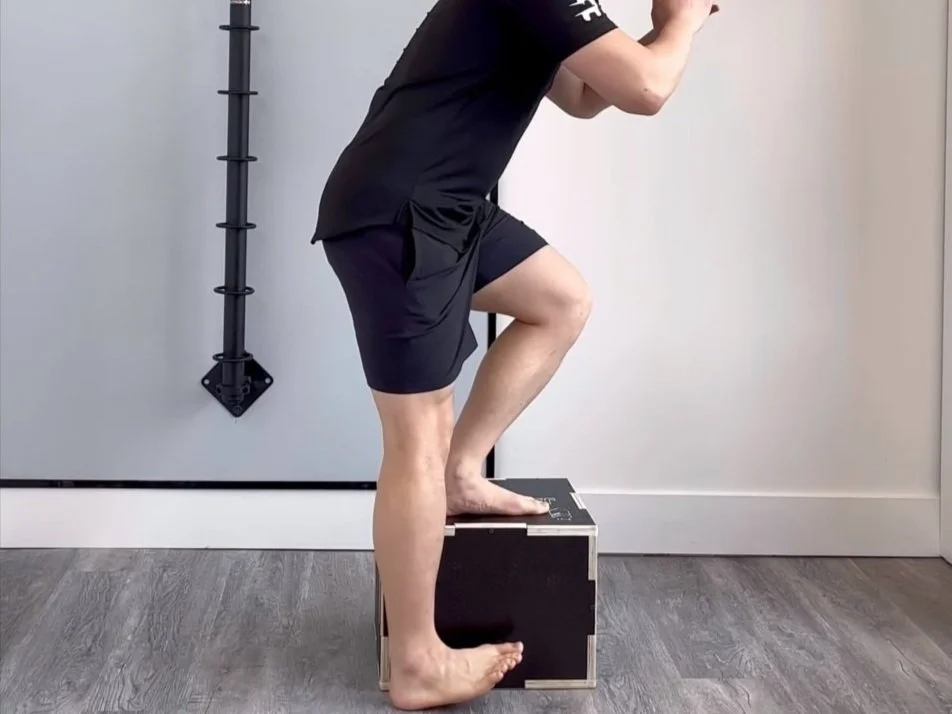
Begin tall on the working leg with the knee relaxed rather than rigidly locked. Inhale comfortably, brace enough to keep your trunk organized, and lower by bending the stance knee and hip. Imagine the supporting leg acting like the suspension of a vehicle: it absorbs the descent smoothly instead of letting the body fall.
- Lower for about two to four seconds. The speed is a coaching tool, not a universal scientific prescription. Choose a pace slow enough that you could stop midway without falling.
- Guide the knee broadly in the direction of the toes. Do not crank it outward; simply avoid an uncontrolled collapse as fatigue builds.
- Let the free heel brush the floor. Do not shift your weight onto it or spring upward from that foot.
- Stand back up using the leg on the step. Finish with your hips level, then repeat with the same controlled rhythm.
If the heel cannot reach the floor without a big hip drop, the heel tap is not required. Stop at a shallower depth and call that your current range. Filming a front or three-quarter view can help you see whether your foot, knee and pelvis tell the same story from rep to rep.
A useful set finishes when the next repetition would lose control. Eight clean reps can provide a better training signal than fifteen hurried ones with a loud floor landing on every descent.
4. Fix the four cheats that make step-downs easier but less useful
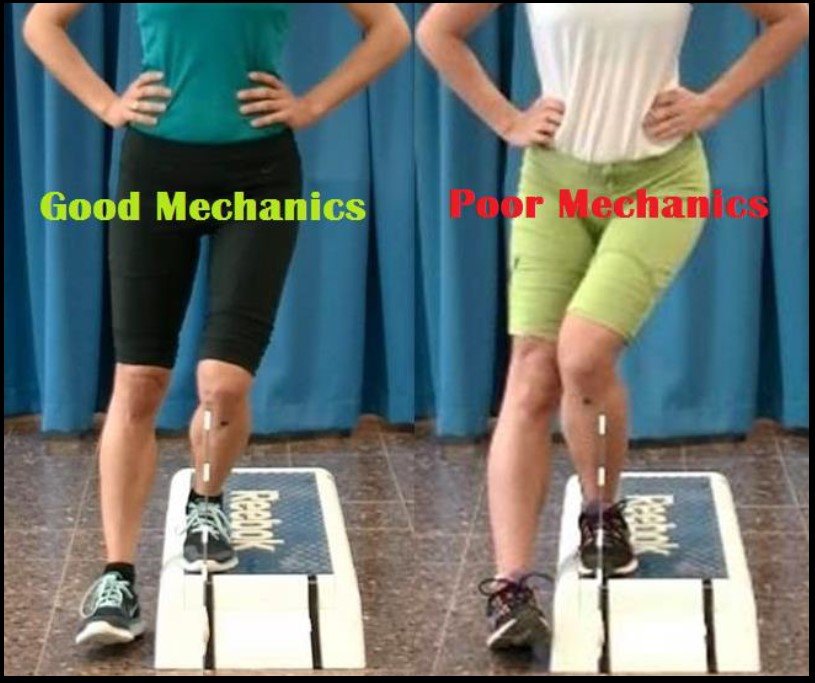
Knee suddenly collapses inward. First examine whether the step is too high or the set too fatiguing. Reduce depth, slow down and keep pressure distributed across the working foot. A little knee movement is normal; the issue is losing control compared with your own stable repetitions. Do not force the knee outside the foot just to make a video look perfect.
Pelvis drops and the trunk sways. One hip may dip toward the dangling leg as you reach for the floor. Put your hands on the hip bones, shorten the descent and add fingertip support. The goal is enough pelvic control that the free foot cannot drag the whole body down. A modest natural torso lean is different from a sudden sideways lurch.
Free foot jumps off the floor. This can hide a lack of strength in the working leg. Think of the heel contact as barely touching wet paint: it should leave a mark without transferring significant weight. If that is difficult, use a shorter step rather than adding ankle weights or a dumbbell.
Bottom half becomes a fall. The last third of the descent often exposes the biggest weakness. Try partial-range reps with an intentional pause before the point you lose control, or lower the step. Avoid turning the movement into repeated hard landings just to complete an arbitrary rep target.
Sharp pain, locking, giving way or swelling are not form cues to push through. Stop and obtain individualized medical or physiotherapy guidance when symptoms persist or make loaded knee bending difficult.
5. Step-downs versus step-ups, split squats and leg machines
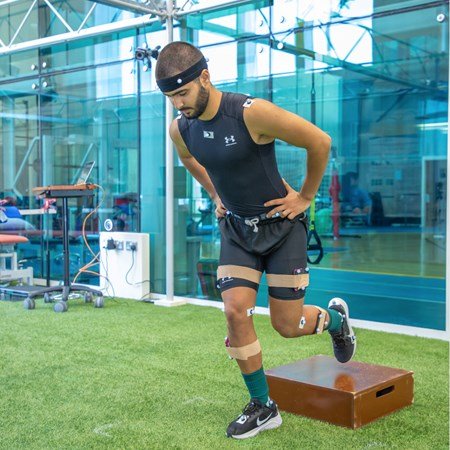
Each lower-body exercise asks a different question. In a step-up, you begin below the platform and lift your body onto it. That makes the ascent a major challenge and can involve more momentum if you kick off the trailing foot. In a lateral step-down, you already stand on the platform and deliberately control lowering on the support leg. The heel tap removes most of the urge to push off the ground when performed correctly.
A split squat lets you train the quadriceps and glutes with far greater external loading in a stable, repeatable pattern. If your main goal is building big legs, split squats, squats and leg presses can provide the easier route to progressively heavy sets. Step-downs contribute balance, coordination and lower-load single-leg knee control; they need not take the place of your main strength movements.
A leg extension isolates knee extension more directly, while a hip-abduction machine can load the side hip without the same balance requirement. Those are sensible alternatives when you want specific muscular work rather than a coordinated standing drill. They are not substitutes for learning to control a real single-leg descent, however.
Runners and field-sport athletes may value the movement’s braking-and-balance qualities, but transfer to sprinting, injury prevention or running economy is not guaranteed by a few weeks of step-downs. Treat those as reasons to consider the exercise, not promises. Build your program around measurable strength work and use step-downs to practice the particular control you want.
Equipment Worth Exploring
Explore equipment, accessories and gear from our carefully selected range.


Leg Press/Hack Squat BPR-790
Convertible 45-degree leg press and hack squat machine with a broad footplate and band pegs.

Compact Leg Press CLP-700
Compact reverse-style leg press with a moving seat carriage and an adjustable footplate.

Standing Abductor
Plate-loaded standing hip abductor for targeted outer-glute and hip-stability training.

Studio V-Squat
Plate-loaded V-squat machine for supported lower-body strength training.

GymPin Squat Wedges
Non-slip 15-degree squat wedges help elevate the heels for deeper quad-focused squats.



Pro Sled System
Heavy-duty push-pull training sled for loaded conditioning, speed, and strength work.

6. Progress for four weeks without turning form work into a max-out
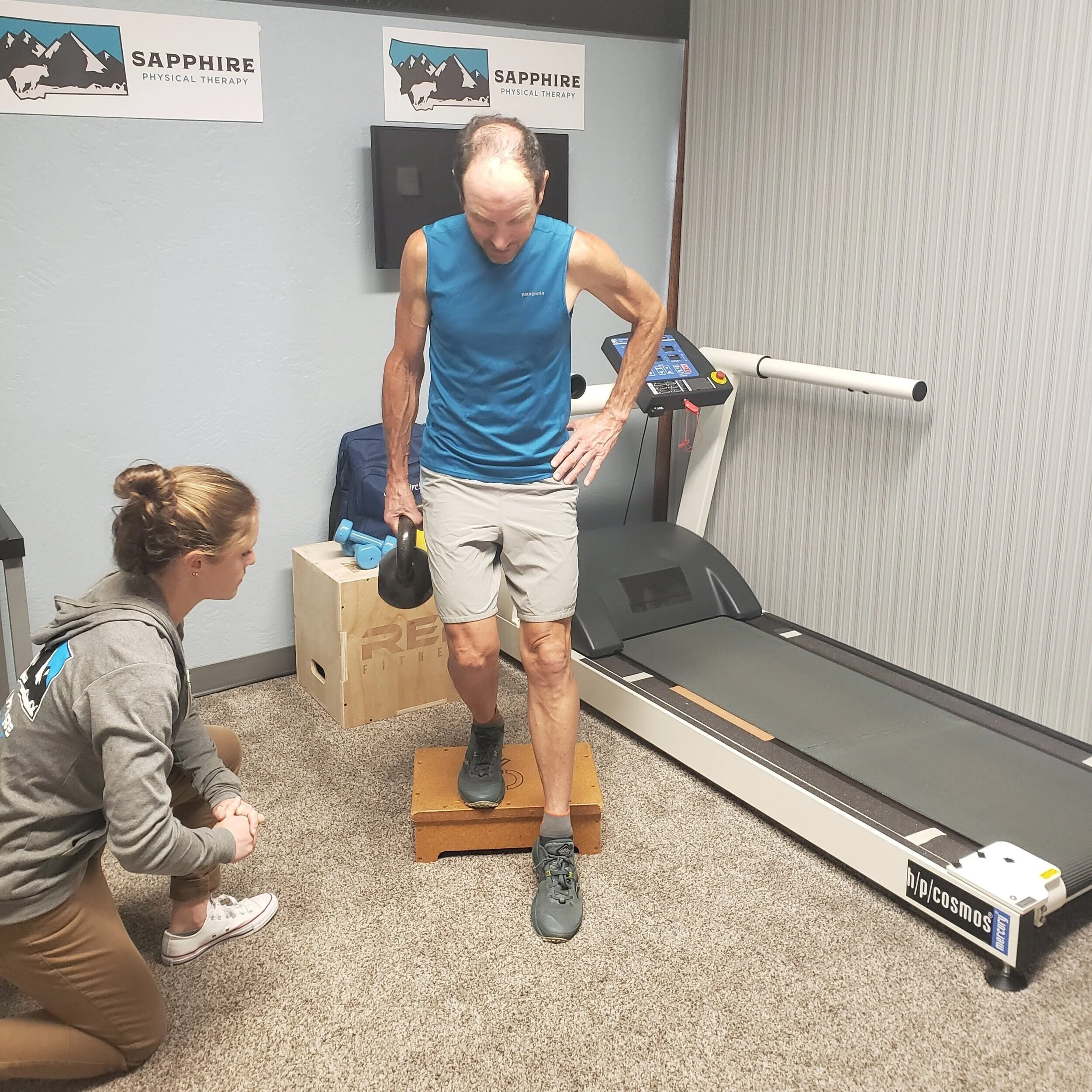
Use two sessions per week as a practical starting point, leaving recovery time between them. Put step-downs early enough in the session that fatigue from heavy squats does not destroy your coordination, or use them as a light controlled accessory afterward. If you’re returning from an injury, the plan below is not a rehab prescription; tailor loading and range with your clinician.
- Week 1: Two sets of six to eight reps per side from a low step. Hold a support if balance competes with your leg strength. Use a calm three-second descent and stop the set when the heel hits heavily.
- Week 2: Add a third set or build to eight to ten reps at the same height. Do not increase both volume and height in one session just to feel progression.
- Week 3: Remove a little hand support or add a brief pause near the bottom. If both legs remain controlled, consider a slightly higher step, but keep the movement smooth.
- Week 4: Use two or three challenging sets of eight to twelve clean reps. Only when that is predictable should you try a small dumbbell, weighted vest or a slower lowering phase.
For balanced development, begin with your less confident leg and match that side’s quality and repetition count on the stronger one. Keep notes on step height, heel contact, support and tempo so you can actually tell when skill improves. A taller box is not necessarily better: increased height can simply create a different exercise if the free foot starts pushing or the pelvis drops.
After these four weeks, you can keep a couple of sets in your leg-day warm-up, pair them with loaded split squats, or rotate them with another single-leg control exercise. The winning progression is one in which the working leg keeps doing the job, not one in which the exercise finally looks dramatic.

Leg Day Shirts & Workout Gear
Leg-day gym shirts and workout gear for lifters who never skip squats, lunges and lower-body punishment.

Thicc Butt Energy – , Meme , & Gains Top Booty T-Shirt
Bring “Thicc Butt Energy” humor to your next gym day.

Booty Building Mode Girl – Squats, Leg Day & Gains – T-Shirt
Bring “Booty Building Mode Gym Girl” humor to your next gym day.

Big Booty Energy Glute Lovers & Bodybuilders Vest Tank Top
Add some lifting attitude to training with “Big Booty Energy”.

Bunny Squats & Booty Motivation Cute Sweater T-Shirt
Show some gym-day personality with “Gym Bunny”.

Let It Grow Booty Building Leg Day & Squat Tank Top
Bring “Let It Grow” humor to your next lifting session.

Invisible Booty To Visible Booty Squats & Leg Day Hoodie
Make your off-duty look more fun with “Invisible Booty To Visible Booty”.

Sleeping Booty Bootybuilding Meme Sweater Princess T-Shirt
Bring “Sleeping Booty” humor to your everyday gym style.

Thickers Gym | Funny You're Not You With A Small Booty Hoodie
Keep it laid-back with a little “Thickers” attitude.

Fantastic Booty Leg Day Decal Water Bottles & Sticker
Stick a little “Fantastic Booty” humor on your favorite gear.

GymTok – TikTok Parody Peach Booty Training Gym Decal f Sticker
Give your everyday gear a playful “GymTok” twist.