Advertising disclosure: This page includes affiliate product links that may earn us a commission, as well as products from our own store.
Stability Ball Hamstring Curls: Lift Your Hips, Control the Roll and Build Stronger Legs
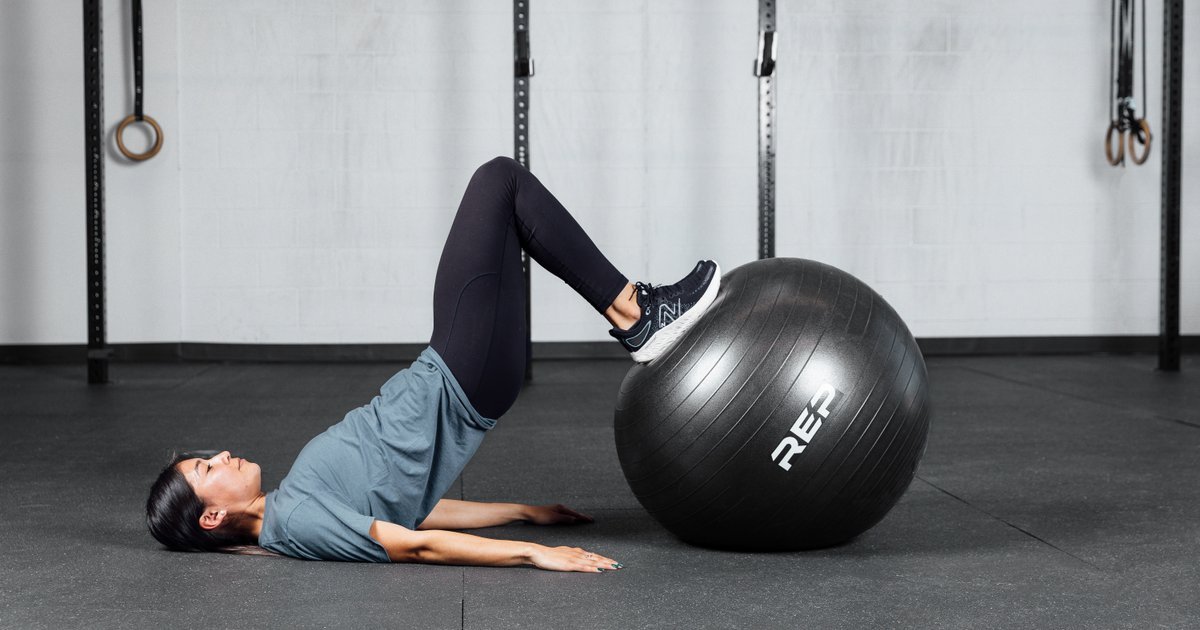
Stability ball hamstring curls look simple: lie on your back, put your heels on a large exercise ball, lift your hips and roll the ball toward your body. The surprise is how quickly this simple drill exposes a weak link. Your hamstrings need to bend the knees while your hips and trunk remain steady. If the ball starts steering you, the intended movement becomes a series of rushed adjustments instead of repeatable training.
Done properly, a ball curl makes a useful knee-flexion accessory and gives lifters another way to practise hip control. Done carelessly, it becomes bouncing hips, sliding feet and accidental calf work. Here is how to select the setup, complete an honest rep, troubleshoot common mistakes and progress from basic bridges to harder single-leg work.
1. What the stability ball hamstring curl really trains
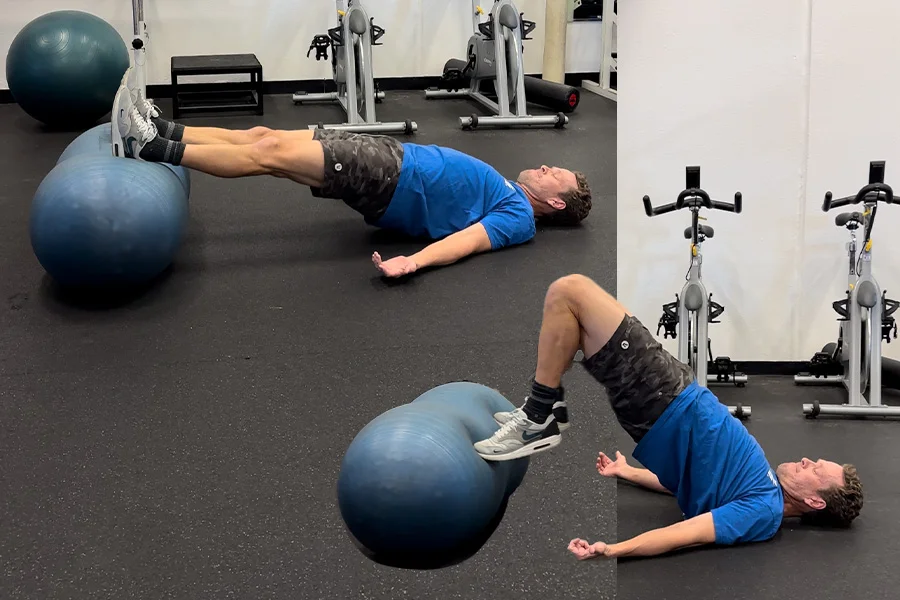
The curl combines two demands. First, you hold a raised hip bridge while your heels press against a ball that can roll in several directions. Then you bend the knees to bring that ball toward your glutes. The hamstrings produce knee-flexion force; the glutes help keep the pelvis high and the midsection prevents unnecessary twisting. Your arms give the body a broad support base. If the hips collapse every time the ball moves, much of the combined challenge disappears.
Most of the hamstring muscles cross both the hip and knee. This means their working length and contribution change as one joint extends and the other bends. The short head of the biceps femoris crosses the knee alone. The exercise is therefore more than a way to make your thighs burn: it challenges the ability to coordinate the two joints. Wobbling is not a special growth stimulus by itself, and a curl that looks dramatic can be less productive than an unremarkable controlled rep.
Short laboratory comparisons suggest that different knee-flexion and hip-extension exercises may recruit the individual hamstrings somewhat differently. In a small 16-person comparison, a ball curl produced greater semitendinosus activity than a prone machine curl, but lower biceps femoris activity. Electrical activity recorded during a set does not directly predict months of muscle growth, however. What matters in practice is which movement you can load, control and gradually improve for your particular goal.
Use ball curls to complement other leg work, not to replace it all. Romanian deadlifts challenge hip extension under load. Seated or lying machines allow more direct, measurable knee-flexion resistance. A Nordic variation offers a particularly demanding lowering task. The ball version combines knee flexion and a sustained bridge with limited equipment, making it useful when this blend fills a genuine gap in your training.
2. Choose the ball, brace your torso and build the bridge
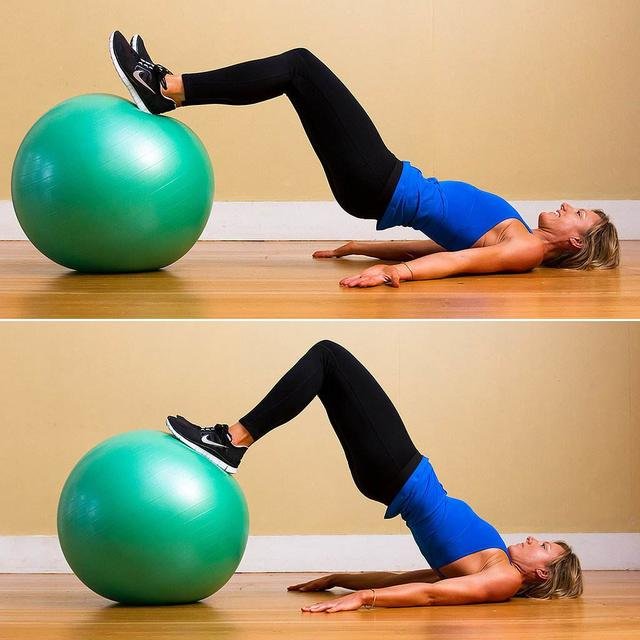
Choose a ball in sound condition, inflated according to its instructions and suitable for your body size and weight. Check for scratches, punctures and slippery surfaces before loading it. Leave enough clear floor for the ball to move toward you. Lie on your back on a firm mat, with the back of each heel resting near the top of the ball. Start with feet about hip-width apart, legs close to straight and toes pointing upward. Keep the ball centred rather than placing one foot near the edge.
Rest the arms beside you, palms down, and spread them slightly wider for extra support. Take a quiet breath, gently brace your abdomen and press through both heels to lift the hips. Stop when the shoulders, hips and legs create one controlled line. Do not chase the highest possible pelvis position; an exaggerated lower-back arch changes the effort without helping the hamstrings. Your shoulders should stay in contact with the floor while your neck remains relaxed.
Before adding any knee movement, hold the bridge for two or three breaths. Can you keep heel pressure even? Is the pelvis level? Does the ball stay mostly still? These answers matter more than whether the first position looks like a dramatic pose. If the ball drifts immediately, use ordinary heel-on-ball bridge holds for three sets of roughly 10–20 seconds, improving the duration before attempting the curl. A standard floor glute bridge is another sensible regression.
There is no universal ball diameter that guarantees correct technique. A very small or underinflated ball can make the exercise cramped, while a huge ball may place your heels awkwardly high. Use the size that permits a comfortable nearly straight-leg bridge and a smooth roll toward your hips. A lightly textured ball and stable floor improve control, but grippy equipment never replaces appropriate pressure through the feet.
3. Curl in with your heels and own the return
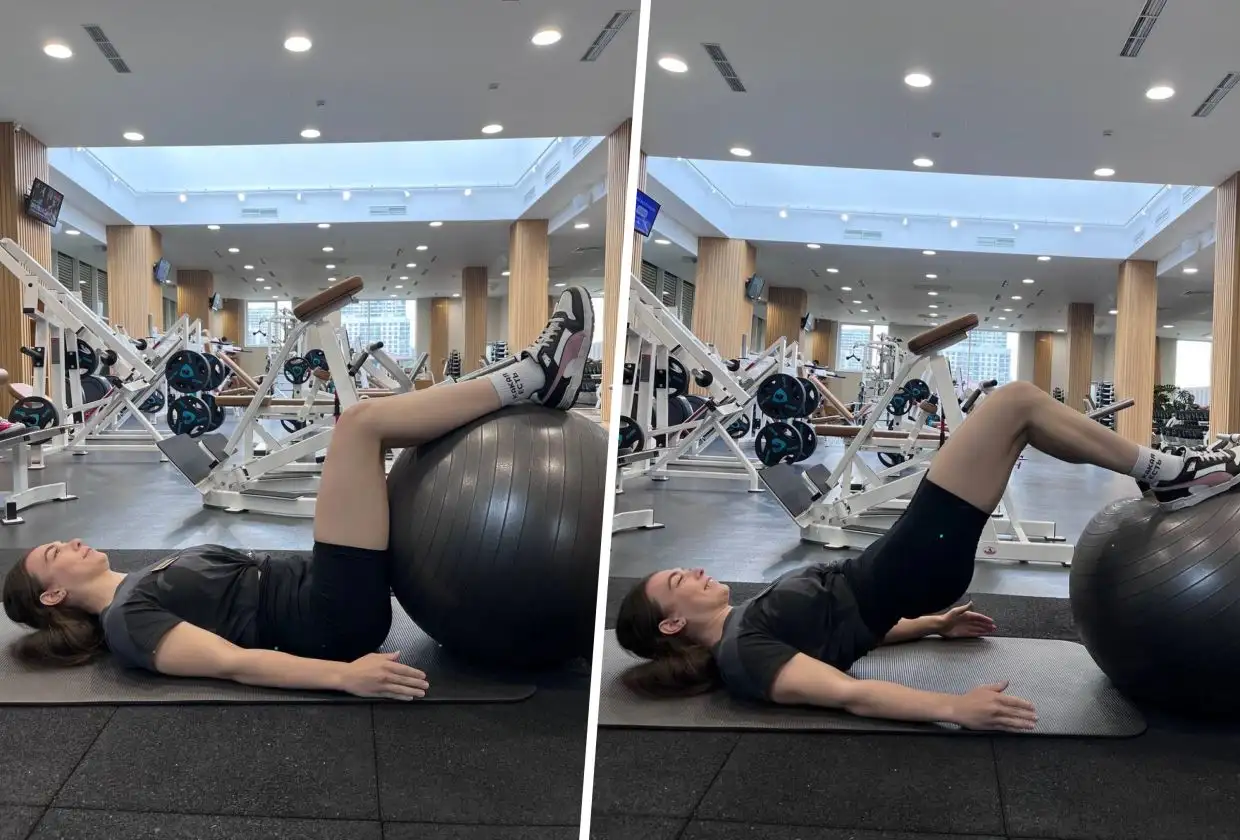
Begin from the established bridge rather than trying to lift the pelvis at the same moment you move the ball. Push the heels down lightly and bend both knees so the ball rolls toward the hips. Imagine the ball travelling straight toward your seat. Keep the chest fairly quiet and resist letting the pelvis drop or twist. The hips may rise slightly near the end of the curl, but avoid throwing them upward to squeeze another centimetre out of the movement.
Stop where the knee bend remains comfortable and your heel contact is secure. At that position you should notice firm work along the back of the thighs. If the calves seize the movement, experiment with directing pressure through the heels rather than pointing the toes aggressively, and use a smaller range. If the feet slide, stop and reset. Trying to rescue a slipping ball with a frantic kick is not useful hamstring training.
Let the knees straighten over roughly two to three seconds while the ball rolls away. Do not set the hips down halfway through the return. The lowering phase often reveals the real difficulty: the hamstrings must control knee extension while your trunk maintains the bridge. Finish with legs nearly straight, pause briefly, and only then start the next curl. A smooth six-repetition set beats twelve repetitions in which the pelvis repeatedly falls onto the floor.
Start with six to ten repetitions using a deliberate two-second inward pull, a brief pause and a slower outward roll. Record the number of repetitions performed with consistent hip height and ball path. When you notice the first obvious technique breakdown, that is the useful end of the set. The goal is not to make the ball wobble as much as possible; it is to make each repetition repeatable.
4. Fix hip sag, cramps and sideways ball drift
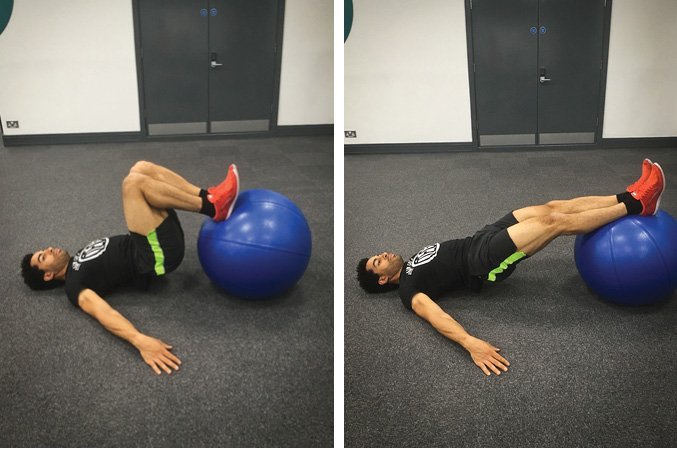
Hip sag is the most obvious shortcut. As the knees straighten, the pelvis starts descending and the exercise loses the uninterrupted bridge component. Do not solve this by forcing more reps. Shorten the curl range, pause at the strongest position and return before the hips fall. You can also perform several separate heel-on-ball bridge holds, then add short knee bends. A full-range curl is the reward for controlling the simpler version, not something to force from day one.
Hamstring cramps are common when the muscles are not accustomed to supporting the hips while bending the knees. Stop when a cramp begins instead of trying to push through sharp gripping discomfort. Rest, reset the foot position and try a gentler partial curl or fewer repetitions on the next set. Some people need a few sessions of stable bridge practice before combining the two tasks comfortably. A cramp is not proof that the exercise was especially effective.
A sideways-moving ball often reflects uneven pressure through the heels or a rushed return. Look at where each foot sits and imagine an invisible straight track beneath the ball. Minor movement is normal, but a strong turn is a signal to reduce range or speed. Keep the hands wider on the floor until you can control the curl. Moving the arms closer to the body is a progression you can use later; it is not a mandatory starting position.
Leave your weight on the shoulders and upper back rather than digging the head into the floor. If your back feels compressed, check whether the ribs are flaring and whether the hips are being pushed higher than you can comfortably control. Sharp knee, tendon or back pain is a reason to stop rather than search for a more aggressive cue. Anyone returning from a significant injury may need individual progression advice instead of an off-the-shelf routine.
5. Progress from two legs to a stronger single-leg curl
Start with an elevated heel-on-ball bridge, then add short bilateral curls and eventually full-range curls with the hips held up throughout the set. Build toward two or three smooth sets before making the movement unstable on purpose. Widening or narrowing arm support can vary the balance challenge, but do not remove support while the basic ball path is still inconsistent. Change one factor at a time so you can tell whether the exercise is improving.
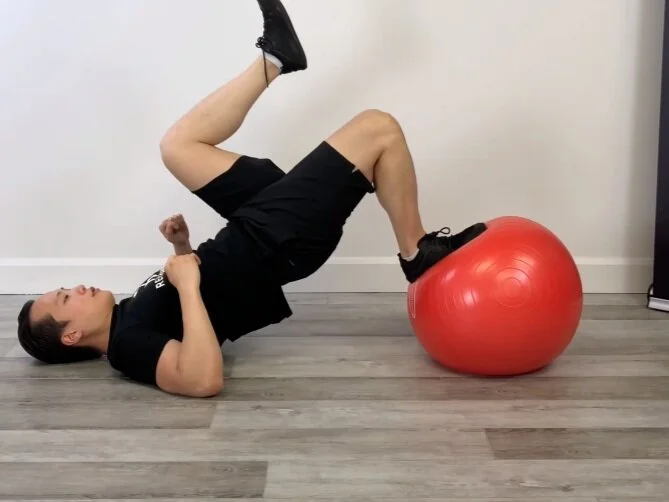
A useful intermediate challenge is two legs in and one leg out. Curl the ball inward with both heels, lift one foot carefully, and guide the ball outward with the remaining heel for a slow eccentric phase. Place both feet back on the ball before the next inward roll. This is much harder than a two-leg return, so begin with one or two quality repetitions per side and keep the pelvis level. Avoid rushing this progression when bilateral reps still cause visible hip sag.
For the full single-leg curl, raise into the bridge with both heels, lift one foot, then bend and straighten the working knee while the other leg stays clear. The unsupported side of the pelvis will want to fall or rotate. Resist the change rather than compensating with a large back twist. Start with only three to five controlled repetitions on each side. A clean bilateral version remains more valuable than a single-leg rep performed with a collapsed trunk.
Adding external resistance is not the first priority. Balancing a loose plate or dumbbell on the pelvis while a ball moves can make the handling problem bigger than the muscle problem. If you need precise heavy resistance, a machine leg curl is often easier to progress safely. You can also train complementary hip-hinge exercises and assisted Nordic work. The most demanding option is not automatically the most appropriate option for the training block.

Equipment Worth Exploring
Explore equipment, accessories and gear from our carefully selected range.



Leg Extension/Curl BCO-780
Leg extension and lying leg curl combo with plate loading, band pegs and a cable-loading option.

Seated Leg Combo BCO-680
Adjustable seated leg extension and leg curl machine with band pegs for added resistance.

Glute Ham Developer GHD-820
Adjustable glute-ham developer with contoured pads and a fold-out knee support.


45° Hyperextension HPX-650
Angled back-extension trainer with split padding, a ribbed footplate and resistance-band pegs.


Studio Glute Drive
Plate-loaded hip-thrust machine with supported back pad and adjustable foot platform.
6. Fit the curl into leg day and follow a four-week plan
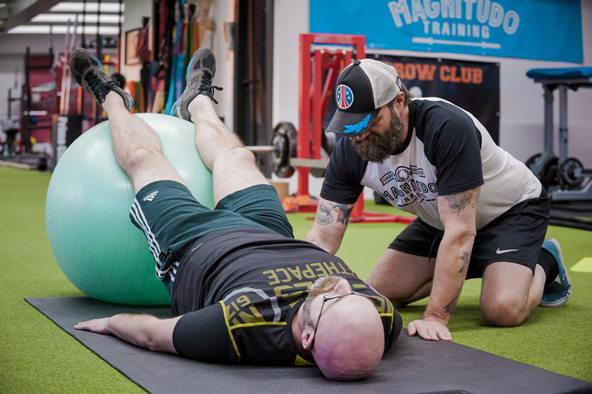
Place ball curls after your main squat or hinge, or use them as a focused hamstring accessory in a lighter lower-body session. Begin with two or three working sets and stop when you feel only one to three clean repetitions remain before the hips would sag. Rest 60–120 seconds between sets, longer if your hamstrings cramp or the ball gets away from you. Use the same ball, foot position and repetition tempo when tracking progress across workouts.
For week one, try two sets of six to eight bilateral curls on two nonconsecutive days. If necessary, shorten the range and supplement them with heel-on-ball bridge holds. The aim is even pressure through both heels and a stable pelvis. In week two, work toward three sets of eight to ten while keeping the outward roll slow. If performance deteriorates after the first set, repeat the previous week’s work rather than forcing a target that outpaces your control.
In week three, complete two or three sets of eight to twelve full-range curls with consistent hip height. In week four, lifters already performing twelve smooth repetitions can experiment with a few carefully controlled two-leg-in, one-leg-out returns after the normal sets. If that is too difficult, continue refining the bilateral curl with a longer lowering phase. Progress does not have to mean single-leg gymnastics by a particular date.
Pair this knee-flexion pattern with hip-extension work such as a Romanian deadlift if your programme lacks that stimulus. If you already do heavy machine curls, strenuous Nordics and frequent sprints, consider whether additional ball-curl volume helps or merely adds fatigue. Track clean repetitions, the consistency of your bridge and how recovered you feel for subsequent leg sessions. Stronger hamstrings come from progressive, manageable work over time—not from forcing an unstable ball through an arbitrary rep count.

Leg Day Shirts & Workout Gear
Leg-day gym shirts and workout gear for lifters who never skip squats, lunges and lower-body punishment.

Let It Grow Booty Builder Leg Day & Hip Thrusts Meme Tank Top
Bring “Let It Grow” humor to your next lifting session.

Booty Building Mode Leg Day & Squats She-Hulk Hoodie
Show off your superhero humor in a laid-back “Booty Building Mode” hoodie.

Never Skip Leg Day Chicken Legs Meme Sweater & Bros T-Shirt
Show some gym-day personality with “Never Skip Leg Day”.

Leg Day No Thanks Skip Leg Day Meme Decal Water Sticker
Give your everyday gear a playful “Leg Day No Thanks” twist.

Negative Leg Day Review Not Recommended 1 Star T-Shirt
Keep things casual with a little “Negative Leg Day Review” attitude.

Never Skip Leg Day Gym | LEGO Workout Decal for Water B Sticker
Stick a little “Never Skip Leg Day” humor on your favorite gear.

Never Skip Leg Day Flamingo – Fitness Meme Vest Muscle Tank Top
Train hard, laugh a little, and rep “Never Skip Leg Day Flamingo”.

I Love Booty Peach – Valentine's Leg Day Meme Jumper Pu T-Shirt
Show some gym-day personality with “I Love Booty Peach”.


My Leg Hurts Leg Day , Meme Lovers & Bros Casual T-Shirt
Bring “My Leg Hurts” humor to your next gym day.
Some product links may be affiliate links, which can support Mind Muscle Perfection at no additional cost to you.