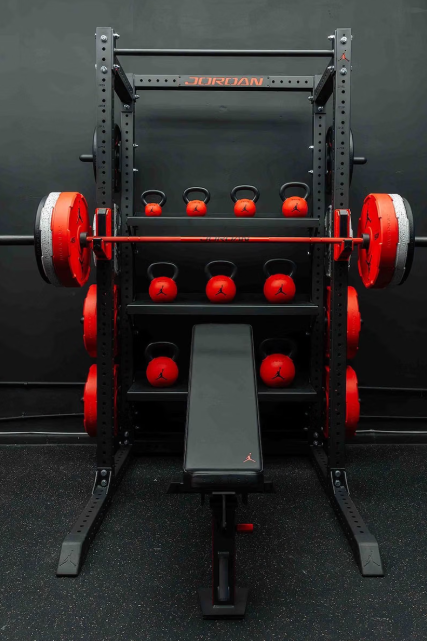
Jordan Brand is no longer limiting its signature black, cement-grey and Chicago-red palette to sneakers and apparel. Its Jordan Strength equipment line brings that design language to an entire weight room: a heavy-duty half rack, an adjustable bench, barbells, plates, dumbbells, kettlebells, storage and conditioning accessories. Rather than a novelty collection of branded gym accessories, this is an attempt to provide most of the hardware needed for a serious strength-training space.
The range launched on October 13, 2026, with some listings still taking pre-orders or displaying later shipping dates. Those dates should not be confused: a collection can be released while a particular piece of equipment has yet to ship. For anyone considering the range, the more interesting questions are practical. How much floor space does the rack actually consume? Are the working components compatible with other attachments? Does the bench suit real pressing and pulling movements? And does the finished setup justify a premium over less visually distinctive equipment?
At a glance: The Jordan Strength Half Rack is built from 11-gauge, true 75 × 75 mm uprights; the adjustable bench offers 28 back-and-seat combinations; the Shield Barbell is a 20 kg general-purpose bar; and the free-weight range extends to bumper plates, dumbbells and rubber-coated kettlebells.
Our perspective: This is a specifications-and-use-case analysis of newly introduced equipment, not a claim that MMP has physically tested the complete range.
1. The Jordan Strength Half Rack: serious steel, serious footprint
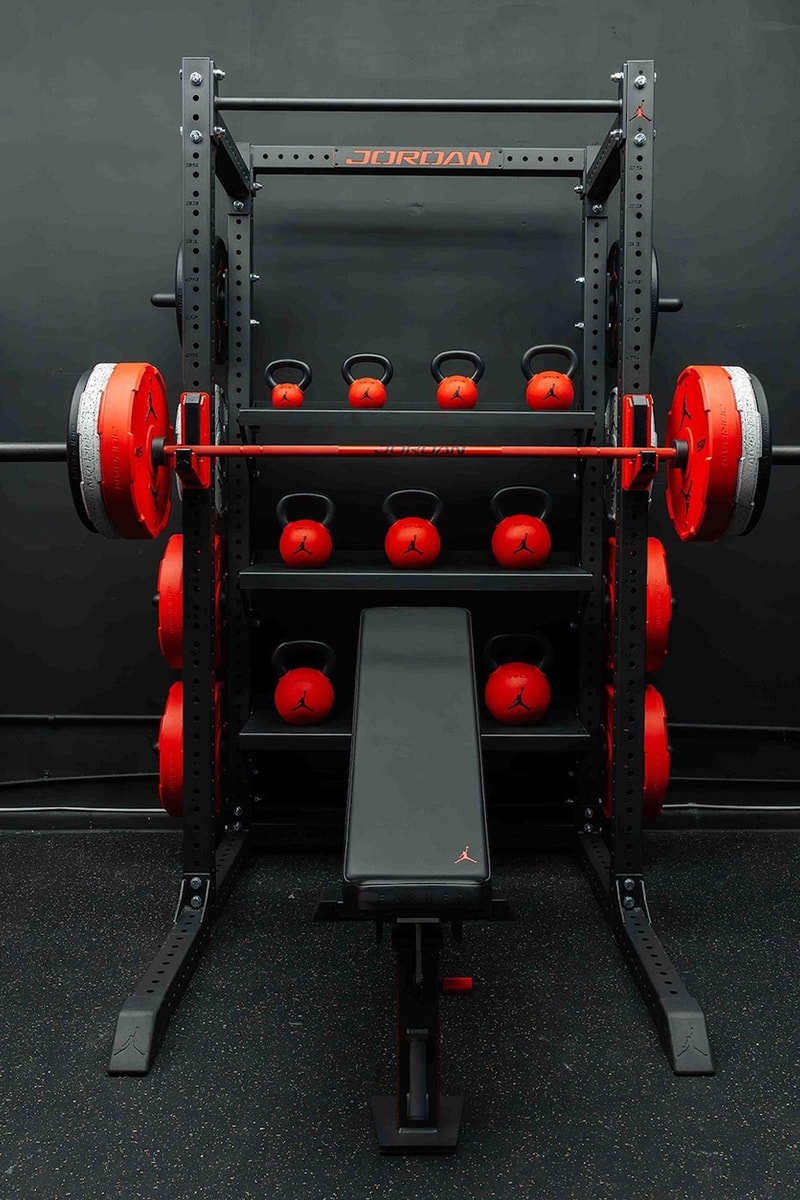
The Jordan Strength Half Rack is the centrepiece. It uses four 11-gauge uprights made from true 75 × 75 mm tubing, joined with 5/8-inch hardware. The manufacturer lists a 1,100 lb (499 kg) rack and J-cup capacity and a 475 lb (215 kg) limit for the 1.25-inch pull-up bar. Those figures comfortably exceed the requirements of many home users, but a rating is not the same as proof of stability in every movement or loading arrangement.
What distinguishes the rack visually is clear: red J-cups, contrasting branding, exposed plate storage and details inspired by Jordan footwear. What matters during training is less glamorous. The J-cups need to sit securely, the working position needs to be convenient for your bar path, and the protection system must fit the way you train alone. The rack includes premium J-cups and eight plate-storage horns. Spotter arms and storage shelves are separate accessories, not automatically part of the bare rack purchase.
Its stated dimensions are 93 inches high, 53.5 inches wide and 60.4 inches deep (236 × 136 × 153 cm). With plates stored on the horns, depth reaches about 65.4 inches (166 cm); a shelf configuration can push that farther. Add the clearance required to load a 7-foot barbell, move a bench, perform pull-ups and step back from the rack, and the practical room requirement becomes substantially larger than the steel footprint alone.
There are two worthwhile details for buyers who already own equipment. First, 50 mm hole spacing makes adjustment straightforward, but it is not identical to every common imperial rack pattern. Second, equivalent Nike Strength rack attachments are listed as compatible. Check fit for any third-party part rather than assuming that broadly similar tubing or pin sizes guarantee safe interoperability. The rack also needs an appropriate anchoring plan; do not treat heavy weight storage as a substitute for installing it as required.
Best fit: a dedicated strength-training room where a permanent rack can be anchored and left assembled. Less convincing for a tiny office-gym or a space where the equipment must disappear after each session.
2. The adjustable bench: versatile, but not exactly portable
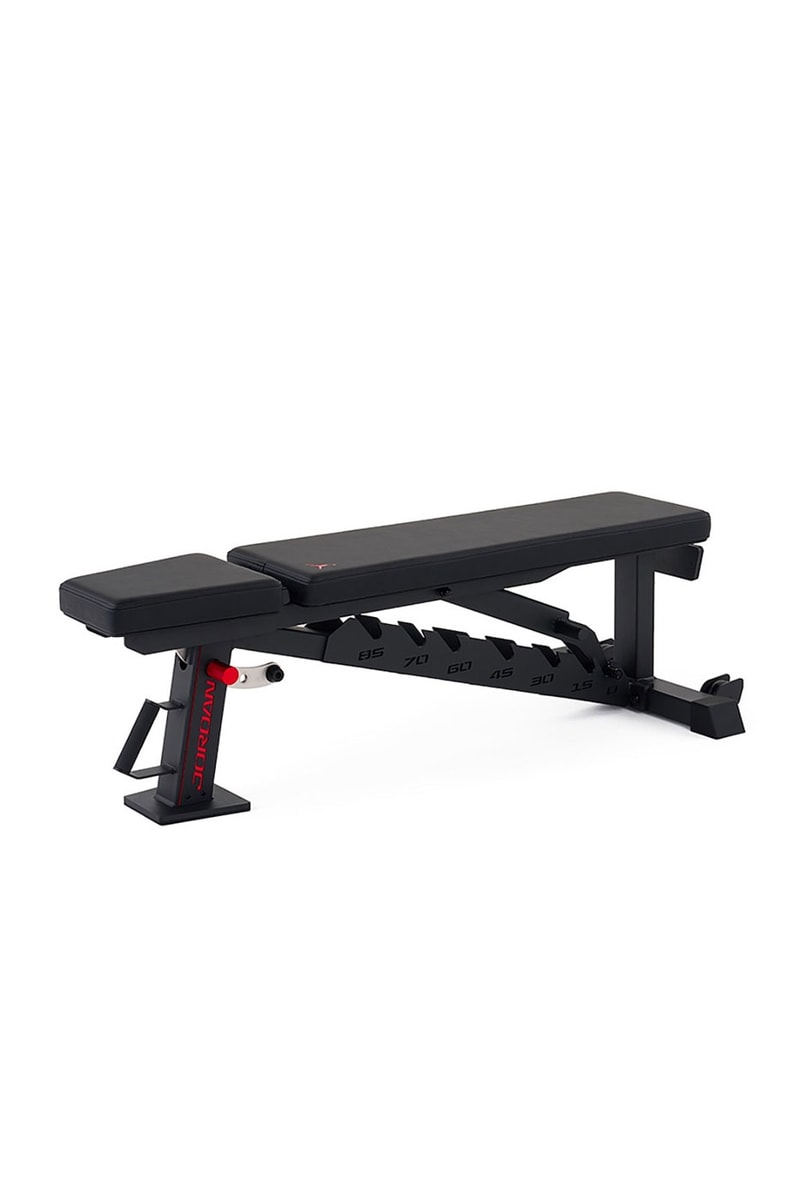
The Jordan Strength Adjustable Bench has seven backrest positions—0, 15, 30, 45, 60, 70 and 85 degrees—and four seat positions at 0, 10, 20 and 30 degrees. That gives 28 possible combinations without requiring separate flat and incline benches. Manufacturer figures list a 1,000 lb (454 kg) capacity in the flat position and 600 lb (272 kg) on an incline.
A backrest reaching 85 degrees makes the bench useful for near-upright dumbbell pressing as well as conventional flat and incline work. A movable seat can also reduce forward sliding on steep inclines. The arrangement is practical for supported dumbbell rows, curls, lateral raises and certain single-leg exercises, provided the selected angle is stable and the bench is used within its intended loading conditions.
However, this is not a minimal folding bench. It weighs 101.4 lb (46 kg), stands 16.9 inches (43 cm) high and measures 53.6 inches (136 cm) long. Built-in rear wheels and a knurled handle help reposition it, yet the mass remains significant if you regularly rearrange a dual-purpose training and office room. A floor plan that requires lifting the bench over cables or furniture several times a week is probably the wrong floor plan.
The real buying tests are pad firmness, the back-to-seat gap, how the rear support behaves under shoulder pressure, adjustment speed and whether your feet can reach a stable position at the chosen bench height. A listed maximum load tells you little about those sensations. Until direct long-term training experience is available, the sensible conclusion is that the specification is strong and the adjustment range useful—but comfort and everyday ergonomics deserve more weight than the Jordan graphics.
3. Barbells, bumper plates and change plates: the working core
The Jordan Strength Shield Barbell weighs 20 kg (44 lb) and uses a 28.5 mm shaft, four bushings, a Cerakote finish and a medium volcano-style knurl with dual markings. There is no centre knurl. The manufacturer specifies 190,000 PSI tensile strength and a 1,500 lb (680 kg) weight capacity. These features place it closer to an all-round training bar than a very stiff specialist powerlifting bar.
For a mixed home-gym routine, that makes sense. A centre-knurl-free shaft can be comfortable during front-rack work, while dual marks help with repeatable grip positions for pressing and pulling. The trade-off is that someone focused almost exclusively on heavy low-bar squats may prefer the contact characteristics of a traditional power bar. Four bushings provide a conventional, serviceable sleeve-rotation design rather than turning this into a specialist Olympic-weightlifting bar.
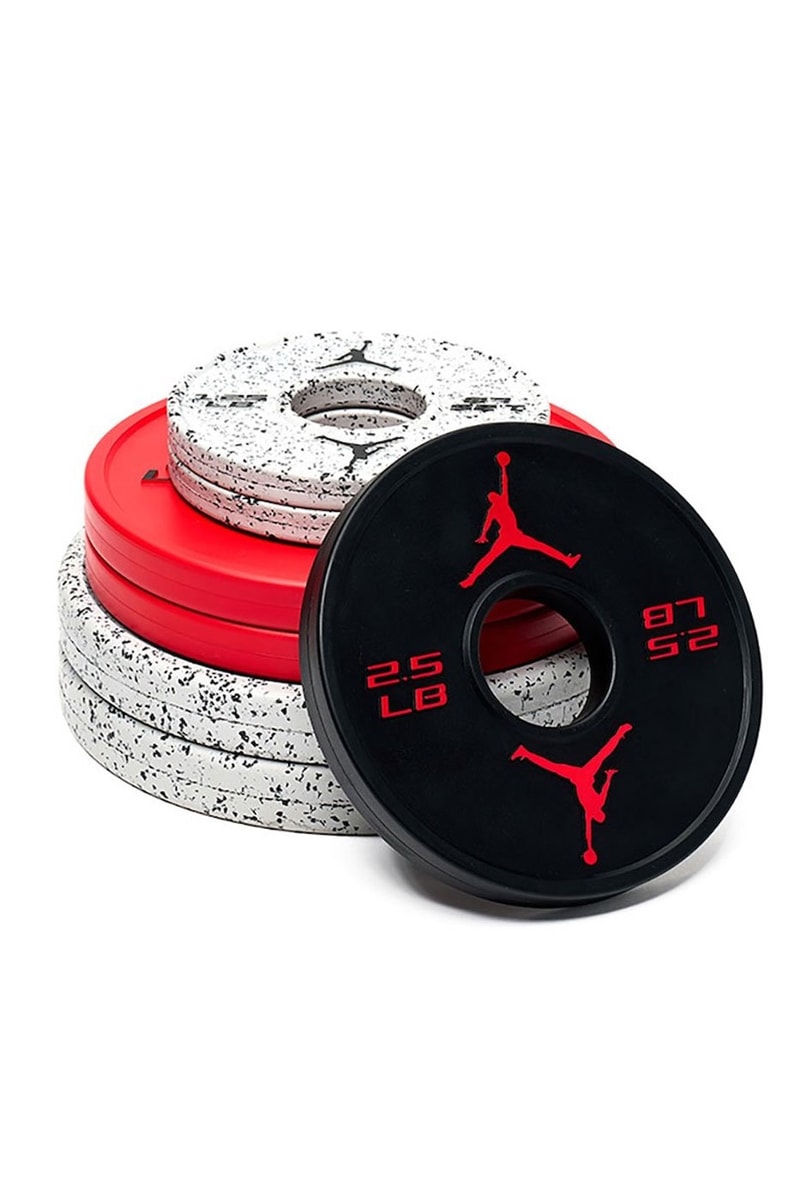
The bumper plates add recognizable visual character without changing the fundamentals of loading. The initial pound-based ladder includes 10, 15, 25 and 45 lb plates, with contrasting black, cement and red finishes. They are intended for standard Olympic barbell sleeves. Their appearance is distinctive, but practical priorities remain thickness, weight tolerance, noise and bounce, how easily they can be handled and the type of flooring beneath them.
Smaller change plates are worth including in a purchase plan. They allow useful progression on overhead presses, curls and other lifts where increasing each side by 10 or 25 lb would be excessive. Storage also matters. A rack with plate horns may save room elsewhere in the gym, but it increases the effective operating depth of the rack and can place plates directly in the path used to walk around it. Plan both the lifting zone and the loading zone before deciding that integrated storage has eliminated your space problem.
4. Dumbbells: familiar training value with unmistakable Jordan details
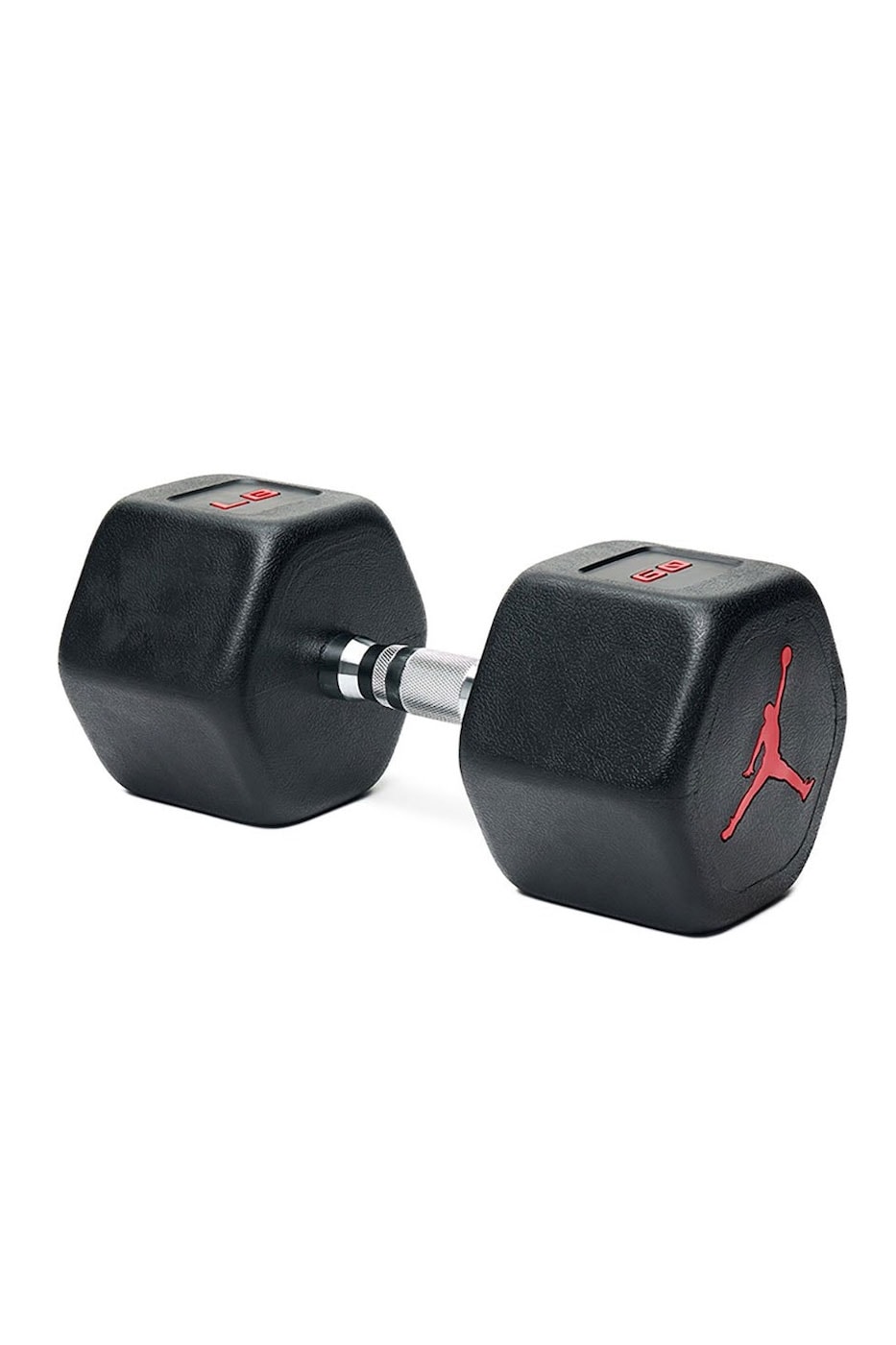
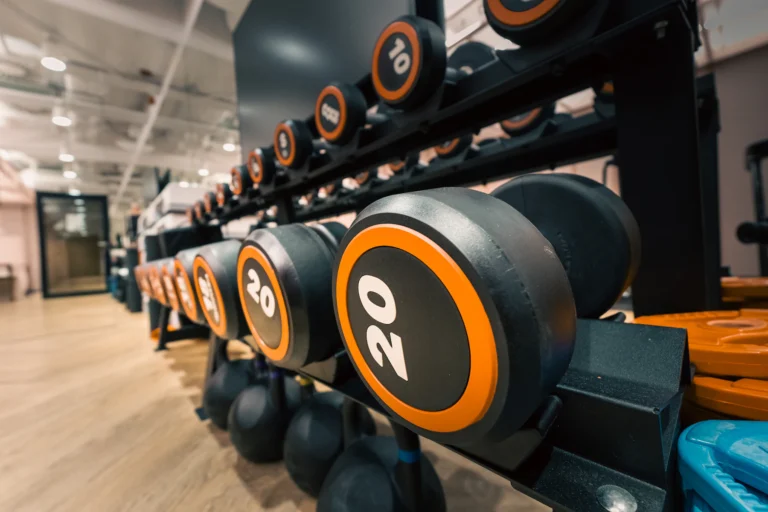
Jordan Strength Dumbbells use rubber-encased hex-shaped heads with a knurled chrome handle. The signature design is not merely a decal: the heads carry elephant-print-inspired texture and recessed Jordan markings. The sculpted shape is also designed to resist unwanted rolling and to sit more neatly on a storage rack.
Dumbbells are arguably the least controversial part of a home-gym build. They support presses, rows, split squats, lunges, lateral raises, loaded carries and dozens of variations that do not require a rack. Their value is limited chiefly by available weight increments, space and the effort required to move a full set around. The pound-based Jordan range reaches 100 lb per dumbbell, though particular weights and availability vary between markets.
For a home gym with limited square footage, this is where a buyer should be especially honest about what they need. A full fixed set takes significant wall or floor space and often duplicates the utility of an adjustable dumbbell pair for many exercises. On the other hand, fixed dumbbells make drop sets, supersets and quick transitions much easier, and they avoid the mechanisms that adjustable models introduce. If two people train together, the flexibility can be worth the added storage burden.
The visual finish is a differentiator, not a substitute for fundamentals. Test handle diameter, balance in the hand, whether the recessed weights remain readable and how the heads feel when resting on the thighs between presses. The right choice is the dumbbell that suits your training and storage needs, even if the Jordan finish is the first thing that caught your attention.
5. Kettlebells: functional handles, bright red bodies
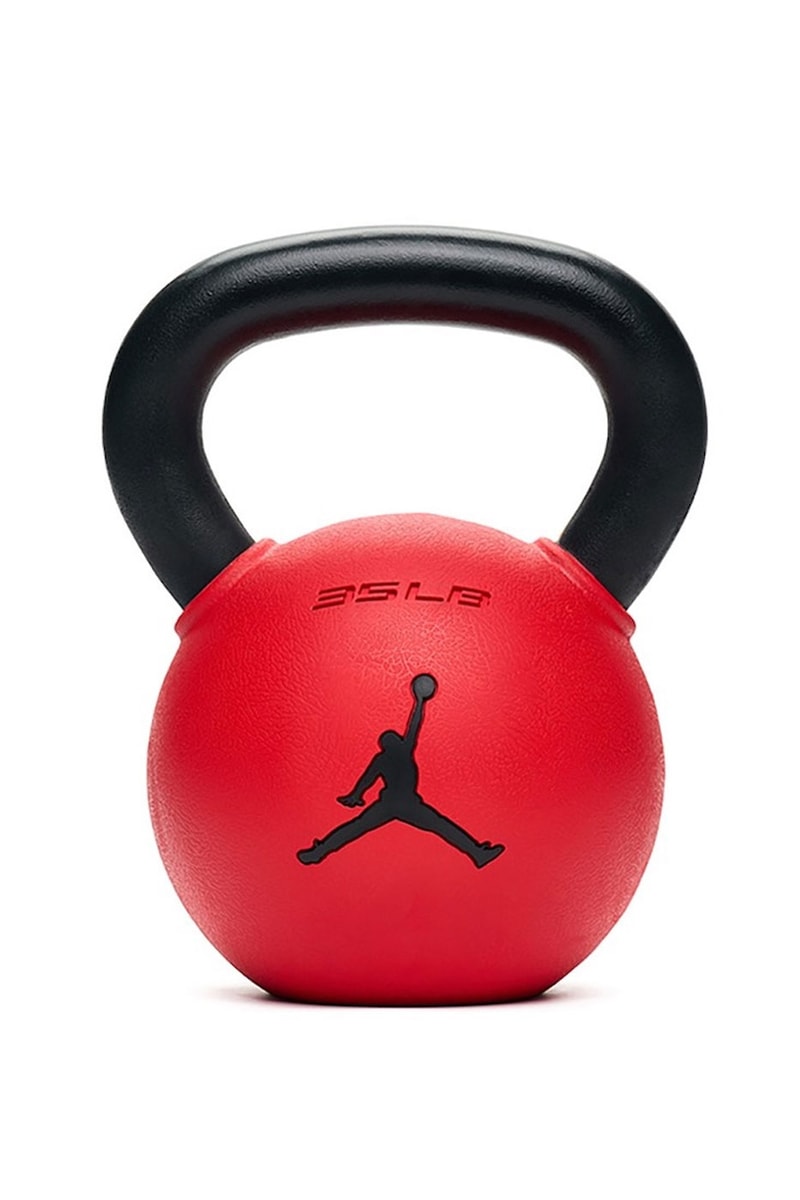
The Jordan Strength Rubber Coated Kettlebells use a cast-iron core beneath a protective red shell with a black, uncoated handle. The enlarged handle window is intended to make two-handed swings more comfortable, while the coated body offers some protection when weights are set down. The line includes weights from 9 to 70 lb (roughly 4 to 32 kg), with available increments differing across the pound and kilogram collections.
A kettlebell is not simply a dumbbell with the mass rearranged. Its centre of mass sits below the handle, which changes the feel of swings, cleans, carries, goblet squats and overhead holds. Those differences make kettlebells useful even when a gym already has plenty of free weights. One moderate bell can support conditioning circuits; heavier models can serve carries, deadlift variations and demanding double-kettlebell work.
Handle clearance is particularly important. An oversized window can help with two-handed movements, but the handle’s thickness and surface texture also influence comfort and grip fatigue. For swings, you want a secure hold without excessive abrasion. For presses, the bell needs to settle sensibly against the forearm. Colour, branding and protective rubber are secondary once an exercise becomes demanding.
There is also a programming advantage to owning only two or three carefully chosen kettlebell weights. You can build effective sessions from swings, squats, rows, carries and cleans without purchasing a full display rack. The Jordan collection can scale much farther than that; whether it should depends on your training, not on completing the colour-coordinated set.
6. Accessories, storage and the Jordan soft plyometric box
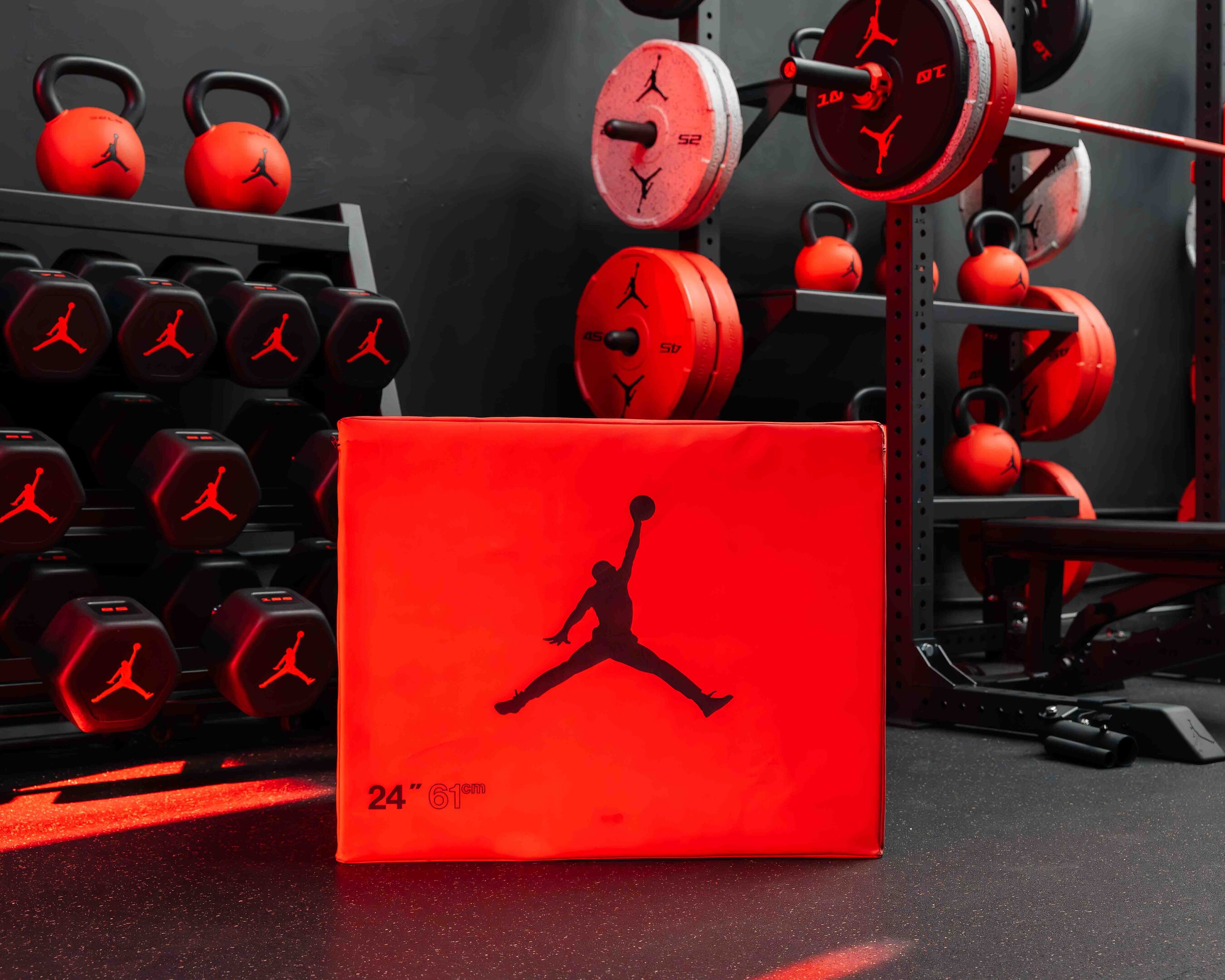
The smaller pieces can make the equipment ecosystem feel complete, but they should not all be treated as automatic add-ons. Jordan Strength offers spotter arms, additional J-cups, storage shelves, collars and a dedicated four-tier dumbbell-and-kettlebell rack. Each solves a specific problem. Spotter arms are important for many solo lifting setups; a secondary pair of J-cups is useful only if your workflow actually benefits from different bar heights; and a storage shelf adds convenience at the cost of additional depth.
The four-tier rack is designed for up to ten pairs of dumbbells and seven kettlebells. Sloped trays improve visibility and pickup compared with stacking bells on the floor. But a dedicated rack also consumes a substantial rectangular area of its own. It is a sensible purchase for a full fixed-weight room, less persuasive for an apartment gym using one adjustable dumbbell pair and a few kettlebells.
The Jordan Strength Soft Plyo Box extends the collection beyond barbell strength. Its shoebox-inspired silhouette is visually memorable, but the key buying questions are ordinary ones: does it have a stable footprint, an appropriate landing surface, enough firmness to avoid collapsing under repeated steps or jumps, and dimensions that allow safe storage? A soft box can make some movements less intimidating, but a cushioned exterior does not remove the consequences of mistimed foot placement.
For conditioning sessions, you do not need to turn every workout into maximal jumps. Step-ups, controlled jumps, supported split-squat movements and carefully chosen interval work can offer more repeatable benefits. Keep the box height and fatigue level within what you can control. The presence of a recognizable logo does not change those principles.
7. Bundles and real home-gym value: Takeoff, Flight and Jumpman
Jordan Strength offers several bundles that help buyers avoid piecing together every part separately. The Takeoff Home Gym Setup includes the half rack, adjustable bench, 20 kg Shield Barbell, 250 lb of bumper plates and barbell collars. It is the most straightforward starting point for someone who wants to squat, bench, hinge and press with a matched set of equipment.
The Flight setup extends that foundation with dumbbells, kettlebells and dedicated storage, while the Jumpman Home Gym Setup is a near-complete collection that adds more free weights, a curl bar, accessories, extra storage and a plyometric box. Exact contents, delivery dates and prices should always be checked on the selected listing because bundles and available configurations can change.
There is a real advantage to buying a coherent system: attachments and storage layouts are easier to plan, the visuals match and a new lifter has fewer purchasing decisions to make. The downside is that bundles can persuade you to buy equipment before you know whether it supports your preferred training style. Owning a full dumbbell rack, multiple kettlebells and a loaded half rack makes little sense if the training room is shared with an office or has no spare wall space.
A more sensible buying sequence is to write down your core movements, available floor area, ceiling height, budget and how many people will train at once. Price those requirements individually, then compare them with a bundle. Be sure to include floor protection, delivery and assembly, anchoring hardware, storage clearance and the cost of any accessories that are not included. A matching gym that cannot be used comfortably is less valuable than a mixed-brand room that works.
8. What a practical Jordan Strength training setup might look like
For a lifter with sufficient space, a Jordan half rack, adjustable bench, Shield Barbell, a manageable plate selection and a pair of suitable dumbbells can cover the majority of conventional strength exercises. You do not need the entire range to benefit from the most useful parts. A straightforward three-day program could rotate between two full-body sessions:
- Session A: squat or split squat, horizontal press, supported or barbell row, and a loaded carry.
- Session B: hinge or deadlift variation, overhead press, pull-up or another suitable back exercise, and focused trunk work.
Alternate A/B/A one week and B/A/B the next. A starting structure of two or three challenging working sets per lift is often easier to sustain than filling the room with equipment and attempting every exercise in one session. Adjust repetition ranges, training frequency and total weekly volume to your experience, recovery and movement skill; progress load only when technique remains controlled.
If you want conditioning, add kettlebell carries or swings and appropriately scaled box work at the end of selected workouts rather than trying to turn heavy barbell sessions into high-speed circuits. If the rack’s pull-up bar, spotter arms or storage would conflict with your room dimensions, resolve that before purchase. The best part of a permanent home gym is being able to train consistently with minimal setup friction.
Bottom line: Jordan Strength brings unusually cohesive visual design to a serious collection of conventional strength equipment. Its half rack and adjustable bench have substantial listed ratings, the barbell covers a wide range of lifts, and the free-weight options make the range more than a decorative collaboration. The strongest reasons to buy are equipment suitability, compatibility, fit and long-term usefulness. The strongest reason to be selective is that Jordan styling comes on top of equipment whose core training functions can also be delivered by less coordinated alternatives.
For a dedicated room and a buyer who values the Jordan aesthetic, the range deserves a closer look. For a small, flexible home gym, choosing only the pieces that solve real training problems is the smarter approach.
Product specifications and availability are subject to change; confirm dimensions, included accessories and shipping information before ordering.